What to Buy Before ACL Surgery or a Knee Scope

Two different shopping lists, depending on what your surgeon actually did inside the knee.

The most recent national count — from 2006, likely an undercount of today's true volume — put outpatient knee arthroscopy at about 984,607 procedures a year, 127,446 of them ACL reconstructions and nearly 500,000 for meniscal tears (Journal of Bone and Joint Surgery, from CDC survey data). Three of those things — crutches, ice, and a leg-elevation pillow — cover what everyone in this research needs, at roughly $105–115 total, as of July 2026 (always check current prices on Amazon). Whether you need a fourth and fifth — a hinged knee brace and compression stockings, another $110–120 — depends on one question your surgeon can answer in a sentence: see the fork below before you buy anything else.

Every pick here was checked against 7 hospital and professional-society sources, across both surgical tracks — how we choose →

Before you buy anything: which track are you on? Three independent hospitals — University of Washington, Brigham and Women's/Mass General Brigham, and University of Kentucky — plus AAOS's own general knee-arthroscopy page all draw the same line, and it isn't "ACL surgery vs. a knee scope." AAOS states it in one sentence: "Sometimes braces are used post-operatively if a repair or reconstruction is performed that must be protected." The real question is what your surgeon actually did inside the knee — was anything stitched or reconstructed, or just trimmed and cleaned up? ACL reconstruction always counts as "stitched." A meniscus tear can go either way: repaired (stitched, Track A) or trimmed (a partial meniscectomy, Track B) — both get called "knee arthroscopy," with completely different equipment needs. If you're not sure which one you had, ask before you shop; it changes two of the five items below. One routing note: if your surgery was meniscus-only — nothing stitched or reconstructed, no ACL work at all — our dedicated meniscus surgery hub covers that case in more depth than this page does.

The 3 shared essentials

Everyone in this research needed these, regardless of track.

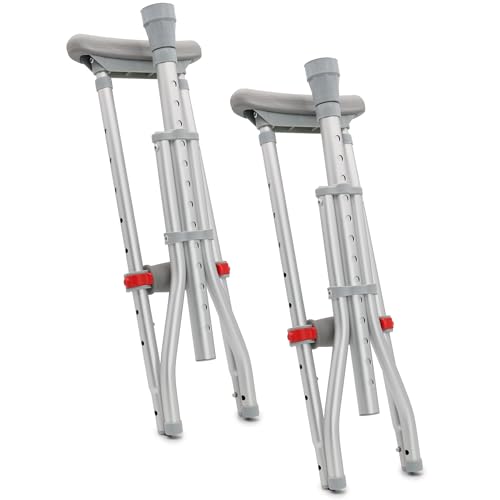
Drive Medical RTL10433 Adjustable Crutches for Walking, Silver

Because every hospital source in this research names crutches — whether you're off the leg completely for weeks, or just steadying your balance for a few days.

The crutches

Drive Medical RTL10433 Adjustable Crutches

Adjusts at both the height and the handgrip separately — one pair fits a 24-inch height range.

  • Euro-style clips plus a pushpin adjust height and handgrip position independently — most single-SKU crutches only adjust one.
  • Fits a 38.5"–62.5" height range, so most adults don't need a separate size purchase.
  • Classified E0114 in Medicare's own crutches code — covered with a prescription (see the FSA/HSA page for what that means if you're not on Medicare).

The count: We checked 2 crutches options for this hub — this Drive Medical pair covers the widest single-SKU height range, so it fits most adults without a second purchase; the BodyMed pair below is the tighter, per-height-sized alternative.

One flaw (not a dealbreaker): One height range fits most adults reasonably, not precisely — if you're notably short or tall, the sized BodyMed alternative below fits closer.

Also good: sized pair for a closer fit ($44.99)

See how long you actually need these →

REVIX Reusable Gel Ice Packs for Knee (2-Pack)

Because every source gives a concrete icing cadence — and this pick is actually shaped for a knee, unlike the bandage-shaped packs some other recoveries get stuck with.

The ice packs

REVIX Reusable Gel Ice Packs for Knee (2-Pack)

Knee-shaped wraps with elastic straps — buy two, so one's always in the freezer.

  • UW's own post-op sheet: ice up to 20 minutes every hour for the first 2 days, then taper to 3 times a day for 2 weeks — a cadence three separate hospitals independently confirm, within a day or two of each other.
  • Freeze-and-swap — no pump, no batteries, nothing to break.
  • UW's sheet separately names an "ice cooling unit" as a real option some patients use instead — not a requirement, just an alternative.

The count: Checked four cold-therapy options on file — three motorized or gravity-fed machines running $99–$200, plus this; it's the only one with nothing to plug in or wind, and UW's sheet lists gel packs and an 'ice cooling unit' as parallel options, not one over the other.

One flaw (not a dealbreaker): No continuous cold — you're swapping packs from the freezer instead of a machine holding a steady temperature.

HOMBYS Leg Elevation Pillow for After Surgery, Knee Replacement & Recovery

Because three separate hospital sources give the identical instruction, almost word for word: pillow under the calf, never under the knee.

The leg-elevation pillow

HOMBYS Leg Elevation Pillow

Raises your leg above heart height — the standard swelling-control setup, cited three times over.

  • 27" × 11.6" × 9" wedge — fits most beds and couches.
  • UW's own sheet: "placing a pillow under your calf and/or ankle... Do NOT place a pillow under your knee as it will keep you from straightening your knee."
  • UKY independently confirms the same 72-hour elevation window from a different institution.

The count: We've verified one leg-elevation pillow against a live Amazon listing — call this one vetted, not the winner of a field we checked; three hospital sources (UW twice, UKY) all give the identical calf-not-knee instruction this pick's own listing already follows.

One flaw (not a dealbreaker): No HCPCS code exists for a wedge or leg-elevation pillow, so Medicare never bills for it under any circumstance — irrelevant either way if you're paying from an FSA/HSA.

A second reason for the brace, if you had a nerve block: UW's own sheet flags something worth knowing even if you're on the simple track — "If you received a Nerve Block... you should wear the knee immobilizer until the feeling returns in your leg (this will keep you from falling if you put weight on your leg)." That's a fall-prevention reason for a brace, separate from protecting a repair — ask your surgical team whether it applies to you.

Track A only — if anything was reconstructed or repaired

ACL reconstruction, and/or a meniscus REPAIR (stitched, not trimmed). Skip this tier entirely if your surgeon just trimmed or cleaned things up — see Track B below.

DonJoy 11-2151-9 X-Act ROM Knee Brace, Universal

Because if anything was stitched or reconstructed — not just trimmed — your surgeon wants your knee locked straight while you walk, for six weeks.

The hinged ROM knee brace

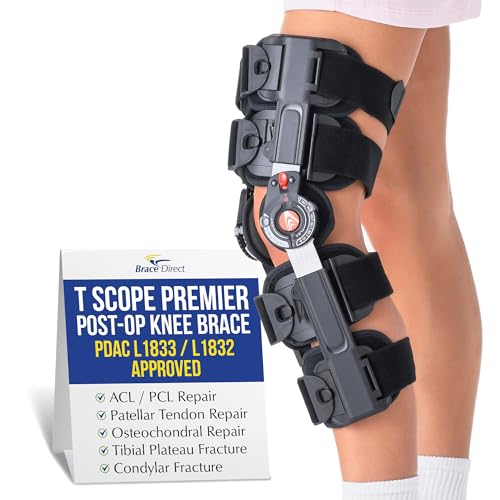
DonJoy 11-2151-9 X-Act ROM Knee Brace

Dial-adjustable hinge locks in extension while you're on crutches, then opens gradually as your surgeon clears more motion.

  • UW's own sheet: "You must be non-weight bearing with brace and crutches until cleared by your surgeon... your brace must be locked in extension. You must wear the hinged-knee brace for the first 6 weeks."
  • BWH's ACL-reconstruction sheet independently confirms the same brace-locked-in-extension protocol, from a different institution and surgeon.
  • Dial-adjustable flexion/extension stops mean one brace can be reset at each follow-up instead of needing a new one as restrictions ease.

The count: Checked three hinged ROM brace options live — DonJoy (clinical-tier) and TANDCF (budget) are the two we added as picks; a third, Breg, was in stock at $151.90 but wasn't added, to keep this a clean quality/budget pair.

One flaw (not a dealbreaker): Ask your surgeon's office first — many patients are issued a hinged brace directly at the hospital or the first post-op visit. Confirm before buying a duplicate.

Also good for less: same dial-adjustable mechanism ($89.96)

Truform 15-20 mmHg Graduated Compression Stockings, Knee High, Unisex

Because UW's own sheet puts you in thigh-high stockings for two weeks — not just for ACL reconstruction, for any meniscus repair too.

The compression stockings

Truform 15-20 mmHg Graduated Compression Stockings

OTC graduated compression — a reasonable stand-in if your surgeon didn't send you home with a hospital-fitted stocking.

  • UW's own sheet: "You will be given thigh-high compression stockings after surgery... wear these at all times for the first 2 weeks... Alternatively you can use an ace wrap."
  • 15-20 mmHg, closed-toe, unisex sizing.
  • A registered Class II medical device, made in the USA, per the listing's own feature bullets.

The count: Reused, not re-shopped for this hub — checked two OTC compression options on file (Truform, JOBST) originally for the heart-surgery hub; UW's own post-op sheet is what puts either pick on this checklist, not a fresh product search this pass.

One flaw (not a dealbreaker): General OTC compression, not a hospital-fitted TED stocking — ask your surgical team if they specifically prescribed one instead. UW's own sheet also lists a plain ace wrap as an accepted alternative, which costs less.

Track B — simple arthroscopy (meniscus trim, chondroplasty, debridement, no ligament work): you probably don't need to buy anything new here. Three independent hospitals confirm the same lighter pattern: BWH's own matched sheet says "Weight bear as tolerated. Use crutches as needed" — no brace named at all. UKY draws the clearest line: "Crutches or a cane may be necessary to assist walking. These aids are used to help with balance but not to remove weight from the leg." UW's own knee-arthroscopy sheet notes an even lighter case for straightforward debridement/synovitis — crutches for as little as 3-4 days. If you're on this track, the 3 shared essentials above are genuinely the whole list; skip Track A entirely. UKY's sheet also mentions a plain ace wrap (5-7 days) as this track's lighter compression option, in place of Track A's thigh-high stockings — a real product, but common and inexpensive enough that we're not verifying a specific ASIN for it here.

Situational

Depends on your specific setup — not everyone needs these.

Medline Backless Shower Chair with Arms

Because standing one-legged with the brace off — which UW's own sheet says is fine to do — is exactly the moment a fall risk shows up.

Shower stool

Medline Backless Shower Chair with Arms

Something to sit on for the minutes the brace comes off — not universally needed, but worth having if balance is a concern.

  • UW's own sheet: "It is OK to remove the brace for showering but be careful" — the direct basis for this pick, an honest inference from that instruction, not a hospital-quoted "buy a shower stool" line.
  • 350 lb. weight cap, height adjusts in 1" steps.
Vive Fleece Crutch Pads & Hand Grips

Because underarm soreness shows up fast once you're actually using crutches for weeks, not days.

Crutch pads

Vive Fleece Crutch Pads & Hand Grips

A cheap comfort upgrade — makes more sense for Track A's weeks of use than Track B's few days.

  • Slides over the stock foam pad most crutches ship with, plus a washable cover.
  • At $14.99, a sixth the price of buying a whole new pair of crutches.

Bonus comfort

Nobody needs this one, but people find it useful with a brace or crutches in the mix.

Xpand No Tie Elastic Shoe Laces for Sneakers

Because bending down to tie a shoe over a locked-straight brace, or while balancing on crutches, isn't happening.

Elastic laces

Xpand No Tie Elastic Shoe Laces

Turns any lace-up shoe into a slip-on — no bending required.

  • Stretches to fit, no tying.
  • Works on sneakers and most lace-up walking shoes.

Borrow or skip

The honesty section — what this recovery genuinely doesn't need, and why it's different from the site's other joint-recovery hubs.

  • Skip the knee scooter entirely — not applicable here, unlike the foot-ankle hub. A knee scooter works by kneeling the injured leg on a padded platform while the healthy leg pushes. But here, the operated knee itself is the joint that can't bend or bear weight — there's no way to kneel on it. None of the 7 sources in this research mention a knee scooter for either track.
  • Skip the raised toilet seat — also not needed here, unlike the knee/hip-replacement hubs. No hospital source names one, and the reason those other hubs need it (a joint that can't bend at all) doesn't apply — the restriction here is on weight-bearing and bending past 90 degrees, not on using a normal-height toilet.
  • Ask your surgeon's office whether a hinged brace will be issued to you directly, before buying one. Common in practice, though no single source in this research states it as a guaranteed rule — a reasonable question to ask, not a promised freebie.

Go deeper

Two follow-up pages cover what comes up next — the coverage story, and the crutches timeline everyone asks about first.

This is an equipment and cost-coverage guide, not medical advice. It doesn't cover physical therapy, weight-bearing status, or any other instruction that should come from your surgeon or care team — follow their discharge instructions over anything here. Whether you're on Track A or Track B is a clinical determination only your surgeon can make.
See the full printable checklist — every item, both tracks ↓

Everything on this hub in one table — which track each item belongs to, and its coverage status. This is what prints when you use the button up top.

The full ACL / knee-arthroscopy recovery checklist
ItemTrackStatusHCPCS / coverage
CrutchesBothBuyE0114 — covered
Ice (gel packs)BothBuyOut of scope — see coverage page
Leg-elevation wedge pillowBothBuyNo HCPCS code
Hinged ROM knee braceTrack A onlyBuy — ask firstL1832/L1833 — out of scope
Compression stockingsTrack A onlyBuyNo HCPCS code
Ace wrapTrack B alternativeMention only — no pick verifiedNo HCPCS code
Shower stoolSituationalBuyNo HCPCS code
Crutch padsSituational / comfortBuyA4635/A4636 — out of scope
Elastic lacesBonusBuyNo HCPCS code
Knee scooterNot applicableSkip — see Borrow or skipE0118 — no claims regardless
The coverage story

IRS Publication 502 names crutches individually as an eligible FSA/HSA expense; the rest of this checklist qualifies under its general medical-equipment rule when a doctor directs it — not guaranteed by name the way crutches are.

You're probably not on Medicare for this hub — but Medicare's own crutches code (E0114) is still the best national price benchmark this site has: $57.17–$88.73 a pair, 44,541 claims nationally in 2024. That's not the single highest-volume code Medicare tracks overall — but it is 31.6 times more claims than every other crutches-family code combined, a real dominance worth knowing even if you're paying out of pocket.

Source: IRS Publication 502 (2025) + CMS DMEPOS Fee Schedule, July 2026 (DME26-C) + DY2024 utilization, checked 2026-07-30

See the full item-by-item FSA/HSA breakdown →

This page has Amazon links — we may earn a commission if you buy through them, at no extra cost to you. It never changes which product we recommend. See our methodology.

Sources

  1. Kim S, Bosque J, Meehan JP, Jamali A, Marder R. "Increase in outpatient knee arthroscopy in the United States." J Bone Joint Surg Am. 2011. — the 984,607/127,446/~500,000 volume stat, from 2006 CDC ambulatory-surgery survey data
  2. American Academy of Orthopaedic Surgeons (AAOS), "Anterior Cruciate Ligament (ACL) Injuries" — injury-incidence context, female-athlete rate, repair-vs-reconstruction distinction
  3. AAOS, "Knee Arthroscopy" — the brace-is-conditional-on-repair/reconstruction sentence this hub is organized around
  4. University of Washington Dept. of Orthopaedics & Sports Medicine (Dr. Mia S. Hagen), ACL + Meniscus Repair postop instructions (PDF) — THE brace-locked-in-extension, compression-stocking, and elevation citations
  5. University of Washington, Knee Arthroscopy postop instructions (PDF) — the same-surgeon, no-brace, progressive-weight-bearing contrast case
  6. Brigham and Women's Hospital / Mass General Brigham, ACL Reconstruction postop instructions — independent cross-institutional confirmation of the brace protocol
  7. Brigham and Women's Hospital, Knee Arthroscopy postop instructions — the matched-pair no-brace, weight-bear-as-tolerated contrast case
  8. University of Kentucky HealthCare, Knee Arthroscopy postop instructions — the balance-vs-offloading crutches distinction; third independent institution
  9. IRS Publication 502 (2025), Medical and Dental Expenses — the crutches-named-by-item FSA/HSA citation
  10. CMS DMEPOS Fee Schedule, July 2026 (DME26-C) + DY2024 utilization — crutches E0114 fee range and claim counts
  11. CPSC SaferProducts.gov + data/recalls.json — 0 hits for DonJoy, TANDCF; checked for every pick above
  12. Amazon Creators API + live amazon.com/dp/ verification — product search/detail lookup for every pick above; the 2 new knee-brace ASINs live-verified 2026-07-30
  13. VerifiedCareData dataset.json (CC-BY-4.0) — every HCPCS code and fee range above in one machine-readable endpoint