The 5 Things to Buy Before Back Surgery

Five things, one order — because for the first few weeks your spine needs to stay still while everything around it keeps moving. What almost nobody is told is that the instruction inverts at about six weeks.

Everything on this list exists to solve one problem: for the first stretch after spine surgery you are not supposed to bend, lift or twist, and almost every ordinary task at home requires one of those. That phase is real and the products are for it. But it is a phase, not a destination, and the evidence for what comes next is stronger than the evidence for staying still.

Every pick here is checked against named hospital instructions and the published trial evidence — how we choose →

The 5 essentials

HealthSmart Enhanced Comfort 5" Raised (Round) Toilet Seat Riser

Because three separate hospital sources name this directly for spine surgery — not carried over from another hub.

The raised toilet seat

HealthSmart Raised Toilet Seat

Rests on your existing bowl rim, no tools — but measure first: this fits round bowls only, and the wrong shape will rock instead of sitting flat.

  • Mayfield Brain & Spine (“if your toilet is low, get a raised toilet seat”), UW Medicine’s Activities of Daily Living guide, and UW’s own pre-op checklist all name a raised toilet seat directly for spine surgery — three independent hospital sources.
  • 300 lb weight capacity, no tools or hardware to install.
  • Round bowls only — the listing states it isn’t compatible with elongated toilets; see the elongated match below if that’s your bowl shape.

The count: We've verified five raised-toilet-seat picks across this site — the one built to fit either bowl shape without measuring first is currently out of stock (re-checked live for this build), so bowl shape genuinely matters here: 30 seconds with a tape measure tells you whether you need this one or the elongated match below.

One flaw (not a dealbreaker): Sits on the bowl rim rather than clamping to it — a real risk if someone leans on the front edge while standing. Pair with the toilet safety frame further down if that's a concern.

Also good: elongated-bowl match if that's your toilet shape ($38.39)

See the full raised-toilet-seat comparison →

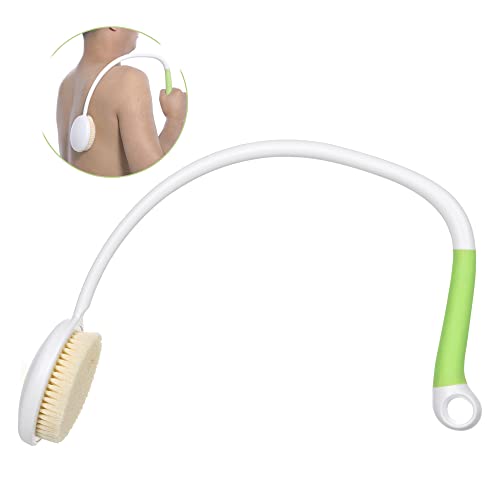
Fanwer 27.5" Long Handled Back Bath Brush for Shower, Adaptive Equipment for Shower

Because UW Medicine teaches a hip-hinge technique for dressing first — this is for the one motion that trick doesn't solve: washing your own feet and legs in the shower.

Washing without bending

Fanwer Long-Handled Bath Sponge

27.5 inches of reach means you don't bend forward at all to wash your lower legs and feet — the most honestly conditional pick on this hub, not a flat must-buy.

  • UW Medicine’s Spine Care Companion teaches crossing your ankle over your opposite knee and bending from your hips as the FIRST-LINE dressing technique — a reacher or dressing aid is offered only “if needed,” genuinely more optional here than on the knee or hip hub.
  • UW’s separate Activities of Daily Living guide: “If it is hard for you to reach your feet, you can use a sock aid, long-handled reacher, or a long-handled shoehorn… your occupational therapist can show you how to use these.”
  • Marketed explicitly as “Adaptive Equipment for Shower” — 9.5" longer reach than the budget alternative.

The count: We checked two long-handled bath sponges for this hub — this is the longer-reach one; if you also want the reacher, sock aid, and shoehorn for dressing (UW’s own OT-taught fallback, not first-line here), the 7-piece hip kit below bundles all four for less than buying them separately.

One flaw (not a dealbreaker): Doesn't cover dressing at all — if bending to pull on socks or pants is genuinely hard those first weeks, see the hip-kit alternative below or the full dressing guide.

Also good: full 7-piece hip kit (reacher, sock aid, shoehorn, dressing stick) if you want it all ($39.99)

See the full getting-dressed-and-bathing guide →

OPTP The Original McKenzie Lumbar Roll, Standard Density

Because every source that mentions sitting says the same thing: avoid soft chairs, and a firm one with support beats a couch.

The lumbar support roll

OPTP McKenzie Lumbar Roll

Straps onto whatever firm chair you already own — UW Medicine's own instructions say a rolled-up towel works too; this is the buy-once version.

  • Mayfield: “identify a chair with a firm cushion, armrests and a seat at knee level.” UW’s ADL guide: “do not sit on deep or overstuffed chairs and couches.” UW’s Companion: “avoid soft chairs… a lumbar roll may help.” Three independent sources, same instruction.
  • Built by OPTP, a physical-therapy equipment brand behind the McKenzie Method — not a generic car-cushion brand.
  • UW’s own phrasing (“you may roll up a towel”) means this is a genuine upgrade, not a required purchase — the chair itself is furniture you already own, not a shopping-list item.

The count: We checked two lumbar-roll options for this hub — this firmer, PT-brand roll versus a softer memory-foam alternative below, for anyone whose incision doesn't tolerate the firmer one yet.

One flaw (not a dealbreaker): Firm enough that it may feel like too much support close to surgery — the memory-foam alternative below is softer.

Also good: softer memory-foam roll ($9.99)

Xpand No Tie Elastic Shoe Laces for Sneakers

Because UW Medicine's own pre-op packing list says the opposite of what most recovery lists tell you.

Elastic no-tie laces

Xpand No-Tie Elastic Shoelaces

Most recovery checklists tell you to get slip-on shoes. UW's own hospital-bag instructions say the opposite — this is the fix that satisfies both.

  • UW Medicine’s Spine Care Companion, verbatim, on what to pack for the hospital: “Comfortable tennis shoes that come up over your heel (do not bring backless or slip-on shoes)” — a fall-safety instruction, not a suggestion.
  • Turns any real, over-the-heel sneaker into a slip-on without a single lace to bend down and tie — you keep the fall-safety shoe UW asks for, and lose the bending.
  • One pack fits most standard sneaker eyelets — keeps your existing shoes rather than requiring a new pair.

The count: Most lists tell you to get slip-on shoes for this. UW's own pre-op packing list says the opposite — so the honest fix here is elastic laces on a real sneaker, not a new pair of backless shoes.

One flaw (not a dealbreaker): Doesn't work on shoes with unusual eyelet spacing or boots — a standard sneaker or athletic shoe is the target here.

Medline Shower Chair with Backrest and Padded Armrests

Because UW Medicine names this directly, and standing to wash on a fresh incision is exactly the balance risk you don't want in week one.

The shower chair

Medline Shower Chair with Backrest

A backrest and padded arms to push off from — use the switch below if you have a tub instead of a walk-in shower.

  • UW Medicine’s ADL guide: “Your occupational therapist may recommend a shower chair or tub-transfer bench to sit on in the shower.”
  • 350 lb weight rating, height-adjustable in 1" steps to fit the stall.
  • Have a tub you’d need to step over? The tub-transfer bench below sits half in, half out, so you slide across the wall instead of lifting a leg over the edge.

The count: We checked four shower-seating options across this site — this backed chair is the default for a walk-in or step-in shower; switch to the tub-transfer bench below if you have a tub.

One flaw (not a dealbreaker): Doesn't help with a tub you have to step over — that's a different product with different legs, not this chair.

Also good: tub-transfer bench if you have a tub to step over ($51.61)

See the full shower-chair & bench comparison →

The second half of the recovery, which nobody mentions

Nothing to buy. Every discharge sheet covers the protective phase; far fewer cover what replaces it, and that is the part with trial evidence behind it.

The five items above are all answers to the same instruction: do not bend, do not lift, do not twist. That instruction is real, it protects a healing repair, and for the first few weeks the reacher and the sock aid are how you live a normal day inside it. Where people get stuck is afterwards. The restriction has an end date, something is supposed to replace it, and that half of the conversation frequently never happens.

The finding this page is built on

Across 22 trials and 2,503 people, exercise programmes started four to six weeks after lumbar disc surgery produced a faster decrease in pain and disability than no treatment. And home programmes did as well as supervised ones on pain, disability and overall perceived improvement.

That is a Cochrane review, and it is careful to rate its own evidence as low to very low quality — the trials are small and varied. A larger 2023 meta-analysis of 45 studies and 3,036 people found supervised exercise beat unsupervised for disc herniation specifically, on both pain and disability. Put together: doing something beats doing nothing, the timing is measured in weeks rather than months, and being sent home without a plan is the one option with nothing behind it.

Source: Rehabilitation after lumbar disc surgery, Cochrane Database of Systematic Reviews (2014), PMID 24627325

Timing is your surgeon’s call, not this page’s, and the difference matters. A single-level discectomy and a multi-level fusion have genuinely different timelines, and a fusion needs bone to knit before loading it is sensible. The four-to-six-week figure above comes from disc surgery trials. So the useful thing is not a schedule from a website — it is to leave your follow-up appointment with an actual answer to: when do I start moving properly, what specifically should I be doing, and am I being referred to anyone? If the answer is a leaflet, that is worth pushing on.

And one for anyone still deciding. If a fusion is being proposed alongside a decompression for lumbar spinal stenosis, it is worth knowing that a randomised trial in the New England Journal of Medicine found adding the fusion made no significant difference at two years — a disability score of 27 with fusion against 24 with decompression alone — and that this held whether or not patients also had spondylolisthesis. That does not settle any individual case, and instability changes the picture. It does make “why fusion as well, in my case?” a fair and specific question.

Depends on your home

Four more, depending on your bathroom, your stairs, or how you're doing — a walker especially: most back-surgery patients genuinely don't need one.

Carex Toilet Safety Frame

Because some people need push-up support more than extra height — or the raised seat above just won't fit their toilet.

Toilet safety frame (alternative)

Carex Toilet Safety Frame

Doesn't add sitting height at all — straddles the existing toilet on adjustable legs for push-up support instead.

  • Width-adjustable (16"–18"), fits round or elongated bowls the seats above are each locked to one shape.
  • 300 lb capacity, no tools to install.
Medline Adjustable Steel Drop-Arm Bedside Commode, Portable Bedside Toilet, 350 lb Weight Capacity

Because UW Medicine's own OT guidance calls for one when the bathroom is far away or up stairs — not universal, but real for some homes.

Bedside commode

Medline Drop-Arm Bedside Commode

Drop-down arms make a lateral transfer easier without twisting at the waist — exactly the motion a BLT restriction rules out.

  • UW Medicine’s ADL guide: “Your occupational therapist may recommend using a bedside commode or grab bars at home” — conditional on distance/stairs, not universal.
  • 350 lb capacity. The listing itself states it can be used bedside, positioned over the toilet as a raised seat, or with the bucket removed as toilet safety rails.
  • Verified live in stock 2026-07-29 — this Medline pick replaces the Drive Medical pick this hub's own research originally checked, which lost its Add to Cart button between the research pass and this build.
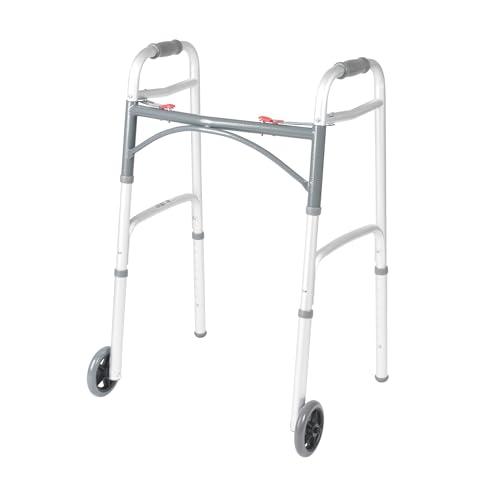
Drive Medical Two-Button Folding Walker with Wheels, Height Adjustable

Because back surgery, unlike hip replacement, doesn't restrict weight-bearing on either leg — the restriction is bending, not walking.

Walker (optional — most people don't need one)

Drive Medical Two-Button Folding Walker

Borrow one first if you're unsteady those first days — none of the five hospital sources fetched for this hub list a walker as standard equipment.

  • UW Medicine’s own Companion booklet: “Walk at a comfortable pace… with whatever walking device you use” — treats a walker as something some patients already have, not something the program hands out.
  • No walker or cane appears anywhere in UW’s separate Activities of Daily Living guide, Mayfield’s guide, UCLA’s discharge instructions, or Dr. Berger’s discharge PDF — a real absence across all five sources, not a search gap.
Gorilla Grip Patented Bath Tub Shower Mat, Suction Cups and Drain Holes, 35x16 Inch

Because a wet floor and a fresh incision are a bad combination no matter which surgery you had.

Non-slip bath mat

Gorilla Grip Bath Tub Shower Mat

Suction cups and drain holes under whichever shower seat you picked above — a cheap extra layer of fall safety.

  • 35" x 16", machine washable, grips the tub floor under a shower chair or bench.

Bonus comfort

Two more people swear by — one directly sourced, one an honest inference stated plainly as one.

Pure Enrichment PureRelief Lumbar & Abdominal Heating Pad

Because Kaiser Permanente points at heat, not ice, for this specific surgery — a genuinely different default than the knee hub's cold-therapy-first framing.

Lumbar heating pad (bonus)

Pure Enrichment Lumbar Heating Pad

4 heat settings including 'low' — Kaiser's own instruction — plus an adjustable belt so you're not holding it in place by hand.

  • Kaiser Permanente: “Use a warm water bottle, a heating pad set on low, or a warm cloth on your back.”
  • Includes a removable gel pack that can be heated or frozen, covering the ice option Dr. Berger’s discharge PDF also mentions as one pain option among several.
  • 2-hour auto shut-off.
Bekweim Adjustable-Height Bed Wedge Pillow, 12 Inch

Because UCLA's own discharge instructions prefer a reclined position over long stretches of upright sitting — though no source in this research names a wedge for back surgery by name.

Sleep wedge (honest inference, not a direct instruction)

Bekweim Adjustable Bed Wedge Pillow

Recreates a recliner's angle in bed — an honest inference from UCLA's own wording, not a direct hospital recommendation the way it is on other hubs.

  • UCLA Health: “the preferred positions are standing, walking, lying down or sitting in a recliner (approximately 45 degrees)” rather than prolonged upright sitting.
  • Reused from the shoulder-surgery hub’s own verified pick — same physical shape need (a torso incline), re-verified live for this hub.
  • Honest gap, stated plainly: no source in this research explicitly instructs a wedge for nighttime sleep after back surgery — a reasonable bonus option, not a citation-backed core pick.

Also good: 3-piece adjustable set if a fixed wedge doesn't sit right ($39.98)

Borrow or skip

The honesty section — what this recovery doesn't need, according to the hospitals themselves.

The coverage record

A raised toilet seat pays zero Medicare dollars, by law, regardless of prescription — and the same rule applies even to a Medicare-covered commode chair the moment it's positioned to work as one instead.

Medicare's own Commodes Policy Article (A52461) requires a non-covered GY billing modifier the instant a commode chair is used as a raised toilet seat instead of a commode — the same policy article that makes the raised seat itself (E0244) noncovered in the first place. See the full covered/not-covered breakdown, including the walker and commode fees, on the Medicare page.

Source: data/coverage_status.json (68 HCPCS codes), Commodes Policy Article A52461, LCD L33736

  • The pillow under your knees (or between them) is a regular household pillow. Mayfield, UW's Companion, and Dr. Berger's discharge PDF all describe the same sleeping-position pillow placement — none names a special product. You almost certainly already own what you need for this one.
  • A back brace is typically surgeon-supplied, not something to shop for. See the note above the essentials — four independent sources describe it with conditional, surgeon-directed language.
  • Borrow a walker first if you're unsteady, rather than buying one. No hospital source among the 5 fetched for this hub lists a walker as standard equipment — back surgery doesn't restrict weight-bearing on either leg the way hip replacement does.

How we know this

Every recommendation above has to survive independent checks. None of them is our opinion.

  1. Medicare’s own data. Whether the item is covered, what it pays, and how many were billed nationally — from the CMS DMEPOS fee schedule, the HCPCS Level II file and DY2024 utilization, queried directly rather than through a third party’s summary. Published as an open dataset.
  2. Named hospital instructions. Clinical claims are quoted from a named institution’s own discharge or patient-education material and linked, never paraphrased into fact. Where sources disagree, the page says they disagree instead of picking one.
  3. Published outcome research. What helps after lumbar spine surgery once the protective phase ends has been studied in more than 5,000 people across two systematic reviews, and the question of whether to add a fusion has a randomised trial behind it. Every figure on this page that describes what happens during recovery — when pain rises, when the wound changes, what the evidence says about diet — comes from one of these, cited inline and linked to the paper rather than summarised from memory.

What that research is and is not. These are studies of what happens to patients after this operation — how the wound heals, how pain moves, what changes outcomes. They are not a substitute for your surgeon's instructions, and this page never tells you what treatment to have. Where a study's finding and your discharge sheet disagree, follow the discharge sheet and ask the question at your follow-up.

Our datasets are published under CC BY 4.0 — see the rest of our datasets. More about who writes this and how →

Go deeper

Two follow-up pages cover what comes up next for this surgery specifically — the Medicare coverage story, and the practical day-to-day setup.

This is an equipment and cost-coverage guide, not medical advice. It doesn't cover physical-therapy protocols, medication management, wound care, or any other instruction that should come from your surgeon or care team — follow their discharge instructions over anything here. Bending/lifting/twisting limits, the recovery window, and whether a brace is needed genuinely vary by surgeon, procedure (fusion, laminectomy, discectomy), and surgical approach.
See the full printable checklist — all 14 items ↓

Everything on this hub, in one list — the five essentials, the four situational picks, the two bonus-comfort picks, and what to skip. This is what prints when you use the button up top.

The full back-surgery recovery checklist
ItemCategoryStatusMedicare
Raised toilet seat Essential Buy Not covered
Long-handled bath sponge Essential Buy No HCPCS code
Lumbar support roll Essential Buy No HCPCS code
Elastic no-tie laces Essential Buy No HCPCS code
Shower chair / tub-transfer bench Essential Buy Not covered
Toilet safety frame Depends on your home Buy, if raised seat won't fit Not covered
Bedside commode Depends on your home Buy, if bathroom is far/upstairs Covered w/ Rx (E0163)
Walker Depends on your home Borrow first Covered w/ Rx (E0143)
Non-slip bath mat Depends on your home Buy Not covered
Lumbar heating pad Bonus comfort Buy No HCPCS code
Torso-incline sleep wedge Bonus comfort (honest inference) Buy No HCPCS code
Reacher / hip-kit bundle Optional (conditional) Buy, if hip-hinge dressing is hard No HCPCS code
Regular household pillow (sleeping position) Borrow or skip Already own n/a
Back brace/corset Borrow or skip Surgeon-supplied Out of this site's scope
What Medicare actually pays for

Two items on this checklist carry a real Medicare fee: a walker (E0143, $55.55–$125.91) and a commode (E0163, $60.15–$139.61), both with a doctor's prescription.

Everything bathroom-safety related — the raised toilet seat, toilet safety frame, shower chair, and tub-transfer bench — pays zero Medicare dollars by law, and a back brace has no HCPCS code inside this site's 68-code dataset at all. See the full breakdown, including the commode-as-raised-seat coverage flip, on the Medicare page.

Source: data/coverage_status.json (68 HCPCS codes)

See the full Medicare coverage breakdown →

This page has Amazon links — we may earn a commission if you buy through them, at no extra cost to you. It never changes which product we recommend. See our methodology.

Sources

  1. Martin BI, Mirza SK, Karamian BA, et al. "Cost and Utilization Trends of Lumbar Fusion." JAMA Network Open. 2026;9(3):e260452. — source of the 274,750-procedures-in-2023 / 5,033,772-total-since-2002 surgery-volume stat; fetched live 2026-07-28
  2. Mayfield Brain & Spine, "Preparing for Lumbar Spinal Fusion" — the 2-week/5-lb BLT window, log-roll, raised toilet seat, firm-chair, and brace citations; fetched live 2026-07-28
  3. University of Washington Medicine, "Activities of Daily Living After Spinal Injury or Surgery" (PDF) — the 4-12 week/5-10 lb BLT window, log-roll, raised toilet seat, reacher/sock-aid, shower chair, and bedside-commode citations; clinician-reviewed 07/2012, text-extracted 2026-07-28
  4. University of Washington Medicine, "Spine Surgery Care Companion" (PDF, 22 pages) — the slip-on/backless-shoe correction, the hip-hinge dressing technique, the lumbar-roll citation, and the 10-lb/no-bend BLT window; clinician-reviewed 03/2023, text-extracted with a Chrome UA 2026-07-28
  5. UCLA Health, "Patient Discharge Instructions: Spinal Fusion" (PDF) — the 5-lb BLT figure and the 90-degree/45-degree recliner sitting-posture citation behind the sleep-wedge bonus pick; text-extracted 2026-07-28
  6. Ryan J. Berger, MD (orthopaedic spine surgeon, Michigan Orthopaedic Surgeons/Corewell Health Royal Oak), "Standardized Hospital Discharge Instructions for Post-Operative Spine Surgery" (PDF) — the 6-12 week/"No BLT with 2 pickles" window, push/pull and overhead limits, and the strongest brace citation; text-extracted 2026-07-28
  7. Kaiser Permanente, "Lumbar Spinal Fusion: What to Expect at Home" — the heat-not-ice citation behind the lumbar heating pad pick; fetched live 2026-07-28
  8. data/coverage_status.json (68 HCPCS codes) — walker (E0143), commode (E0163), and the full bath-safety not-covered cluster, checked against every relevant code
  9. Amazon product listings, direct live fetch (Chrome UA) — stock/price re-verification for the two flagged ASINs on 2026-07-29 — see the frontmatter comment above for method and result
  10. CPSC SaferProducts.gov + FDA recall databases — checked for every new category/ASIN above — zero hits for all three new gear files
  11. VerifiedCareData dataset.json (CC-BY-4.0) — every coverage fact above in one machine-readable endpoint