What to Buy Before Hiatal Hernia Surgery: The 4 Essentials

Four things for the weeks of liquid-to-soft eating ahead — plus a note about the straw bottle other sites recommend.

At least 13,658 elective hiatal hernia repairs happened across 174 U.S. thoracic-surgery centers from 2018 to 2023 — a real floor, not a full national count, since that registry doesn't cover every hospital. This recovery looks different from most others on this site: instead of a big mobility-equipment list, you're managing weeks of liquid-to-soft eating while your fundoplication heals, plus gas that gets trapped more easily than before. Four things cover what actually helps: sleeping elevated, blending meals, easing gas-related shoulder pain, and getting pills down. Today all four cost about $110 on Amazon. One thing worth knowing before you shop: every hospital source we checked agrees on skipping the straw, for a reason that has nothing to do with your incision.

Every pick here traces to a hospital discharge instruction or a peer-reviewed academic review, cross-checked against recall records and Medicare data — how we choose →

The 4 essentials

Bekweim Adjustable-Height Bed Wedge Pillow, 12 Inch

Because keeping your head above your stomach at night is the same gravity trick your surgeon's repair needs time to fully take over.

The sleep wedge

Bekweim Adjustable-Height Bed Wedge Pillow, 12 Inch

A torso incline, not a leg-elevation wedge — raises your whole upper body at a steady angle.

  • One foam wedge, not a multi-piece set — less to set up at 11pm.
  • Cleveland Clinic's own hiatal-hernia guidance: elevating your head at night can help keep reflux down while you sleep.
  • The wedge we recommend for knee and hip swelling is a LEG-elevation wedge — a different shape entirely; this is the torso version.

How we chose it: The same torso-incline wedge we recommend after shoulder surgery. The leg-elevation wedge we recommend after joint replacement is the wrong shape for this, so we use the torso version.

One flaw (not a dealbreaker): One caveat: no discharge instruction we read for THIS surgery specifically tells patients to sleep elevated after surgery — that citation is Cleveland Clinic's general hiatal-hernia guidance, aimed more at people managing symptoms before or instead of surgery. The gravity mechanism doesn't stop applying the day after your operation, but we couldn't find a post-op-specific hospital source requiring it.

Hamilton Beach Go Sport Portable Blender for Smoothies, 20 oz.

Because you're looking at weeks of liquid and soft food, not days — and a blender is the tool that makes that survivable.

The personal blender

Hamilton Beach Go Sport Portable Blender for Smoothies, 20 oz.

The blending jar doubles as the cup you drink from — one less dish to manage.

  • MSK's own diet table lists smoothies, milkshakes, and blended soups across the full-liquid and soft-diet stages.
  • UPMC's diet table separately lists blended, custard-style, or whipped foods and smoothie-style drinks.
  • Kastenmeier's academic review notes patients 'will likely lose 10-15 pounds during the first 4-6 weeks' — a calorie-dense blended meal is a real, practical answer to that.

How we chose it: This is equipment, not a diet plan — we don't author blended-recipe content here; every specific food mentioned above is a direct quote from a hospital's own published diet table, not this site's invention.

One flaw (not a dealbreaker): Entirely optional if you already own any blender — this is here for anyone who doesn't.

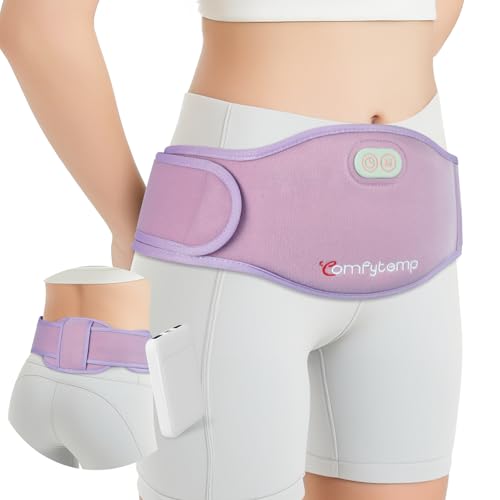
Comfytemp Portable Belly and Back Heating Pad, Cordless, Rechargeable

Because the pain that surprises people isn't at the incision — it's a burning ache in your shoulder from the gas used to inflate your abdomen during surgery.

The heating pad

Comfytemp Portable Belly and Back Heating Pad, Cordless, Rechargeable

Drape it over your shoulder, not your belly — the reason for this pick is different from our other guides that use it.

  • MSK, verbatim: "If you had a minimally invasive (laparoscopic) surgery, you may have pain in your shoulder. This is called referred pain and is common. It's caused by the gas that was put into your abdomen during your surgery... They will bring you a hot pack to put on your shoulder to help with the pain."
  • MSK's own estimate: this referred shoulder pain resolves in about 7 to 10 days.
  • Cordless and rechargeable, 3 heat levels with a 15/30/45-minute auto-shutoff timer.

How we chose it: We recommend this same Comfytemp pad for incision soreness after c-section and hernia surgery. Here the reason is different and comes from MSK: referred shoulder pain from laparoscopic gas, not incision care.

One flaw (not a dealbreaker): Marketed and shaped for the belly and back, not the shoulder — a standard flat wrap-style pad would fit a shoulder more precisely, but this one works fine draped over it.

Because for the first week or two, you may not be able to swallow a pill whole at all.

The pill crusher

Deke Home 3-in-1 Pill Cutter & Crusher with Storage

Not a dose-scheduling organizer — a physical crusher/splitter, for pills that are too big to get down right now.

  • MSK, verbatim: "For the first few weeks after your surgery, you will not be able to swallow large pills... Do not crush any pills without talking with your pharmacist first."
  • Kastenmeier/Medical College of Wisconsin (peer-reviewed): "we also recommend crushing large pills for the first 2 weeks after surgery... pills larger than the size of a pencil eraser be divided or crushed."
  • Las Vegas Surgical Associates' own discharge sheet: "During the first 2 weeks, do not take any pills whole. Crush all pills."

Why not the AM/PM organizer we recommend elsewhere: it solves dose SCHEDULING across days and times — a different problem entirely from not being able to physically swallow a pill. It wouldn't help here.

Note: we don't have a product photo for this item. We could not confirm which image on the Amazon listing is the real product photo.

What we skipped, and why

Two categories the research strongly supports — but we won't link a mismatched or dead product just to fill a slot.

The straw bottle everyone else recommends? Wrong buy here.

Our hydration-tracking straw bottle is a good pick after several other surgeries — but not this one. Every hospital source we checked that addresses straws says the same thing:

“Avoid drinking through a straw.”

— Memorial Sloan Kettering Cancer Center, listed under “Gas or Discomfort” tips

“Avoid drinking through a straw and chewing gum or tobacco. These actions cause you to swallow air, which produces excess gas in your stomach.”

— UPMC HealthBeat, “Diet After Nissen Fundoplication Surgery for GERD” (the identical instruction is independently repeated in LMH Health’s own licensed adaptation of this same protocol)

Three independent sources, zero disagreement — a real contrast with our own tonsillectomy guide, where hospital sources split on straws. The mechanism here is different too: this isn't a bleeding-risk concern at a healing site, it's gas-bloat syndrome — swallowing extra air is worse than usual after a fundoplication, because the wrap makes it physically harder to belch or vomit to relieve the pressure. We're not linking a straw-lid bottle here as a result. Small sips, all day, no straw, is the guidance every source supports — see the full write-up on our diet-progression page →.

Small divided/portion dishes: real evidence, no live product

Four sources — UPMC, LMH's adaptation of the same protocol, MSK, and the Kastenmeier academic review — independently describe the same instruction: small, frequent meals, with a specific fluid limit. UPMC, verbatim: “limit fluids to 1/2 cup (4 fluid ounces) with meals and one cup (8 fluid ounces) with snacks... Eat small, frequent meals (six to eight per day).” That's a real, hospital-repeated case for a divided or portion-marked dish. We didn't pick one: any small plate or set of small containers does the job, so there's no product link here. Follow the small-frequent-meals, limited-fluid instruction your own hospital's discharge sheet gives you instead.

Hospitals disagree here — on three different numbers at once. We checked six real hospital and academic sources for how long the liquid/soft diet lasts, how long to avoid carbonated drinks, and how much you can lift, and found real disagreement on all three: diet-stage structures range from a flat 3-week combined liquid/soft phase to a conditional puree diet extended up to 6 weeks; carbonation-avoidance windows range from 3 weeks to 6–8 weeks; lifting limits range from no fixed number at all to a strict 10 lbs for 8 weeks. None of these sources are wrong — a peer-reviewed academic review we found explains why: recommendations “vary significantly from one surgeon to another and one institution to another.” Ask your own surgeon for your numbers, and see every real position, hospital by hospital → How long is the liquid/soft diet, really?

A surprising, hospital-sourced fact: the Kastenmeier academic review notes that patients “will likely lose 10-15 pounds during the first 4-6 weeks after surgery before the nadir of weight loss.” That's counseled as a normal, expected part of this recovery, not a red flag — worth knowing ahead of time so it doesn't feel alarming when it happens.

Borrow or skip

What this recovery doesn't need, according to the hospitals themselves.

  • Borrow a recliner if you have one to borrow. Try it for the first couple of weeks before buying the sleep wedge above — several sources across our guides find a recliner does the same job for people who have one.
  • Constipation is a real, hospital-flagged concern — but medication is out of scope here. MSK is direct about it: “Constipation can lead to your hiatal hernia coming back.” It's worth knowing that fact. The specific over-the-counter products hospital sources name for it are a conversation for you and your pharmacist, not a product this site recommends or links.
  • Nausea and vomiting are worth taking seriously — again, not a shopping decision. MSK ties vomiting directly to a real risk of undoing the surgical repair. The medication for that is a prescription from your surgeon, not something to add to a cart.

Go deeper

Two follow-up pages: every hospital's real diet, carbonation, and lifting position, hospital by hospital, and the Medicare and insurer coverage picture.

This is an equipment and cost-coverage guide, not medical advice. It doesn't cover surgical technique, medication, or the specific diet, carbonation, or lifting numbers that apply to you — those instructions should come from your surgeon, not this page. Hospitals themselves disagree on the numbers, so follow your own discharge instructions over anything here.
See the full printable checklist — all 9 items ↓

Everything on this page, in one list — the 4 essentials, the two categories we skipped and why, and the borrow-or-skip section. This is what prints when you use the button up top.

The full hiatal-hernia-surgery recovery checklist
ItemCategoryStatusMedicare
Torso sleep wedge Essential Buy, or borrow a recliner first No HCPCS code
Personal blender Essential Buy (skip if you own one) No HCPCS code
Heating pad (shoulder gas pain) Essential Buy No HCPCS code
Pill crusher / splitter Essential Buy No HCPCS code
Hydration straw bottle Skipped Don't buy — straws are contraindicated here Not needed here
Portion-control dishes Skipped No pick — any small plate works Not needed here
Recliner Borrow or skip Borrow, don't buy Not needed here
Stool softener / laxative Borrow or skip Ask your surgeon/pharmacist Medication — out of this site's scope
Anti-nausea medication Borrow or skip Prescribed by your surgeon Medication — out of this site's scope
What Medicare actually pays for

Classical laparoscopic or open Nissen/Toupet fundoplication is covered under Medicare's general medical-necessity standard once documented — it isn't gated by a special coverage policy the way newer, less invasive alternatives like the LINX device or an incisionless (TIF) procedure are.

None of the four recovery-equipment picks — the wedge, the blender, the heating pad, or the pill crusher — has a Medicare DME billing code. This surgery, done laparoscopically, isn't a mobility-limiting procedure the way a joint replacement is, so there's no bathroom or walking-aid checklist behind it.

Source: CMS LCD L35080 + Blue Cross Blue Shield of Massachusetts and Kaiser Permanente Washington medical policies

See the full coverage and insurer breakdown →

This page has Amazon links — we may earn a commission if you buy through them, at no extra cost to you. It never changes which product we recommend. See our methodology.

Sources

  1. Rosenbaum JJ, Theeuwen HA, Varma S, et al., "Clinical Volume and Perioperative Outcomes of Hiatal Hernia Repair Within the Society of Thoracic Surgeons-General Thoracic Surgery Database," Ann Surg Open, Oct 2025 — the 13,658-repairs / 174-centers registry-floor figure; read 2026-08-05
  2. StatPearls (NCBI Bookshelf), "Hiatal Hernia," Puri R, Sharma S, last updated January 2026 — the 55-60% prevalence / ~10% symptomatic context stat
  3. University Hospitals (UH) Cleveland Medical Center, Hiatal (Nissen Fundoplication & Paraesophageal) Hernia Surgery Recovery — the 3-week combined liquid/soft diet and 3-week carbonation positions; read 2026-08-05
  4. University of Utah Health, "What to Expect at Hernia Surgery: Hiatal Hernias" — the 2-week liquid / 2-4 week soft / 4-6 week normal-diet staging; read 2026-08-05
  5. Memorial Sloan Kettering Cancer Center, "What to Expect After Your Nissen Fundoplication or Hiatal Hernia Surgery" — the straw, referred-shoulder-pain, pill-crushing, constipation, and 10-lb/8-week lifting citations; read 2026-08-05
  6. UPMC HealthBeat, "Diet After Nissen Fundoplication Surgery for GERD" — the meal-count diet staging, 6-8 week carbonation position, straw citation, and portion/fluid-limit citation; read 2026-08-05
  7. Lawrence Memorial Hospital / LMH Health, "Diet After Hiatal Hernia Repair / Nissen Fundoplication Surgery" (licensed adaptation of the UPMC protocol) — independent confirmation of the 6-8 week carbonation position and straw instruction; read 2026-08-05
  8. Kastenmeier AS, "Hiatal hernia repair: postoperative diet, activity, and optimal long-term follow-up," Ann Laparosc Endosc Surg 2021;6:43 — peer-reviewed academic review; the 15-lb/6-week lifting citation, pill-crushing citation, and expected-weight-loss fact; read 2026-08-05
  9. Las Vegas Surgical Associates (Jimmy Xu, MD), discharge instructions for laparoscopic hiatal hernia repair with fundoplication — single-surgeon private-practice source; the 15-lb/4-week lifting position and pill-crushing citation; read 2026-08-05
  10. Cleveland Clinic, "Hiatal Hernia: What It Is, Symptoms, Treatment & Surgery" — the sleeping-elevated citation, which is pre-op, general disease-management advice, not post-op-specific; read 2026-08-05
  11. Medicare's equipment fee schedule (CMS DMEPOS, July 2026), product classification list (Palmetto GBA DMECS), and CPSC and FDA recall records — we searched for hiatal, fundoplication, nissen, toupet, wedge, blender and pill crusher and found nothing relevant; confirms the thin Medicare equipment coverage
  12. Amazon product listings — We check each Amazon price and whether it is in stock every night. A price only shows if it was checked in the last 24 hours.
  13. Our free dataset (CC BY 4.0) — every coverage fact above in one downloadable file