Shoulder Surgery Recovery: What You Actually Need

Your legs are fine. One arm is out of action for about six weeks and you will not be sleeping flat — that is the whole problem, and it is a short list.

A shoulder operation leaves you walking normally and unable to use one arm. That sounds obvious, and it is exactly why the standard post-surgery shopping list is wrong for it: almost everything on those lists — walkers, canes, raised toilet seats, grabbers — solves a leg problem you do not have. Four things cover what actually gets hard. Plan on roughly $120–160, as of July 2026.

What patients actually say

We read 752 posts from 141 people who had shoulder surgery. A sling is mentioned by 77% of them and a recliner by 55% — against 20% of knee patients and 27% of hip patients in our other two corpora. A walker is mentioned by 6%, against 50% for hip.

That is the shape of this recovery in three numbers: the sling defines it, sleeping upright is the thing people talk about most after it, and the mobility equipment that dominates every other recovery page is simply not relevant here.

Source: VerifiedCareData shoulder patient-account corpus v1 — see How we know, below

Every pick here is checked three ways — Medicare’s own coverage and fee data, named hospital instructions, and the patient corpus above — how we choose →

The sling you cannot take off

Mentioned by more people than anything else here, and worn far longer than most expect.

A sling comes up in 108 of 141 accounts — 77%, more than any other single thing, and more than icing. The hospital gives you the sling itself, so it is not something you buy. What people describe is how long it stays on and how it feels round the neck by week three.

“My surgeon doesn't permit any PT and doesn't release you from the sling until 6 weeks.”

— SaraK, BoneSmart, 2020-03-25

Six weeks is the figure that recurs, and it is why the strap pad is the one accessory worth having on day one rather than day ten. One practical tip that comes up repeatedly and costs almost nothing:

“Purchase a waterproof net material shoulder sling for showering in, just swap into/out off, easy and only a few quid on Amazon.”

— Titanium bits, BoneSmart, 2023-11-15
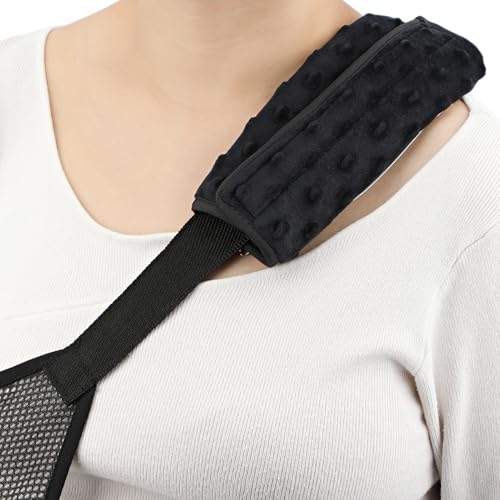
BNRendles Cushioned Arm Sling Neck Strap Pad

Because the free sling's strap digs into your neck for weeks — this is the one thing about it people actually buy.

The sling pad

BNRendles Arm Sling Neck Pad

Slides over the strap where it crosses your neck — the thin factory pad isn't enough for six weeks of wear.

  • Velcro-on sleeve, no tools, fits over any standard sling strap.
  • The sling itself is hospital-provided, per OHSU's own patient guide — not something you buy.
  • AAOS puts rotator cuff sling duration at 4–6 weeks (shoulder replacement runs longer — see our shoulder-replacement guide if that's your surgery).

The count: We checked two sling-pad options for this hub. The sling itself was never a candidate — OHSU's total shoulder discharge guide states plainly it's 'hospital provided' — so this pad, not a sling, is the actual purchase decision here.

One flaw (not a dealbreaker): Doesn't fix a sling that fits badly to begin with — if the strap itself feels wrong, not just uncomfortable, ask your care team before adding padding.

Also good: minky-dot fabric with adjustable fill ($12.99)

You will not be sleeping flat

The single biggest difference between this recovery and every other one on this site.

A recliner is mentioned by 55% of shoulder patients, against 27% of hip patients and 20% of knee patients. It is not a comfort preference here — people are told to sleep upright, and they do it for weeks.

“With the shoulder I was told I must sleep reclined (not flat) and on my back wearing the brace/sling for 6 weeks.”

— anniemfuse, BoneSmart, 2018-01-26

“I ended up sleeping in my recliner for around seven weeks.”

— Debbie_joints, BoneSmart, 2022-08-27

“Slept in it for the first eight weeks and occasionally still retreat to it.”

— Hip4life, BoneSmart, 2025-01-08

If you already own a recliner, that is your bed for a while and you need nothing else. We have not researched buying one and will not recommend a purchase this large off the back of a forum count. The wedge below is the answer for people sleeping in an ordinary bed; it is cheaper and it is what the sleep spoke covers in more detail.

Bekweim Adjustable-Height Bed Wedge Pillow, 12 Inch

Because most people aren't back sleepers — until this surgery makes them one, almost overnight.

The sleep wedge

Bekweim Adjustable Bed Wedge Pillow

Borrow a recliner first if you can — this is the buy-path if you can't.

  • One solid foam wedge, not a multi-piece set — less to arrange at 11pm.
  • A 2026 study found back sleeping jumped to 85% of patients two weeks after rotator cuff repair — most weren’t back sleepers before surgery.
  • 12-inch adjustable incline, sized to prop the whole upper body, not just the head.

The count: We verified one torso-incline wedge against a live Amazon listing for this hub (plus a 3-piece alternative) — call this one vetted for the job, not the winner of a big field. It's a genuinely new category: the site's existing wedge pillow is shaped for leg elevation, wrong purpose entirely for sleeping upright.

One flaw (not a dealbreaker): No HCPCS code exists for a sleep-positioning wedge, so Medicare never pays toward it — same as everything else on this list.

Also good: 3-piece adjustable set if a fixed wedge doesn't sit right ($39.98)

See the sleep-position study and the full setup →

Dressing with one working arm

Getting a shirt on is the daily friction nobody warns you about.

The corpus is blunt about how hard the first week is, and about the fact that most people need another pair of hands for it.

“Dressing and donning the sling in the first week was very difficult without help because of the pain as well as my limited mobility in the non operated arm.”

— AlanInAZ, BoneSmart, 2025-06-24

“It's difficult to dress with one arm and having things that are very loose really helps.”

— Jamie, BoneSmart, 2020-05-06

An adaptive or button-front shirt is raised by 6% of the corpus — a smaller number than the sling or the recliner, but it appears in no other procedure's corpus at all, and the people who mention it describe buying them specifically so someone else could help them dress.

Deyeek Post Shoulder Surgery Shirt, Men's, Side-Snap Tearaway

Because pulling a normal shirt overhead takes two working arms — and yours won't cooperate for weeks.

The adaptive shirt

Deyeek Side-Snap Tearaway Shirt

Snaps open flat down both sides and sleeves — goes on without lifting the operated arm.

  • Full side-snap opening — no overhead lift, no help needed to get dressed.
  • Also sold in a women's cut (same design, different fit) — see the alt link below.
  • AAOS's own figures put most patients back to basic dressing within 2 weeks — this is a short bridge, not a wardrobe change.

The count: This category doesn't exist anywhere else on this site — knee and hip patients keep full use of both arms, so neither hub needed adaptive clothing. We verified two cuts of the same side-snap design for this hub, both confirmed live on Amazon.

One flaw (not a dealbreaker): You'll likely only need this for the two-week window AAOS names for basic dressing recovery — buy one or two, not a wardrobe's worth.

Also good: women's cut, full snap-open arm ($14.99)

Xpand No Tie Elastic Shoe Laces for Sneakers

Because tying a shoelace takes two hands, and one of yours is in a sling.

The slip-on laces

Xpand No-Tie Elastic Shoelaces

Turns any lace-up shoe into a slip-on — the same fix knee and hip patients use, for a different reason.

  • Stretches to fit, no tying — the operated arm can't help.
  • Works on sneakers and most lace-up walking shoes.

The count: Reused from the knee and hip hubs' own verified pick, re-checked live for this hub on 2026-07-28 — the product transfers directly, just for a different limitation (a sling arm instead of a bent knee or a hip precaution).

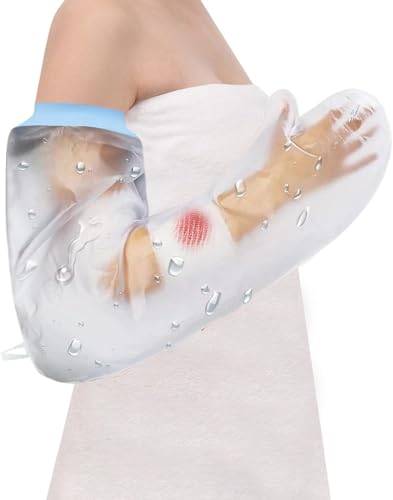
CureSquad Waterproof Full-Arm Cast/Dressing Shower Cover

Because the sling comes off for showers — it's your dressing, not the sling, that needs to stay dry.

Arm/dressing shower cover

CureSquad Waterproof Arm Shower Cover

A silicone sleeve that seals around the upper arm — useful for the few days before your dressing can get wet.

  • Two hospital sources (OHSU, University of Washington) independently say the sling comes off to shower — this protects the incision underneath, not the sling.
  • OHSU: dressings stay dry until a pain block comes out, about 3 days; no baths or pools until roughly 6 weeks.
  • Puts on and takes off one-handed, per the listing.

One flaw (not a dealbreaker): Most people don't need this past the first few days — once your dressing is cleared to get wet, a normal shower is fine.

Also good for less: budget alt, standard-length coverage ($9.99)

Ice, shaped for a shoulder

Widely used — and the corpus is split on whether a machine is worth it.

Icing is mentioned by 68% of shoulder patients and a circulating cold-therapy machine by 37%. Before you rent one, two accounts from people who had the machine and went back to packs:

“I had the Bregs ice machine, but found a couple of ice packs from Amazon were much easier to deal with when keen replaced 4 years ago.”

— dwhist, BoneSmart, 2025-01-15

“For the last few days, I have stopped using the ice machine and use an ice pack in the day or night when I have pain--very minimal, but still enough discomfort to interfere with sleep at times, but the ice solves that issue.”

— Joy0987, BoneSmart, 2023-04-16

A shoulder-shaped wrap is the sensible starting point. A machine is worth pricing if you are having a knee done as well — that is the recovery where the corpus genuinely favours one, at 42% against this page’s 37%.

NEWGO Shoulder Ice Pack, Rotator Cuff Cold Therapy Wrap

Because ice needs to hug a shoulder, not a knee — and this site's other gel packs are shaped for the wrong joint.

The ice wrap

NEWGO Shoulder Cold Therapy Wrap

Wraps around the shoulder itself — on with one hand, since the other arm's in a sling.

  • One-handed application with wide-tab fasteners — 'no reaching behind your back,' per the listing.
  • Stays cold about 45 minutes per application, per the listing.
  • OHSU's discharge guide has patients icing 15 minutes, five times a day.

The count: We checked two shoulder-shaped ice options for this hub, after first confirming the site's existing knee gel packs don't fit here at all — their own listing is titled 'for Knee.' Of the two shoulder-specific wraps, this is the one built with a one-handed fastening system, which matters when your other arm is doing everything.

One flaw (not a dealbreaker): Costs more than a flat gel pack — you're paying for the anatomical shape and the one-handed strap, not a different cooling technology.

Also good for less: Chilmax shoulder wrap ($18.99)

What shoulder surgery doesn't need

The most useful thing this corpus said was how short the list is.

Most “what to buy before surgery” lists are written for a leg operation, and it shows. Set against our hip and knee corpora, the mobility and bathroom equipment that dominates those pages barely registers here:

Share of each procedure’s corpus mentioning the item.
ItemShoulderHipKnee
Walker or rollator6%50%42%
Cane7%46%33%
Crutches6%36%23%
Raised toilet seat1%13%6%
Reacher or grabber3%14%3%
Leg lifter1%10%3%

You will walk out of hospital on your own legs. Unless you have a separate problem with them, none of that belongs on your list — and a checklist that includes it is one written for a different operation.

The one honest exception we do stock is a reacher, and even here the case is weak: 3% of this corpus mentions one, against 14% for hip. It earns its place only if the operated arm is your dominant one.

Blue Jay 32" Reacher Grabber Tool for Seniors, 2 Pack - Sturdy Non-Folding Pick Up Stick with Magnetic Tip

Because this is honestly the weakest case for a reacher anywhere on this site — your legs and your other arm both still work fine.

Reacher / grabber (optional)

Blue Jay 32" Reacher (2-Pack)

Only genuinely useful for grabbing something without using the operated arm at all — not the essential it is on the knee and hip hubs.

  • The knee/hip hubs recommend this because patients can't bend to reach the floor — that limitation doesn't apply here.
  • The real use case: a high shelf, or a dropped item you’d otherwise need the sling arm for.

How we know this

Every recommendation above has to survive independent checks. None of them is our opinion.

  1. Medicare’s own data. Whether the item is covered, what it pays, and how many were billed nationally — from the CMS DMEPOS fee schedule, the HCPCS Level II file and DY2024 utilization, queried directly rather than through a third party’s summary. Published as an open dataset.
  2. Named hospital instructions. Clinical claims are quoted from a named institution’s own discharge or patient-education material and linked, never paraphrased into fact. Where sources disagree, the page says they disagree instead of picking one.
  3. 752 posts from 141 people who had this surgery, across 142 threads on the BoneSmart Joint Replacement Patient Forum, December 2012 to July 2026. Counted per person rather than per post, so the handful of very prolific posters cannot distort a total. Excerpts are short, attributed, and linked back to the thread they came from.

What that corpus is not. People who post on a recovery forum are self-selected — more prepared than average, and often posting because recovery is going badly. The counts are a floor, not a census: someone can use a walker for six weeks and never write the word. And a mention is not an endorsement — we count who raised a thing, then read the posts to see what they said about it. Whether an item was recommended or rejected is read by a person, because pattern-matching that judgement was tested and got it wrong.

The corpus is published in full at /data/patient-corpus-shoulder-v1.json under CC BY 4.0, alongside the rest of our datasets. More about who writes this and how →

Go deeper

Two follow-up pages cover the questions that come up most for this surgery specifically — the sleep question everyone asks, and Medicare's honest fine print.

This is an equipment and cost-coverage guide, not medical advice. It doesn't cover physical therapy, weight-bearing status, or any other instruction that should come from your surgeon or care team — follow their discharge instructions over anything here. Sling duration and activity restrictions genuinely vary by surgeon and surgical approach. (Having a shoulder replacement rather than rotator cuff repair? See our dedicated shoulder-replacement guide.)
See the full printable checklist — all 8 items ↓

Everything on this hub, in one list — what the hospital gives you, the five essentials, and the two situational picks. This is what prints when you use the button up top.

The full shoulder-surgery checklist
ItemCategoryStatus
Sling Provided Hospital-provided
Sling comfort pad Essential Buy
Shoulder-shaped ice wrap Essential Buy
Torso incline sleep wedge Essential Borrow recliner first
Adaptive snap-side shirt Essential Buy
Slip-on shoes / elastic laces Essential Buy
Waterproof arm/dressing shower cover Depends on your situation Buy
Reacher / grabber Depends on your situation Optional
Walker, cane, toilet seat, shower chair, commode None of it applies Skip
What Medicare pays

Medicare's DME fee schedule covers almost nothing for shoulder recovery — the sling comes from the hospital; the rest is yours to buy.

None of the 68 codes this site tracks apply to a sling, an ice wrap, an adaptive shirt, or a sleep wedge. That's not a coverage gap CMS overlooked — this equipment simply isn't billed as the lower-extremity/general-mobility DME those codes cover.

Source: data/coverage_status.json (68 HCPCS codes) + OHSU Orthopaedics total shoulder patient guide

See the honest breakdown, item by item →

This page has Amazon links — we may earn a commission if you buy through them, at no extra cost to you. It never changes which product we recommend. See our methodology.

Sources

  1. AAOS 2025 Clinical Practice Guideline, "Management of Rotator Cuff Injuries" (PDF) — surgery-volume figure (~250,000 rotator cuff repairs/yr, citing Mather et al. 2013); text-extracted 2026-07-28
  2. AAOS OrthoInfo, "Shoulder Joint Replacement" — 174,000–350,000/yr projection by 2025 (AAOS’s own stated projection, not a firm count); the 2–6 week sling range; the 2-week basic-dressing figure; fetched live 2026-07-28
  3. AAOS OrthoInfo, "Rotator Cuff Tears: Surgical Treatment Options" — the 4–6 week sling duration for arthroscopic repair; fetched live 2026-07-28
  4. AAOS OrthoInfo, "Rotator Cuff Tears" — the ~2 million annual doctor-visit context stat (not a surgery count)
  5. OHSU Orthopaedics, "Total shoulder arthroplasty patient preparation and recovery guidelines" (PDF) — the single richest source for this hub — sling/ice/showering/walker-cane facts; text-extracted 2026-07-28
  6. University of Washington Medicine, "Care After Your Rotator Cuff Repair Surgery" (PDF) — independent confirmation of the sling-off-at-home point and the lifting/driving restrictions; text-extracted 2026-07-28
  7. Fiandeiro M, et al. "How patients sleep after rotator cuff repair." J Shoulder Elbow Surg. 2026;35(8):1965-1972. — source of the 85%-back-sleeping-at-2-weeks finding on the sleep wedge card above
  8. Mozes AD, et al. "The effect of rotator cuff repair on sleep quality." Shoulder & Elbow. 2024;17(5):608-624. — the 41%-ongoing-sleep-disturbance-at-2-years long-tail stat — see the sleeping spoke
  9. CMS DMEPOS Fee Schedule, July 2026 release (DME26-C) + HCPCS Level II quarterly file — confirms no code exists for a sling, ice wrap, adaptive shirt, or sleep wedge among the 68 codes checked
  10. Palmetto GBA DMECS Product Classification List (PDAC) — confirms zero shoulder/sling-immobilizer classification among the 9,806 lower-extremity DME products tracked
  11. CPSC SaferProducts.gov + FDA recall databases — checked for every pick above — zero relevant recalls for any of the 5 new categories or the 2 reused picks
  12. Amazon Creators API — live product search/detail lookup for every pick above — ASIN, price, and image, each stamped with the date captured
  13. VerifiedCareData dataset.json (CC-BY-4.0) — every HCPCS code and coverage fact above in one machine-readable endpoint