What to Buy After Colon Surgery, With or Without a Stoma

The clinical supplies are covered by insurance and come from your stoma nurse. What you actually buy is the comfort layer — four things — and the two problems most likely to land you back in hospital are not on any shopping list at all.

Between 725,000 and a million Americans are living with an ostomy, and about 100,000 more have the surgery each year. What you need afterwards divides cleanly in two. The pouches, barriers, rings, pastes and adhesive removers are medical supplies: they are prescribed, they carry Medicare billing codes, and they should come through your stoma nurse rather than a shopping list — the coverage detail is here. What you buy yourself is the layer around that, and it is short.

Every pick here is checked against named hospital instructions and the published clinical literature — how we choose →

The two things that actually go wrong

Nothing to buy. One is the commonest complication, the other is the commonest reason people end up back in hospital — and most of both is preventable.

A new ostomy comes with a long list of things people worry about, and the two that matter most are rarely the ones on it. A clinical review of postoperative stoma care puts both in a single sentence: dehydration is the most frequent reason ostomates are readmitted, while irritant dermatitis and other peristomal skin problems are the more common complications overall.

The finding this page is built on

Peristomal skin complications — the skin around the stoma becoming red, sore, broken or ulcerated — were reported in between 36.3% and 73.4% of ostomates across 23 studies, and they lengthened hospital stays and raised readmissions within 120 days. Dehydration is separately the single most frequent reason for readmission.

Both are largely preventable, and the same clinical review is blunt about it: a few simple interventions prevent or resolve most common peristomal complications. Nearly all of them come down to the seal — a barrier opening cut to fit the stoma, changed before it leaks rather than after. That is a stoma nurse’s job, not a shopping decision, which is why this page does not try to sell you a solution to it.

Source: Intestinal Stomas: Postoperative Stoma Care and Peristomal Skin Complications, Clinics in Colon and Rectal Surgery (2017), PMID 28684936

On the skin. Output on skin is what damages it, so leaks are not just inconvenient — they are the mechanism. Two things follow. First, a stoma changes shape for weeks after surgery as swelling settles, so the barrier opening that fitted on day three will not fit on day thirty, and re-measuring is a real instruction rather than fussiness. Second, sore skin is a reason to contact your stoma nurse early, because it is much easier to fix at the pink-and-itchy stage than at the broken-and-weeping one. Wound, ostomy and continence nurses exist precisely for this and are free to you in most systems.

On dehydration — and this one is urgent. Your colon’s job was absorbing water. Without it, an ileostomy loses far more fluid and salt, and the small bowel only partly compensates through a process called adaptation that takes weeks to months. Some people never adapt well and run high output from the start. The warning signs are worth memorising before you need them: output that is suddenly much higher or much more watery, thirst, dark or scanty urine, dizziness on standing, headache, cramps or unusual drowsiness. These are reasons to ring your stoma nurse or surgical team the same day, and to seek urgent care if you cannot keep fluids down. Do not wait for a scheduled appointment and do not try to work out from a website whether your output counts as high — your team can tell you what your own numbers should be.

If you have a new ostomy

Four things — the belt and pouch cover you put on, the odor control you carry.

Men Or Women Medical Ostomy Belt Ostomy Hernia Support Belt Abdominal Stoma Binder Brace Abdomen Band Stoma Support for Colostomy Patients to Prevent Parastomal Hernia Stoma Opening

Because heavy lifting in the first few months is exactly when parastomal hernia risk is highest.

The support belt

HKJD Ostomy Hernia Support Belt

An elastic belt with a stoma-sized opening that holds the pouch flat and adds support across the stoma site.

  • Cleveland Clinic names the risk directly: "loops of bowel bulge through weak muscles around your stoma" — a parastomal hernia.
  • UOAA independently frames the same belt as sports/activity protection: "a guard or belt can be worn for protection" during contact activity.
  • Two real Medicare codes exist for this category — A4367 (basic, capped 1/month) and A4396 (hernia support, no stated cap) — though this specific belt isn't automatically billed through either without your doctor's order.

The count: We checked two ostomy belts for this hub — this hernia-support style is built specifically for the peristomal hernia risk Cleveland Clinic names, not just general abdominal support; the alt below is $4 cheaper and adjustable rather than fixed-waist.

One flaw (not a dealbreaker): Sized by waist measurement, not one-size-fits-all — measure first, and if hernia risk is a real concern for you, ask your surgeon whether a prescription hernia-support belt (billed through A4396) makes more sense.

Also good: adjustable sizing instead of fixed-waist ($14.90)

See the full ostomy belt & hernia coverage math →

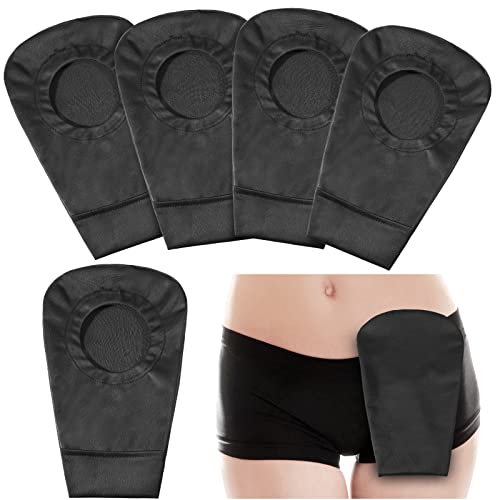
4 Pcs Black Ostomy Bag Cover, Ostomy Pouch Cover, Odor Control Stretchy Bag, Washable Pouch Liner for Women Men

Because a bare plastic pouch shows through clothes, and gets hot and sweaty against skin.

The pouch cover

Jutom Fabric Ostomy Pouch Cover (4-Pack)

A washable fabric sleeve that slips over the pouch — Cleveland Clinic's own patient booklet names this exact product.

  • Cleveland Clinic's own booklet: "Opaque pouches and fabric pouch covers keep the waste from being visible when you are undressed... also makes wearing the pouch more comfortable by reducing heat build-up."
  • Genuinely uncoded — no HCPCS code exists for this category at all, confirmed by a full search of the federal billing-code file. Medicare has no mechanism to pay for this, ever.
  • 4-pack, washable, so there's always a clean one while another is in the wash.

The count: We checked two fabric pouch-cover options; this 4-pack is the closest to the plain, opaque style Cleveland Clinic's booklet describes — the alt below doubles the pack size in assorted colors for $8 more.

One flaw (not a dealbreaker): Purely a comfort and discretion layer — it doesn't change how the pouch itself seals or drains.

Also good: 8-pack, assorted colors ($19.99)

Hollister 7717-EA m9 Odor Eliminator Drops, Unscented, Bottle, 8 oz

Because everyday confidence runs on odor control — and it's less automatic than you'd think.

In-pouch odor control

Hollister m9 Odor Eliminator Drops

A few drops in the pouch at each change — the surprise here is that Medicare actually has a billing code for this.

  • UOAA's own Odor Control page describes exactly this: liquid drops placed in the pouch when you first put it on.
  • Real HCPCS code A4394 was billed 2.27 million times in 2024 alone — though most people simply buy a bottle out of pocket rather than route a few-dollar item through a DME claim.
  • Unscented, 8 oz bottle from Hollister, one of the two largest ostomy-supply manufacturers in the U.S.

The count: We checked two 8 oz odor-drop options, same size and function — the alt below is nearly $12 cheaper for the identical use case.

One flaw (not a dealbreaker): This is the in-pouch, all-day version — for emptying away from home, see the travel spray next.

Also good for less: same 8 oz size, different brand ($14.99)

See the deodorant coverage surprise in full →

Hollister 7732 m9 Odor Eliminator Spray, Unscented, 2 oz Bottle

Because emptying the pouch away from home is a different problem than what goes in it at home.

Travel odor spray

Hollister m9 Odor Eliminator Spray (2 oz, Travel Size)

Small enough for a pocket or bag — Cleveland Clinic's own booklet suggests carrying exactly this.

  • Cleveland Clinic's own patient booklet: "If you are concerned about odor, you can carry a pocket-sized room deodorizer spray."
  • UOAA independently describes spray deodorants used "when emptying the pouch, especially when emptying outside of the home."
  • A genuinely different product from the in-pouch drops above, not a substitute for them.

The count: Two independent sources — Cleveland Clinic and UOAA — both describe this exact travel-spray use case in nearly identical terms.

One flaw (not a dealbreaker): A room/toilet-bowl spray, not something you put inside the pouch — see the drops above for that.

For any colon surgery — with or without a stoma

This one item, and one honest fact about timelines, apply either way.

Frida Mom Belly Binder, Postpartum Essentials for Natural and C-Section Recovery, Adjustable Compression Wrap, After Birth Brace, Abdominal Band, 9" High

Because a wide compression wrap gives your incision extra support when you're up and moving.

The abdominal binder

Frida Mom Belly Binder

A three-point adjustable wrap you can tighten more over the incision as swelling changes — useful for any midline abdominal incision, not just this brand's own postpartum framing.

  • No hospital source fetched specifically for colon-resection surgery (MSKCC's 62-page booklet, Oregon Surgical Specialists) mentions a binder by name — an honest gap. This reuses a pick built for c-section recovery, where a Cleveland Clinic ob-gyn recommended one for the same mechanism: support across sutures.
  • A 2023 academic review (PMC10187592) found the clinical evidence for abdominal binders is genuinely mixed — worth trying, not a guaranteed fix.
  • Three-point adjustable strap, fits 29"–46" waist.

One flaw (not a dealbreaker): The packaging and copy are explicitly postpartum-branded ("Postpartum Essentials") — a mismatch for a mixed-gender, non-postpartum audience. The alt below is the same idea in plain clinical styling, at $7 less.

Also good: gender-neutral clinical styling, no postpartum branding ($21.99)

Lifting limits — two different timelines

Without a stoma: Memorial Sloan Kettering and UMass Memorial both say 10 lb for 6 weeks; Oregon Surgical Specialists says 5–10 lb for 4–6 weeks ("a gallon of milk weighs just over 8 pounds"). With a new stoma: Cleveland Clinic's own patient booklet gives a longer window — heavy lifting, especially in the first three months, could cause a parastomal hernia.

Two genuinely different numbers for two different situations, not one flattened rule — ask your own surgeon which applies to you. Full sourcing and the driving/return-to-work timelines for both populations are on the recovery-timeline page.

Source: MSKCC, UMass Memorial Health, Oregon Surgical Specialists, Cleveland Clinic Foundation

Borrow or skip

The honesty section — what this recovery doesn't need, according to the sources themselves.

  • Skip a walker, cane, or crutches. No source fetched for either population mentions any leg-mobility restriction — MSKCC and UMass Memorial both explicitly encourage regular walking as part of recovery.
  • Never buy a pouch, wafer, or skin barrier for yourself. Your WOC nurse and DME supplier set this up before you leave the hospital — a generic one risks the wrong fit. See the scope note above the essentials.
  • Skip a seatbelt-guard product. An ordinary seatbelt, adjusted, is safe and sufficient per Cleveland Clinic's own patient booklet — no special product needed.
  • The incentive spirometer is hospital-supplied. MSKCC's own booklet: "Your nurse will give you an incentive spirometer." Not something to add to a shopping list.
  • Loose, soft clothing already covers you. UMass Memorial's own instructions ("wear soft, loose clothing... rough or tight clothes may rub against your incision") resolve this without a new purchase — most people already own something that qualifies.
  • Swimming and most sports are fine with an ostomy. UOAA, independently: "With a securely attached pouch one can swim and participate in practically all types of sports." Caution (and the belt above) is for heavy body-contact sports specifically.

How we know this

Every recommendation above has to survive independent checks. None of them is our opinion.

  1. Medicare’s own data. Whether the item is covered, what it pays, and how many were billed nationally — from the CMS DMEPOS fee schedule, the HCPCS Level II file and DY2024 utilization, queried directly rather than through a third party’s summary. Published as an open dataset.
  2. Named hospital instructions. Clinical claims are quoted from a named institution’s own discharge or patient-education material and linked, never paraphrased into fact. Where sources disagree, the page says they disagree instead of picking one.
  3. Published outcome research. What actually goes wrong after ostomy surgery is well documented: a clinical review of postoperative stoma care, a review of 23 studies of peristomal skin complications, and a review of the fluid physiology behind high-output ileostomies. Every figure on this page that describes what happens during recovery — when pain rises, when the wound changes, what the evidence says about diet — comes from one of these, cited inline and linked to the paper rather than summarised from memory.

What that research is and is not. These are studies of what happens to patients after this operation — how the wound heals, how pain moves, what changes outcomes. They are not a substitute for your surgeon's instructions, and this page never tells you what treatment to have. Where a study's finding and your discharge sheet disagree, follow the discharge sheet and ask the question at your follow-up.

Our datasets are published under CC BY 4.0 — see the rest of our datasets. More about who writes this and how →

Go deeper

Two follow-up pages cover what comes up next — the full coverage story, and the activity/driving timelines for both populations.

This is an equipment and cost-coverage guide, not medical advice. It doesn't cover wound care, stoma-fitting decisions, ostomy pouch/wafer selection, or any other instruction that should come from your surgeon, WOC nurse, or care team — follow their discharge instructions over anything here. Recovery timelines genuinely vary by surgery type (with or without a stoma, laparoscopic vs. open) and surgeon.
See the full printable checklist — every item, both populations ↓

Everything on this hub, in one list — the four ostomy essentials, the one shared item, and what to skip. This is what prints when you use the button up top.

The full colorectal-surgery / ostomy recovery checklist
ItemWho needs itStatusMedicare
Support / hernia belt New ostomy Buy Category coded (A4367/A4396)
Fabric pouch cover New ostomy Buy No code exists
In-pouch odor drops New ostomy Buy Category coded (A4394)
Travel odor spray New ostomy Buy Not separately coded
Abdominal binder Either population Buy (optional) Not billed
Ostomy pouch, wafer, skin barrier New ostomy Ask your WOC nurse — do not self-select Covered, 87 codes — see Medicare page
Incentive spirometer Either population Hospital-supplied N/A
Loose, soft clothing Either population Already own N/A
Seatbelt guard New ostomy Skip — ordinary seatbelt is safe N/A
Walker, cane, or crutches Either population Skip — no restriction found N/A

What Medicare actually pays for

The coverage story

Medicare covers ostomy pouches, skin barriers, paste, rings, and belts under 87 separate billing codes — 85 of the 87 carry real, priced July-2026 fee-schedule allowances, with monthly quantity limits set by a federal coverage policy (LCD L33828), not guesswork: 20 pouches a month, 20 skin barriers a month, one basic belt a month.

DY2024 national utilization confirms these are real, heavily-billed codes, not paper categories: the skin barrier alone (A4362) was billed 3.3 million times to 35,186 beneficiaries in a single year.

Source: Medicare Coverage Database, LCD L33828 (Ostomy Supplies)

The surprise, reversed

Two items this hub's own task brief assumed were retail-only turn out to have real Medicare billing codes: a basic ostomy belt (A4367) and even ostomy deodorant (A4394, billed 2.27 million times in 2024). Meanwhile, fabric pouch covers and a travel organizer bag are genuinely, confirmedly uncoded — Medicare has no mechanism to pay for either, at any dollar amount.

The specific products on this checklist aren't automatically billed through any of these codes without a doctor's Standard Written Order and a supplier claim — see the full code table, the SWO requirement, and the genuinely-uncoded items on the Medicare page.

Source: CMS HCPCS Level II Jul2026 quarterly file + DMEPOS Fee Schedule Jul2026 (DME26-C)

See every code, every limit, and the SWO requirement →

This page has Amazon links — we may earn a commission if you buy through them, at no extra cost to you. It never changes which product we recommend. See our methodology.

Sources

  1. NIDDK (NIH), "Definition & Facts for Ostomy Surgery of the Bowel" — source of the ~100,000 ostomy surgeries/year figure; last reviewed June 2021, fetched live 2026-07-30
  2. United Ostomy Associations of America (UOAA), "What is an Ostomy?" + "Colostomy Facts" + "Odor Control" + "Product and Supply Information" — source of the 725,000–1,000,000-living-with-an-ostomy figure, the belt/sports rationale, the odor-control product forms, and the pouch/wafer scope-wall finding; fetched live 2026-07-30
  3. Cleveland Clinic, "Colostomy: What It Is, Bags, Surgery, Types & Care" — source of the parastomal-hernia and skin-irritation clinical framing
  4. Cleveland Clinic Foundation, "Having a Colostomy" (patient education booklet, PDF) — source of the fabric pouch-cover, travel-spray, seatbelt, and 3-month hernia-lifting quotes; text-extracted live 2026-07-30
  5. UMass Memorial Health, "Discharge Instructions for Total Abdominal Colectomy" — non-ostomy lifting/driving/clothing instructions; syndicated WebMD Ignite content on a hospital domain, disclosed as such
  6. Oregon Surgical Specialists, "Colon Resection Surgery for Diverticulitis" — private-practice source, disclosed as such; source of the 5–10 lb/gallon-of-milk lifting comparison and the laparoscopic-vs-open return-to-work distinction
  7. Memorial Sloan Kettering Cancer Center, "About Your Colon Resection Surgery" (patient education PDF) — the richest non-ostomy source — 62 pages, zero mentions of "ostomy," confirming this is the non-stoma population's own dedicated hospital resource; text-extracted live 2026-07-30
  8. Medicare Coverage Database, LCD L33828 "Ostomy Supplies" — source of the 87-code count, the quantity-limit table, and the SWO/documentation requirements; revision effective 01/01/2024, fetched live 2026-07-30
  9. CMS HCPCS Level II quarterly file, July 2026 release — code descriptions for all 87 ostomy-related codes checked
  10. CMS DMEPOS Fee Schedule, July 2026 release (DME26-C) — fee ranges cited throughout, including the belt (A4367/A4396) and deodorant (A4394/A4395) surprise findings
  11. CMS DMEPOS utilization by Geography and Service, DY2024 — national claim counts; live data.cms.gov API
  12. Agency for Healthcare Research and Quality (AHRQ), HCUP Statistical Brief #186 — context stat only (305,900 colorectal resections, 2012) — a different, broader metric than the ostomy-specific 100,000/year figure above; not conflated on this page
  13. data/coverage_status.json (68 HCPCS codes, lower-extremity DME set) — confirmed zero of the site's 68 tracked codes apply here — the 87-code ostomy finding above comes from a separate, hub-specific LCD pull
  14. Amazon Creators API — live product search/detail lookup for every new pick above — ASIN, price, and image, each stamped with the date captured
  15. CPSC SaferProducts.gov + data/recalls.json — checked for every new category and ASIN above — zero hits for all three new gear categories
  16. VerifiedCareData dataset.json (CC-BY-4.0) — every coverage fact above in one machine-readable endpoint