The 5 Things to Buy Before Shoulder Replacement Surgery

Five things, one order, and your home is ready — you’ve got this.

Covers total shoulder replacement — anatomic and reverse (rTSA). Rotator cuff repair has its own page.

Before the list: this basket is almost identical to what we recommend for rotator cuff repair — and there's no honest reason to pretend otherwise. All five picks below trace back to the same total-shoulder discharge guide, re-verified live today, same prices within a few dollars. What's genuinely different about shoulder replacement is below the picks: reverse replacement's own dislocation precaution, a much more Medicare-heavy patient population, and a real story about where this surgery gets billed that rotator cuff repair never has.

For weeks after this surgery the operated arm won’t lift, reach overhead, or bear weight — and if you had a reverse replacement, there’s one specific movement to avoid too (more on that below the picks). These five cover the same ground rotator cuff repair does, because the equipment need really is the same; what’s different here is who’s having this surgery and how it gets billed. Plan on roughly $105–115 for all five, as of August 2026 (always check current prices on Amazon) — and if surgery’s close, order today, since most items arrive within a few days.

Every pick here was re-verified live today, and checked against two hospitals’ own reverse-TSA rehab guidelines, AAOS’s official patient guidance, a Medicare-claims study, and federal recall records — how we choose →

The 5 essentials

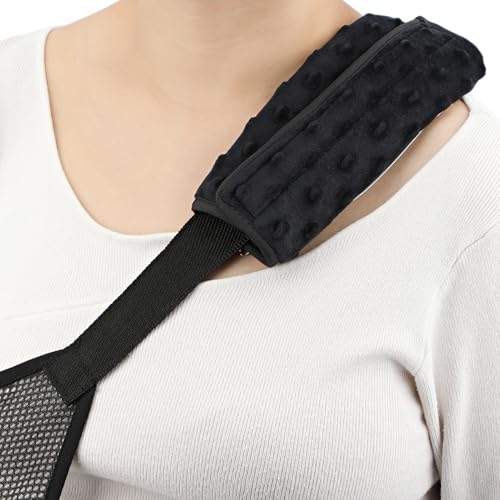
BNRendles Cushioned Arm Sling Neck Strap Pad

Because the free sling's strap digs into your neck for weeks — longer than rotator cuff repair if your reverse replacement included a tendon transfer.

The sling pad

BNRendles Arm Sling Neck Pad

Slides over the strap where it crosses your neck — the thin factory pad isn't enough for weeks of wear.

  • Velcro-on sleeve, no tools, fits over any standard sling strap.
  • Brigham and Women's Hospital's own reverse-TSA guideline: sling worn "at all times except with HEP and bathing," generally 4 weeks (up to 6 with a tendon transfer or subscapularis repair).
  • The same pick, same rationale, as our rotator cuff repair page — reused deliberately, not re-invented.

The count: We checked two sling-pad options for this hub — the same two verified for rotator cuff repair. The sling itself was never a candidate: it's hospital-provided, per OHSU's and Brigham and Women's own guides, so this pad is the actual purchase decision here, not the sling.

One flaw (not a dealbreaker): Doesn't fix a sling that fits badly to begin with — if the strap itself feels wrong, not just uncomfortable, ask your care team before adding padding.

Also good, and cheaper today: minky-dot fabric with adjustable fill ($9.99, verified live — currently less than the pick above)

NEWGO Shoulder Ice Pack, Rotator Cuff Cold Therapy Wrap

Because ice needs to hug a shoulder, not a knee — and this site's other gel packs are shaped for the wrong joint.

The ice wrap

NEWGO Shoulder Cold Therapy Wrap

Wraps around the shoulder itself — on with one hand, since the other arm's in a sling.

  • One-handed application with wide-tab fasteners — 'no reaching behind your back,' per the listing.
  • Stays cold about 45 minutes per application, per the listing.
  • OHSU's discharge guide has total-shoulder patients icing 15 minutes, five times a day.

The count: Same pick as rotator cuff repair, re-verified live today. We checked it after first confirming the site's existing knee gel packs don't fit here at all — their own listing is titled 'for Knee.'

One flaw (not a dealbreaker): Costs more than a flat gel pack — you're paying for the anatomical shape and the one-handed strap, not a different cooling technology.

Also good for less: Chilmax shoulder wrap ($20.89)

Bekweim Adjustable-Height Bed Wedge Pillow, 12 Inch

Because if you had a reverse replacement, lying flat can put your shoulder in exactly the position the precaution below tells you to avoid.

The sleep wedge

Bekweim Adjustable Bed Wedge Pillow

Props your whole upper body, not just your head — so your elbow stays visible, not tucked behind you.

  • One solid foam wedge, not a multi-piece set — less to arrange at 11pm.
  • Brigham and Women's Hospital's own reverse-TSA guideline: "the humerus/elbow complex should be supported by a pillow or towel roll to avoid shoulder extension... always be able to visualize your elbow while on your back."
  • 12-inch adjustable incline, sized to prop the whole upper body, not just the head.

The count: Same wedge as rotator cuff repair, re-verified live today — but the citation is genuinely stronger here: BWH's positioning quote ties this pick directly to the dislocation-precaution mechanics of a reverse replacement, not just general sleep comfort.

One flaw (not a dealbreaker): No HCPCS code exists for a sleep-positioning wedge, so Medicare never pays toward it — same as everything else on this list.

Also good: 3-piece adjustable set if a fixed wedge doesn't sit right ($36.98)

Read the full dislocation precaution →

Deyeek Post Shoulder Surgery Shirt, Men's, Side-Snap Tearaway

Because pulling a normal shirt overhead — or tucking one in — is exactly what the dislocation precaution tells reverse-replacement patients not to do.

The adaptive shirt

Deyeek Side-Snap Tearaway Shirt

Snaps open flat down both sides and sleeves — goes on without lifting or reaching behind with the operated arm.

  • Full side-snap opening — no overhead lift, no reaching behind the back to get dressed.
  • Brigham and Women's own FAQ names "tucking in a shirt" as one of the specific everyday activities to avoid after reverse replacement — a sharper, safety-grounded reason to own one of these than general dressing difficulty.
  • Also sold in a women's cut (same design, different fit).

The count: Same shirt as rotator cuff repair, re-verified live today — but the citation is new and stronger: this is now tied to a named dislocation-avoidance ADL, not just 'hard to dress with one arm.'

One flaw (not a dealbreaker): You'll likely only need this for a few weeks — buy one or two, not a wardrobe's worth.

Also good: women's cut, full snap-open arm ($14.99)

Xpand No Tie Elastic Shoe Laces for Sneakers

Because tying a shoelace takes two hands, and one of yours is in a sling.

The slip-on laces

Xpand No-Tie Elastic Shoelaces

Turns any lace-up shoe into a slip-on — the same fix knee and hip patients use, for a different reason.

  • Stretches to fit, no tying — the operated arm can't help.
  • Works on sneakers and most lace-up walking shoes.

The count: Reused from the knee, hip, and rotator cuff repair hubs' own verified pick, re-checked live today — the product transfers directly across every hub on this site.

If you had a reverse replacement

AAOS's own page says this is most shoulder replacements now — read this before you plan on furniture to push yourself up.

The precaution

Reverse total shoulder replacement now makes up the vast majority of shoulder replacements done in the U.S. — and it carries a dislocation precaution rotator cuff repair never has.

Two hospital rehab guidelines — Brigham and Women's Hospital and University Hospitals Cleveland — independently put the window at 10 to 12 weeks: avoid the combined motion of shoulder extension, adduction, and internal rotation (reaching behind your back or hip). AAOS's own "Do's and Don'ts" list names the everyday version: no tucking in a shirt, no reaching into a back pocket, no pushing yourself up out of a chair or bed with that arm.

Source: AAOS OrthoInfo, "Reverse Total Shoulder Replacement"

That's a direct, hospital-named reason two of the five picks above matter more than they might look. The adaptive shirt exists because Brigham and Women's own FAQ names "tucking in a shirt" as one of the ADLs to avoid. The sleep wedge exists because BWH's positioning instruction — keep your elbow visible while lying on your back — is written specifically to avoid the extension part of this precaution, not just comfort.

Worth knowing, not a recommendation: no hospital source we found — for this hub or the rotator cuff repair hub — tells shoulder patients to buy a raised seat or furniture riser. We're noting it anyway because AAOS's and BWH's own words connect directly: if you can't "push yourself up out of a chair," a chair that starts a few inches higher means less distance and less push-off force needed from your good arm and legs. That's our own reasoning from their instructions, not a hospital recommendation — and it cuts both ways. A toilet seat or chair built for two-handed push-up support works against this same precaution, since the point is to avoid loading the operated arm at all, not give it a better lever. If it still sounds useful: the riser we'd point you to ($19.99, re-verified live today) — most people won't need it.

Read the full precaution — what to avoid, for how long, and why →

Recovery tip: AAOS's own patient page tells people to go through the house before surgery and move anything they'll need onto low shelves — "for the first several weeks... it will be hard to reach high shelves and cupboards." Do this the week before, not the morning of.

Optional extras

Two more, and neither is essential for everyone — the honest read on each.

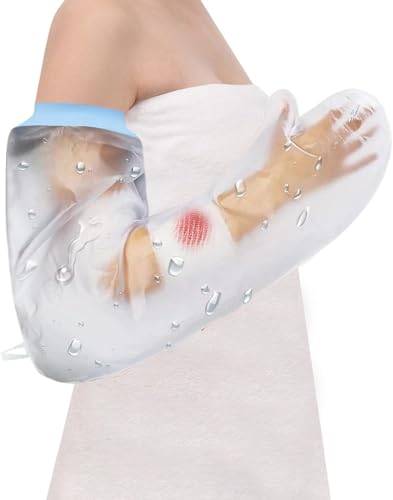
CureSquad Waterproof Full-Arm Cast/Dressing Shower Cover

Because the sling comes off for showers — it's your dressing, not the sling, that needs to stay dry.

Arm/dressing shower cover

CureSquad Waterproof Arm Shower Cover

A silicone sleeve that seals around the upper arm — useful for the few days before your dressing can get wet.

  • Two hospital sources independently say the sling comes off to shower — this protects the incision underneath, not the sling.
  • OHSU: dressings stay dry until a pain block comes out, about 3 days; no baths or pools until roughly 6 weeks.
  • Re-verified live today: in stock at $9.99, down from $13.97 when the rotator cuff repair page last checked it.

One flaw (not a dealbreaker): Most people don't need this past the first few days — once your dressing is cleared to get wet, a normal shower is fine.

Also good for less: budget alt, standard-length coverage ($8.99)

Blue Jay 32" Reacher Grabber Tool for Seniors, 2 Pack - Sturdy Non-Folding Pick Up Stick with Magnetic Tip

Because for shoulder replacement specifically, AAOS gives this a stronger case than it has for rotator cuff repair — but it's still not one of the five essentials.

Reacher / grabber (optional)

Blue Jay 32" Reacher (2-Pack)

AAOS's own advice: move high-shelf items down before surgery. A reacher covers whatever you miss.

  • AAOS's own page: "For the first several weeks after your surgery, it will be hard to reach high shelves and cupboards. Before your surgery, go through your home and place any items you may need afterward on low shelves."
  • Still your legs and other arm doing the reaching in most cases — this is the backup, not the plan.

Recovery tip: The sling doesn't have to stay on all day. OHSU's own discharge guide says you can take it off once you're sitting down — as long as your upper arm stays close to your body — and it comes off for bathing and exercises too.

Borrow or skip

The honesty section — what this surgery doesn't need at all.

The coverage record

None of the core items on this checklist are billed through the Medicare DME fee schedule this site tracks — same finding as rotator cuff repair. There's no code for a sling, an ice wrap, an adaptive shirt, or a sleep wedge.

What's different for shoulder replacement isn't the equipment — it's the surgery itself. See the Medicare page for the site-of-care shift and the 3-day rehab-facility rule, a genuine Medicare story rotator cuff repair never has.

Source: data/coverage_status.json (68 HCPCS codes)

  • Borrow a recliner first, and try it before you buy a wedge. Same doctrine as every hub on this site — most people only need the incline for a couple of weeks.
  • Skip buying a walker, cane, raised toilet seat, shower chair, or commode entirely. None of it applies by default. You'll be fully mobile on your legs — the only thing not working is one arm. The furniture-riser aside above is a narrow, disclosed exception, not a reversal of this rule.
  • If you already use a walker or cane for another reason, expect not to be able to use it for weeks. A walker or cane requires bearing weight through both arms — exactly what neither an anatomic nor a reverse replacement lets you do at first. Line up other help getting around, especially in the first days.

Go deeper

Two follow-up pages cover what actually differs about this surgery — the coverage story and the reverse-TSA precaution.

This is an equipment and cost-coverage guide, not medical advice. It doesn't cover physical therapy, weight-bearing status, or any other instruction that should come from your surgeon or care team — follow their discharge instructions over anything here. Whether you had an anatomic or reverse replacement, and any precautions specific to your own surgery, genuinely vary by surgeon and technique.
See the full printable checklist — every item on this hub ↓

Everything on this hub, in one list — what the hospital gives you, the five essentials, and the two situational picks. This is what prints when you use the button up top.

The full shoulder-replacement checklist
ItemCategoryStatus
Sling Provided Hospital-provided
Sling comfort pad Essential Buy
Shoulder-shaped ice wrap Essential Buy
Torso incline sleep wedge Essential Borrow recliner first
Adaptive snap-side shirt Essential Buy
Slip-on shoes / elastic laces Essential Buy
Waterproof arm/dressing shower cover Depends on your situation Optional
Reacher / grabber Depends on your situation Optional
Furniture riser (reverse TSA, disclosed low-confidence aside) Worth knowing, not a recommendation Only if it sounds useful
Walker, cane, toilet seat, shower chair, commode None of it applies Skip
What Medicare pays

Medicare's DME fee schedule covers almost nothing for the equipment on this list — but a real Medicare story exists for the surgery itself.

55,166 Medicare fee-for-service total shoulder arthroplasty cases were identified in just five calendar quarters (O'Donnell et al., 2024). Even after CMS approved outpatient billing in January 2021, only 38% of those cases were outpatient by 2022 — most Medicare patients still get admitted, and a shorter stay can leave some short of the 3-day rule for rehab-facility (SNF) coverage.

Source: O'Donnell EA, et al. J Shoulder Elbow Surg. 2024;33(4):841-849 + Medicare.gov, SNF coverage

See the full site-of-care and SNF-rule breakdown →

This page has Amazon links — we may earn a commission if you buy through them, at no extra cost to you. It never changes which product we recommend. See our methodology.

Sources

  1. Brigham and Women's Hospital, Department of Rehabilitation Services, "Reverse Total Shoulder Arthroplasty Guideline" (PDF) — the richest reverse-TSA-specific source for this hub — dislocation-precaution mechanics, FAQ, positioning, and sling-duration citations; text-extracted 2026-08-05
  2. University Hospitals (UH) Cleveland Medical Center, "Reverse Total Shoulder Arthroplasty Rehabilitation Post-Operative Guidelines" (PDF) — independent second-institution confirmation of the 10-12-week dislocation-precaution window; text-extracted 2026-08-05
  3. AAOS OrthoInfo, "Reverse Total Shoulder Replacement" — "the vast majority" volume claim, the official Do's-and-Don'ts list, and the low-shelf home-prep advice; fetched live 2026-08-05
  4. O'Donnell EA, et al. "Trends and outcomes of outpatient total shoulder arthroplasty after its removal from CMS's inpatient-only list." J Shoulder Elbow Surg. 2024;33(4):841-849. — 55,166 Medicare TSA cases; the 3%-to-38%-outpatient-share finding; fetched 2026-08-05
  5. OHSU Orthopaedics, "Total shoulder arthroplasty patient preparation and recovery guidelines" (PDF) — sling/ice/showering facts, reused from the rotator cuff repair hub's own research
  6. CMS DMEPOS Fee Schedule, July 2026 release (DME26-C) + HCPCS Level II quarterly file — confirms no code exists for a sling, ice wrap, adaptive shirt, or sleep wedge among the 68 codes checked
  7. CPSC SaferProducts.gov + FDA recall databases — checked for every pick above — zero relevant recalls
  8. Amazon product listings (direct live fetch, Chrome UA) — every ASIN/price above re-verified live 2026-08-05; the Amazon Creators API catalog host was DNS-dead this session, same finding research already documented
  9. VerifiedCareData dataset.json (CC-BY-4.0) — every HCPCS code and coverage fact above in one machine-readable endpoint