Hip Replacement Recovery: What You Actually Need

The problem is reach and height, not swelling — and that changes the whole list. Checked against what 277 people who had this surgery actually say.

Many surgeons still ask hip patients to avoid bending much past a right angle, crossing the legs, or turning the leg inward for the first several weeks — though not every surgeon uses those rules, and an anterior approach often carries none. Follow your own discharge sheet over anything here. Either way, what the equipment is for is the same: you can usually put weight on the new hip almost straight away, but getting down to things and back up from them is the part that gets hard. Plan on roughly $150–200 for the core items, as of July 2026.

What patients actually say

We read 1,993 posts from 277 people who had a hip replacement. A reacher or grabber is mentioned by 14% of them, against 3% of the 265 knee patients in our other corpus — and a cold-therapy machine by 12% against knee's 42%.

Those two numbers run in opposite directions, and that is the whole difference between the operations. A knee swells and needs cold; a hip restricts how far you can bend and needs reach. Counts are per person, not per post.

Source: VerifiedCareData hip patient-account corpus v1 — see How we know, below

Every pick here is checked three ways — Medicare’s own coverage and fee data, named hospital instructions, and the patient corpus above — how we choose →

Raise what’s too low

The first thing people change is the height of everything they sit on.

A raised toilet seat is mentioned by 35 of 277 hip patients (13%) — twice the rate in our knee corpus (6%). It is the clearest hip-specific item on this page, and it is temporary: people report handing it back within weeks.

“Also used the actual normal-height toilet seat today instead of the riser.”

— cold_brew, BoneSmart, 2022-07-25

It is also the item most often borrowed rather than bought, which is worth knowing before you order one.

“I borrowed a toilet seat riser and arm handles from my local disability library.”

— Chichi, BoneSmart, 2024-10-16
HealthSmart Enhanced Comfort 5" Raised (Round) Toilet Seat Riser

Because AAOS and HSS both name this first on their equipment lists — and reaching down to check your bowl shape isn't easy right now.

The toilet seat — measure first

HealthSmart Round Toilet Seat Riser

The clamp-on riser that fit either bowl shape is out of stock as of 6 August 2026 — so bowl shape decides the buy now. This is the round-bowl fit; the elongated match is one tap below.

  • 30-second check: about 16–16½" from the mounting bolts to the bowl's front edge means round, about 18–18½" means elongated.
  • $27.99 as of 6 August 2026, 300 lb. weight cap — rests on the existing bowl rim, no tools.
  • Buy the wrong shape and it rocks or won't seat flush — the most common return reason for any raised seat.

The count: Of the five raised-seat options we checked, the only one that fit either bowl shape without measuring — the HealthSmart locking riser — is out of stock as of 6 August 2026. With that option gone, this card leads with the 30-second measurement instead; if you mainly need push-up support rather than extra height, the toilet safety frame below skips the measuring question entirely.

One flaw (not a dealbreaker): Not compatible with elongated bowls — the listing says so outright. Measure first; if your toilet is elongated, use the Carex riser below instead.

“The loo raiser seat has also been amazing, still using it.”

— a BoneSmart forum member, 7 weeks into THR recovery

Elongated bowl? The Carex elongated-fit riser ($38.39 as of 6 August 2026)

See the full raised-toilet-seat comparison →

Sephyroth Adjustable Bed & Furniture Risers, 4-Pack, 2" or 4" Height, Screw-Clamp

Because AAOS names a firm, higher chair as its own equipment line — and your favorite chair might sit too low right now.

Furniture / chair risers

Sephyroth Adjustable Bed & Furniture Risers (4-Pack)

Screw-clamp risers that lock onto a chair, sofa, or bed leg — raises it 2 or 4 inches.

  • Screw-clamp design locks onto square or round legs, 0.8"–1.6" diameter — won't shift once your weight is on it.
  • Choose 2" or 4" of extra height per set of 4.
  • Felt pads on the base protect floors.
Gorilla Grip Patented Bath Tub Shower Mat, Suction Cups and Drain Holes, 35x16 Inch

Because a wet floor and a healing hip are a bad combination — this is the cheap insurance.

Non-slip bath mat

Gorilla Grip Bath Tub Shower Mat

A cheap extra layer of grip under your shower chair or bench.

  • 35" × 16" mat with suction cups and drain holes.
  • Machine washable — stays flat instead of curling up.

Reaching what you can’t bend to get

The tools that exist purely because your hand can no longer get to your foot.

This is the group that separates a hip from a knee. A reacher or grabber is mentioned by 14% of hip patients against 3% of knee patients; a sock aid or dressing stick 7% against 2%; a leg lifter 10% against 3%. Three to five times the rate, on the same forum, in the same years.

“The sock aid and the dressing stick are essential during the early weeks when you have very limited movement.”

— benne68, BoneSmart, 2026-03-25

Two honest counterweights from the same corpus. Plenty of people barely touch theirs —

“Grabber/Reacher: have only used it twice, but can see it is good to have.”

— tanvat, BoneSmart, 2023-04-13

— and the people who did use one constantly tend to say the same practical thing: get two, because you will drop the first one and be unable to pick it up.

“Also got the toilet riser and TWO grabbers because I knew I'd drop one of them.”

— danelady, BoneSmart, 2022-03-30
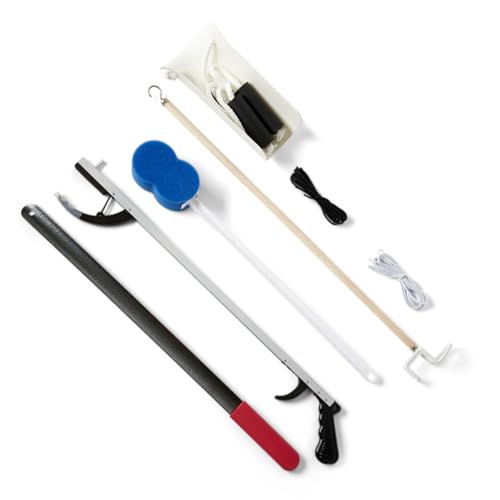
Medline Premium Hip Kit, Mobility Aids for Hip Surgery Recovery, 7-Pieces, 26" Grabber Reacher, Shoehorn, Sock-Aid, Dressing Stick, Shoelaces, Bath Sponge

Because for the first several weeks, bending forward to reach your own feet is exactly the motion most surgeons ask you to avoid.

The hip kit

Medline Premium Hip Kit (7-piece)

Named and built for this exact surgery — not a knee product doing double duty.

  • 7 pieces: 26" grabber reacher, shoehorn, sock aid, dressing stick, elastic laces, bath sponge.
  • 26" reach means you're not bending past the line your surgeon set.
  • $39.99 for all seven vs. $59.91 buying a reacher, sock aid, and shoehorn separately.

The count: We checked four reacher and hip-kit options for this hub; this is the only one that bundles all four pieces that matter (reacher, sock aid, shoehorn, dressing stick) for less than buying them separately — $39.99 here vs. $59.91 for those three alone.

One flaw (not a dealbreaker): Two pieces (elastic laces, bath sponge) you may already have — the reacher, sock aid, shoehorn, and dressing stick are the four AAOS's own hip-replacement equipment list names.

“I found the “hip kits” sold on Amazon to be of great use. The basic one is adequate. I used all and still use the grabber and shoe horn.”

— a BoneSmart forum member, THR recovery thread

Also good for less: the reacher alone if you already have a sock aid and shoehorn ($29.95)

See the full reacher & hip-kit comparison →

RMS Premium Leg Lifter with Hand Strap and Foot Loop, 35 Inch

Because bending forward to grab your own leg is exactly the motion most hip precautions rule out.

The leg lifter

RMS Premium Leg Lifter with Hand Strap and Foot Loop

Some people find a bathrobe belt works just as well — but if bending forward is off the table for you, this is the $9 fix.

  • 35" rigid strap with a metal-rod core — hooks under a foot to lift your leg onto a bed, into a car, or off a wheelchair footrest.
  • Same RMS brand as the sock aid and long-handled shoehorn already on this site.
  • Listed as commonly recommended by physical and occupational therapists for lower-body mobility limits.

The count: We checked two leg lifter straps for this hub — this RMS pick and a 7-inch-longer Nourislif alternative — both using the same rigid-strap-and-loop design. That's a smaller field than most picks on this site because it's a genuinely new category: the knee-replacement hub skips this item on purpose, since knee patients can usually still bend forward far enough to manage without one.

One flaw (not a dealbreaker): One BoneSmart poster called it “unnecessary… the belt of a bathrobe works just as well” — a genuine split opinion, not a must-buy. Try the bathrobe-belt trick first if you're not sure.

“I didn't use the leg lifter stick, but they suggested it in the hospital.”

— a BoneSmart forum member, UK recovery thread

Also good: 7" longer, for a taller bed or car seat ($9.59)

See how it fits into the dressing routine →

Xpand No Tie Elastic Shoe Laces for Sneakers

Because bending down to tie a shoe is off the table for a while.

Elastic laces

Xpand No-Tie Elastic Shoelaces

Turns any lace-up shoe into a slip-on — no bending to tie.

  • Stretches to fit, no tying — your hip can't bend that far yet.
  • Works on sneakers and most lace-up walking shoes.

Getting around: walker, then crutches, then a cane

Hip patients move through walking aids faster than knee patients, and talk about it more.

A walker is mentioned by 50% of the corpus, crutches by 36% and a cane by 46% — every one of those higher than the knee corpus, because most hip patients can put weight on the new joint almost immediately and progress through the aids quickly.

“Anyway was felling pretty good this weekend, had ditched the walker after 3 weeks (doctors orders) and on to a cane.”

— shooter59, BoneSmart, 2025-03-04

The corpus is also clear that the timing is nobody else’s business.

“And there's no medal for ditching walker or cane earlier than anyone else.”

— myglasshalffull, BoneSmart, 2024-12-31

We do not have a verified cane pick yet. A cane is mentioned by 128 of 277 people here — more than any item on this page except a walker — and this site has never researched one: no fitment data, no Medicare check, no live-verified listing. Until it has all three it does not get a card. Ask your physical therapist about height and grip at the session where they clear you for it.

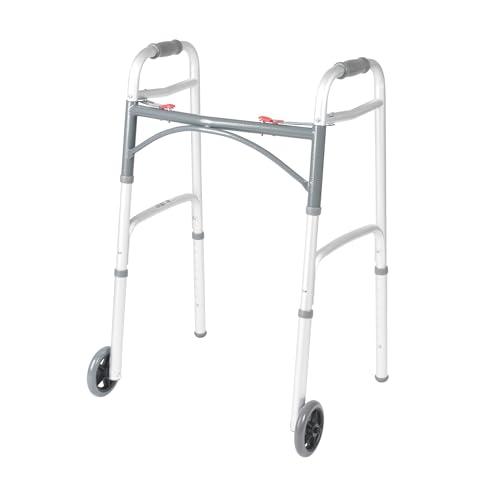
Drive Medical Two-Button Folding Walker with Wheels, Height Adjustable

Because your first steps out of bed need something steadier than your own two legs.

The walker

Drive Medical Two-Button Folding Walker

The standard folding walker most people go home with.

  • Two-button release folds one-handed — no bending to unlock.
  • 350 lb. weight cap, 5" front wheels roll over carpet.
  • Classified E0143 in Medicare's own DMECS walker registry.
  • Walkers came up in 5 of the 31 recovery-forum posts we analyzed — more often as something borrowed than bought new.

The count: We started from the 1,626 walkers in Medicare's own device classification registry (data/dmecs_products.json) and checked 5 folding and rollator options ourselves — this two-button Drive is the only one of the five with no seat, the plain pattern Medicare's E0143 code was built around, not a rollator with extra parts to break.

One flaw (not a dealbreaker): No seat — if you'll want rest breaks mid-hallway, see the rollator options in our walker comparison.

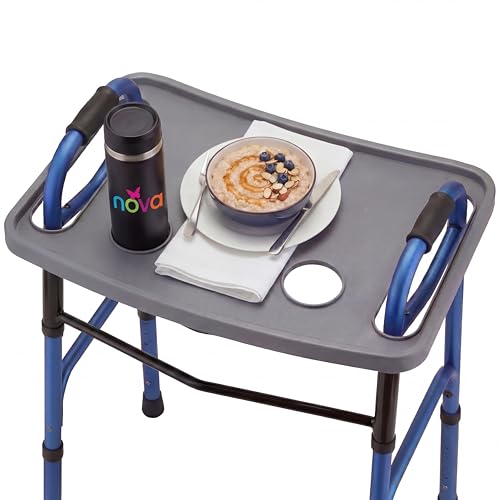
DMI Walker Tray, Rollator Tray with Two Cup Holders, Fits Most Standard Walkers

Because both hands are on the walker, and nothing else gets carried.

Walker tray

DMI Walker Tray

Both hands are on the walker — this is where a drink actually rides.

  • Two cup holders, tool-free assembly, fits most standard walkers.
  • 16" × 11.8" tray — big enough for a plate too.

The bathroom

Depends entirely on your bathroom — measure before you buy any of these.

Lower-rated than you might expect: a shower seat is mentioned by only 6% of hip patients and a commode by 6%. Useful if your shower has a step over a tub wall, or if your only bathroom is up a flight of stairs. Skippable otherwise — and note that Medicare covers none of this category by statute.

Medline Shower Chair with Backrest and Padded Armrests

Because standing and balancing on one leg in a wet shower isn't a safe bet yet — you need something to sit on.

The shower seat

Medline Shower Chair with Backrest

Backrest and arms give you something to push off, not just balance on.

  • 350 lb. weight cap, padded armrests and backrest.
  • Height adjusts in 1" steps, 16"–21", to fit your stall.
  • No Medicare coverage for shower chairs, by law — budget accordingly.

The count: Checked four shower seats in this category; this is the one built for a standard walk-in shower with a full backrest and padded arms — the backless stool skips the back, the tub bench is for stepping over a tub wall, and the bariatric bench costs more for capacity most people don't need.

One flaw (not a dealbreaker): Made for a walk-in shower — if your only bathing option is a tub with a wall to step over, this won't help; see the tub transfer bench instead.

“My large walk-in shower — I wouldn't have been able to climb over a bath.”

— a BoneSmart forum member, 4 weeks post-op THR

Also good for less: backless shower stool ($30.79)

See the full shower-chair & tub-bench comparison →

Drive Medical Tub Transfer Bench for Bathtub, Height Adjustable

Because stepping over a tub wall means lifting a leg past the line your hip precautions set.

Tub transfer bench

Drive Medical Tub Transfer Bench

Sit outside the tub, then slide across — no lifting your leg over the wall.

  • 350 lb. weight cap, dual-column legs adjust in 0.5" steps.
  • Drainage holes and suction-cup feet for a wet tub floor.
  • Classified E0247 in HCPCS — still $0 from Medicare, by law.
Medline Adjustable Steel Drop-Arm Bedside Commode, Portable Bedside Toilet, 350 lb Weight Capacity

Because a hallway that used to take ten seconds can feel like a mile at 2 a.m.

Bedside commode

Medline Adjustable Steel Drop-Arm Bedside Commode

Shortens the bathroom trip — for stairs or a hallway that feels too far at night.

  • 350 lb. weight cap; drop-down arms make a bed-to-commode transfer easier without twisting.
  • HCPCS E0163 — one of Medicare's covered commode codes.
  • Medicare fee runs $60.15–$139.61 with a prescription.

Sleeping on your back

The restriction people find hardest, and the one product answer to it.

Side-sleeping is usually off the table for the first several weeks, and it comes up constantly in the corpus as the thing people most want back.

“All good progress I think, see my consultant at 6 weeks, hopefully I can start bending, twisting & sleeping on my side.”

— Mabel, BoneSmart, 2025-02-19

The standard answer is a pillow between the knees, and it is worth saying that it does not work for everyone.

“Now I’ve tried sleeping with a pillow between my legs, good hip down, but in only a few minutes my operated hip gets so uncomfortable I can’t take it.”

— vansks, BoneSmart, 2024-12-18
NYOrtho Abduction Wedge Knee Separator for Hip Surgery Recovery, 4" Orthopedic Pillow

Because some surgeons prescribe this to keep your hip aligned — but not everyone needs to buy one.

Hip abduction pillow

NYOrtho Abduction Wedge Knee Separator

Ask your surgeon first — if one's prescribed, it's usually supplied for you, not bought.

  • Holds a fixed 4-inch gap between your knees, with an adjustable strap.
  • HSS's own patient materials describe this as surgeon-conditional: instructions on when to use the brace are “provided… by your surgeon.”
  • Some patients buy a soft version just for sleep comfort — one BoneSmart poster used a wedge cushion between the knees for exactly this, separate from any prescribed brace.

What hip patients need less of than knee patients

The other half of the comparison, and the reason not to copy a knee checklist.

A cold-therapy machine is mentioned by 12% of hip patients against 42% of knee patients, and a leg elevation wedge by 11% against 17%. A knee replacement swells hard and people ice it near-constantly for weeks; a hip does not, and the corpus reflects that.

So a plain gel pack is the right starting point here. If you are having a knee done as well, or later, that is when the rent-versus-buy question on a machine becomes worth asking — the knee page covers it.

Magic Gel Hip Ice Pack Wrap

Because hip swelling is real but modest next to a knee's — a plain gel pack shaped for a hip covers it, and most people here never buy a machine.

The ice pack

Magic Gel Hip Ice Pack Wrap

Curved for the hip, not adapted from a knee wrap — two straps hold it in place hands-free.

  • Anatomically curved to hug the hip and outer thigh, with a strap around the waist and one around the leg.
  • Stays cold about 20 minutes per application, per the listing — freeze a second one so you're never waiting on a refreeze.
  • Designed with an orthopedist for post-surgical inflammation and hip bursitis, per the listing.

The count: The knee-replacement hub's ice pick (REVIX) is contoured for a kneecap — we checked its own listing before reusing anything here and confirmed it's built to 'match up the knee cap.' Rather than disclose a shape mismatch on this hub, we searched for and verified a hip-specific alternative instead; this is the one we'd buy.

One flaw (not a dealbreaker): No continuous cold — you're swapping packs from the freezer, the same tradeoff as any gel pack against a machine.

“An ice pack or two are essential”

— a BoneSmart forum member, 7 weeks into THR recovery

Already own a knee-shaped pack? It still works here — the REVIX pack, just built for a different joint

See the full ice-therapy comparison →

How we know this

Every recommendation above has to survive independent checks. None of them is our opinion.

  1. Medicare’s own data. Whether the item is covered, what it pays, and how many were billed nationally — from the CMS DMEPOS fee schedule, the HCPCS Level II file and DY2024 utilization, queried directly rather than through a third party’s summary. Published as an open dataset.
  2. Named hospital instructions. Clinical claims are quoted from a named institution’s own discharge or patient-education material and linked, never paraphrased into fact. Where sources disagree, the page says they disagree instead of picking one.
  3. 1,993 posts from 277 people who had this surgery, across 216 threads on the BoneSmart Joint Replacement Patient Forum, December 2011 to August 2026. Counted per person rather than per post, so the handful of very prolific posters cannot distort a total. Excerpts are short, attributed, and linked back to the thread they came from.

What that corpus is not. People who post on a recovery forum are self-selected — more prepared than average, and often posting because recovery is going badly. The counts are a floor, not a census: someone can use a walker for six weeks and never write the word. And a mention is not an endorsement — we count who raised a thing, then read the posts to see what they said about it. Whether an item was recommended or rejected is read by a person, because pattern-matching that judgement was tested and got it wrong.

The corpus is published in full at /data/patient-corpus-hip-v1.json under CC BY 4.0, alongside the rest of our datasets. More about who writes this and how →

Go deeper

Two follow-up pages cover the questions that come up most for this surgery specifically — Medicare's fine print, and getting dressed under hip precautions.

This is an equipment and cost-coverage guide, not medical advice. The hip-precaution framing above summarizes what hospital patient-education materials say in general terms — it doesn't cover weight-bearing status, physical therapy, or any instruction that should come from your surgeon or care team. Precautions genuinely vary by surgeon and surgical approach; follow your own discharge instructions over anything here.
See the full printable checklist — all 25 items, every phase ↓

The complete before-surgery / week-1 / weeks-2–6 timeline, with every item's coverage flag and HCPCS code. This is what prints when you use the button up top.

Covered w/ Rx Medicare Part B typically pays toward this with a doctor's order (20% coinsurance + Part B deductible apply; supplier must be Medicare-enrolled).
Buy Not billed as DME under Medicare -- bought retail.
Rent Usually rented short-term rather than bought or billed to Medicare.
Borrow — check recall Commonly borrowed secondhand -- check the model/brand against the CPSC recall list before use.
The full 25-item hip-replacement checklist
ItemCategoryPhaseFlagHCPCS
Hip kit (7-piece bundle) Dressing Before surgery Buy
Folding wheeled walker Getting around Before surgery Covered w/ Rx E0143
Raised toilet seat Bathroom Before surgery Buy E0244
Shower chair or bench Bathroom Before surgery Buy E0240
Tub transfer bench Bathroom Before surgery Buy E0247
Toilet safety frame Bathroom Before surgery Buy
Non-slip bath mat Bathroom Before surgery Buy
Leg lifter strap Dressing Before surgery Buy
Sock aid (standalone) Dressing Before surgery Buy
Long-handled shoehorn (standalone) Dressing Before surgery Buy
Reacher / grabber tool Dressing Before surgery Buy
Elastic no-tie laces Dressing Before surgery Buy
Hip abduction / knee-separator pillow Sleeping & positioning Before surgery Buy
Hospital bed, semi-electric Sleeping & positioning Before surgery Covered w/ Rx E0260
Portable bed rail Sleeping & positioning Before surgery Borrow — check recall
Ice packs (hip-shaped) Ice & swelling Before surgery Buy
Walker bag, basket, or apron Home setup Before surgery Buy
Portable/adjustable table Home setup Before surgery Buy
Furniture / chair risers Home setup Before surgery Buy
Crutches, underarm (pair) Getting around Week 1 Covered w/ Rx E0114
Recliner / lift chair Getting around Week 1 Covered w/ Rx E0627
Bedside commode Bathroom Week 1 Covered w/ Rx E0163
Dressing stick Dressing Week 1 Buy
Cold-therapy / cryo-cuff machine Ice & swelling Week 1 Rent
Cane Getting around Weeks 2–6 Covered w/ Rx E0100
What Medicare pays

Medicare covers 6 of the 25 items on this hip-replacement equipment checklist with a doctor's prescription.

Every bathroom-safety item on this checklist — shower chairs, tub benches, and raised toilet seats — pays zero Medicare dollars, by law, regardless of prescription.

Source: CMS DMEPOS Fee Schedule, July 2026 (DME26-C) + CMS DMEPOS utilization by Geography/Service, DY2024

See every fee, every code, and the prescription rules →

This page has Amazon links — we may earn a commission if you buy through them, at no extra cost to you. It never changes which product we recommend. See our methodology.

Sources

  1. AAOS OrthoInfo, "Total Hip Replacement" — surgery-volume figure (450,000+/yr) and the equipment list this checklist is built from; fetched live 2026-07-28
  2. Cleveland Clinic, "Hip Replacement Surgery: What It Is & Recovery Time" — the plain-language precaution phrasing used in the intro above; reviewed 07/24/2025, fetched live 2026-07-28
  3. HSS Complex Joint Reconstruction Center patient booklet (PDF) — the exact 90-degree/crossing/rotation precaution wording and the hip-abduction-brace conditional-and-surgeon-supplied language; text-extracted 2026-07-28
  4. HSS newsroom, Dr. Peter K. Sculco (2019) — the contested-precautions research note behind this page's 'not every surgeon uses these anymore' framing
  5. CMS DMEPOS Fee Schedule, July 2026 release (DME26-C) — purchase-fee ranges cited throughout this checklist
  6. CMS HCPCS Level II quarterly file, July 2026 release — code descriptions
  7. CMS DMEPOS utilization by Geography and Service, DY2024 — national claim counts and totals; live data.cms.gov API
  8. Palmetto GBA DMECS Product Classification List (PDAC) — walker HCPCS classification lookups (E0143), live GET requests — full sourcing detail in our methodology
  9. CPSC SaferProducts.gov recall database — 39 adult portable bed rail recalls, deaths mentioned in 6 of them — see Borrow or skip above
  10. Amazon Creators API — live product search/detail lookup for every pick above — ASIN, price, and image, each stamped with the date captured; full verification process in our methodology
  11. VerifiedCareData dataset.json (CC-BY-4.0) — every HCPCS code, fee range, and recall count above in one machine-readable endpoint
  12. Recovery-forum commentary (BoneSmart, AgingCare) — hip/THR-focused threads for this hub — attribution and scope detail in our methodology