What to Buy Before Meniscus Surgery

Two very different recoveries share one name, and what you need depends entirely on which you are having — whether the meniscus was trimmed away or stitched back together.

Ask your surgeon one question before you buy anything: was the meniscus trimmed away, or stitched back together? A repair means weeks on crutches in a braced knee. A trim often means walking out the same day. Same operation name, entirely different shopping list — and, as it turns out, entirely different evidence behind them.

Every pick here is checked against named hospital instructions and the published trial evidence — how we choose →

The 4 shared essentials

Whichever track you're on, every source in this research names these four.

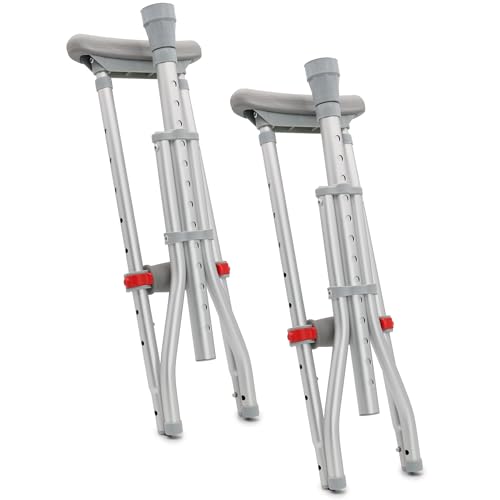
Drive Medical RTL10433 Adjustable Crutches for Walking, Silver

Because every source in this research names crutches for meniscus surgery — whether you're off the leg completely for weeks, or just steadying your balance for a few days.

The crutches

Drive Medical RTL10433 Adjustable Crutches for Walking, Silver

Adjusts at both the height and the handgrip separately — one pair fits a 24-inch height range.

  • Euro-style clips plus a pushpin adjust height and handgrip position independently — most single-SKU crutches only adjust one.
  • Fits a 38.5"–62.5" height range, so most adults don't need a separate size purchase.
  • Classified E0114 in Medicare's own crutches code — covered with a prescription (see the coverage page for what that means if you're not on Medicare).

The count: We checked 2 crutches options for this hub — this Drive Medical pair covers the widest single-SKU height range, so it fits most adults without a second purchase; the BodyMed pair below is the tighter, per-height-sized alternative.

One flaw (not a dealbreaker): One height range fits most adults reasonably, not precisely — if you're notably short or tall, the sized BodyMed alternative below fits closer.

Also good: sized pair for a closer fit ($44.99)

See how long you actually need these, by track →

REVIX Reusable Gel Ice Packs for Knee (2-Pack)

Because every source gives a concrete icing cadence — and this pick is actually shaped for a knee, unlike the bandage-shaped packs some other recoveries get stuck with.

The ice packs

REVIX Reusable Gel Ice Packs for Knee (2-Pack)

Knee-shaped wraps with elastic straps — buy two, so one's always in the freezer.

  • UW's own postop sheet: ice up to 20 minutes every hour for the first 2 days, then taper to 3 times a day for 2 weeks — the same cadence independently echoed by the repair-specific protocols from UW and Mass General Brigham.
  • Freeze-and-swap — no pump, no batteries, nothing to break.
  • UW's sheet separately names an "ice cooling unit" as a real option some patients use instead — not a requirement, just an alternative.

The count: Checked four cold-therapy options on file — three motorized or gravity-fed machines running $99–$200, plus this; it's the only one with nothing to plug in or wind, and UW's sheet lists gel packs and an 'ice cooling unit' as parallel options, not one over the other.

One flaw (not a dealbreaker): No continuous cold — you're swapping packs from the freezer instead of a machine holding a steady temperature.

HOMBYS Leg Elevation Pillow for After Surgery, Knee Replacement & Recovery

Because two separate hospital sources give the identical instruction, almost word for word: pillow under the calf, never under the knee.

The leg-elevation pillow

HOMBYS Leg Elevation Pillow

Raises your leg above heart height — the standard swelling-control setup, cited twice over.

  • 27" × 11.6" × 9" wedge — fits most beds and couches.
  • UW's own sheet: "placing a pillow under your calf and/or ankle... Do NOT place a pillow under your knee as it will keep you from straightening your knee."
  • Mass General Brigham's own repair-specific protocol independently confirms, from a different institution: "Keep your knee straight and elevated when sitting or lying down. Do not rest with a towel placed under the knee."

The count: We've verified one leg-elevation pillow against a live Amazon listing — call this one vetted, not the winner of a field we checked; two independent hospital sources (UW, Mass General Brigham) both give the identical calf-not-knee instruction this pick's own listing already follows.

One flaw (not a dealbreaker): No HCPCS code exists for a wedge or leg-elevation pillow, so Medicare never bills for it under any circumstance — irrelevant either way if you're paying from an FSA/HSA.

Truform 15-20 mmHg Graduated Compression Stockings, Knee High, Unisex

Because UW's own general knee-arthroscopy sheet — not a repair-specific one — puts every patient in thigh-high stockings for two weeks, regardless of which track you're on.

The compression stockings

Truform 15-20 mmHg Graduated Compression Stockings

OTC graduated compression — a reasonable stand-in if your surgeon didn't send you home with a hospital-fitted stocking.

  • UW's own sheet: "You will be given thigh-high compression stockings after surgery... wear these at all times for the first 2 weeks... Alternatively you can use an ace wrap."
  • 15-20 mmHg, closed-toe, unisex sizing.
  • A registered Class II medical device, made in the USA, per the listing's own feature bullets.

The count: Reused from the acl-knee-arthroscopy hub's own build, where this same pick was Track-A-only — that framing came from an ACL-specific postop sheet. This hub's own more directly on-topic source, UW's general (non-ACL) knee-scope sheet, gives stockings to every patient regardless of track, so it's presented as shared here instead.

One flaw (not a dealbreaker): General OTC compression, not a hospital-fitted TED stocking — ask your surgical team if they specifically prescribed one instead. UW's own sheet also lists a plain ace wrap as an accepted alternative for either track, which costs less; common and inexpensive enough that we're not verifying a specific ASIN for it here.

Track A only — if your meniscus was repaired (stitched)

Skip this tier entirely if your surgeon trimmed the tear instead — see the meniscectomy note just below.

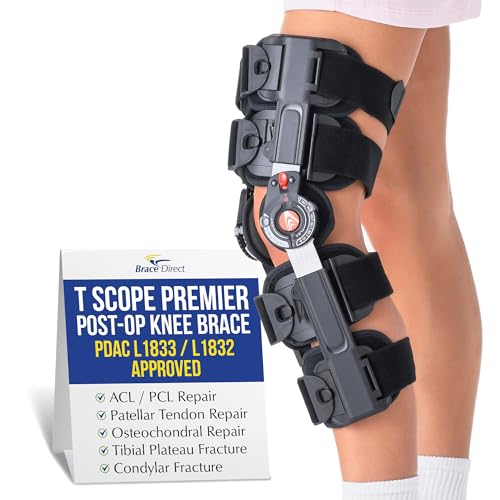
DonJoy 11-2151-9 X-Act ROM Knee Brace, Universal

Because if your meniscus was stitched — not trimmed — your surgeon wants your knee locked straight while you walk, for up to six weeks.

The hinged ROM knee brace

DonJoy 11-2151-9 X-Act ROM Knee Brace

Dial-adjustable hinge locks in extension while you're on crutches, then opens gradually as your surgeon clears more motion.

  • UW's own sheet: "Meniscus repair: you must stay non-weight bearing with brace and crutches. Keep the brace locked in extension when ambulating. You will wear the brace for 6 weeks."
  • Mass General Brigham's own meniscus-repair-specific rehab protocol independently confirms brace-locked, partial-weight-bearing use through the first phase — from a second, separate academic institution.
  • Dial-adjustable flexion/extension stops mean one brace can be reset at each follow-up instead of needing a new one as restrictions ease.

The count: Checked three hinged ROM brace options live for the acl-knee-arthroscopy hub's own build — DonJoy (clinical-tier) and TANDCF (budget) are the two picks added; a third, Breg, was in stock but wasn't added, to keep this a clean quality/budget pair.

One flaw (not a dealbreaker): Ask your surgeon's office first — many patients are issued a hinged brace directly at the hospital or first post-op visit. Confirm before buying a duplicate. The exact week the brace unlocks or comes off also genuinely varies by institution — UW's protocol unlocks around week 4 and discontinues at 6; Mass General Brigham's has you consult your surgeon about unlocking between weeks 3 and 6, with discontinuation after 6 gated on your own function, not just the calendar. Ask your own surgeon for your specific schedule.

Also good for less: same dial-adjustable mechanism ($89.96)

See the full brace-timeline range, by institution →

If your tear is degenerative, read this before you buy anything

Nothing to buy. This operation has something almost no surgery has — a placebo-controlled trial — and the result is worth knowing while you still have a choice.

First, who this section is and is not about. Meniscal tears come in two broad kinds. A traumatic tear happens to a specific knee at a specific moment, usually a younger one, usually with a twist and a pop. A degenerative tear is wear: the meniscus frays over years, and it is extremely common in middle-aged and older knees, including knees that do not hurt at all. This section is about the second kind only. It does not apply to traumatic tears, to meniscal repairs, to younger patients, or to a knee that is genuinely locking or blocked — those are different situations with different answers.

The finding this page is built on

For degenerative meniscal tears, arthroscopic surgery was compared against a SHAM operation — patients taken to theatre and given a simulated procedure. Both groups improved substantially, and the difference between them was not significant: knee scores rose 21.7 points after real surgery and 23.3 points after the sham.

That is the New England Journal of Medicine in 2013, in patients who had a symptomatic degenerative tear but no established knee osteoarthritis. Five years on, the same trial found the surgical group had a slightly higher risk of developing radiographic osteoarthritis with no accompanying benefit on symptoms or function. And a separate randomised trial of 321 people, mean age 58, found exercise-based physiotherapy still noninferior to surgery at five years — its authors conclude physiotherapy should be the preferred treatment.

Source: Arthroscopic partial meniscectomy versus sham surgery for a degenerative meniscal tear, New England Journal of Medicine (2013), PMID 24369076

The most important part of that result is the part people skip. Both groups got substantially better. This is not a finding that people with degenerative tears do not recover — they do, and by a lot. It is a finding that in these trials the improvement did not depend on the trimming. If you have already had this operation and your knee is better, nothing here says otherwise, and there is no reason to read it as a verdict on your own care.

If you have not had it yet, this is a reasonable and specific thing to raise: is my tear degenerative or traumatic, and would a course of physiotherapy be a sensible first step in my case? Sometimes the answer will be no for a good reason — a true mechanical block, a bucket-handle tear, a knee that will not straighten. Your surgeon has your imaging and your examination; a webpage has neither. But it is a question the strongest evidence in this field supports asking, and the trials above are what you would be asking about.
Situational

Depends on your specific setup — not everyone needs these.

Medline Backless Shower Chair with Arms

Because standing one-legged with the brace off — which UW's own sheet says is fine to do — is exactly the moment a fall risk shows up.

Shower stool

Medline Backless Shower Chair with Arms

Something to sit on for the minutes the brace comes off — not universally needed, but worth having if balance is a concern.

  • UW's own sheet: "You may remove it for showering" — the direct basis for this pick, an honest inference from that instruction, not a hospital-quoted "buy a shower stool" line.
  • 350 lb. weight cap, height adjusts in 1" steps.
Vive Fleece Crutch Pads & Hand Grips

Because underarm soreness shows up fast once you're actually using crutches for weeks, not days.

Crutch pads

Vive Fleece Crutch Pads & Hand Grips

A cheap comfort upgrade — makes more sense for Track A's weeks of use than Track B's few days.

  • Slides over the stock foam pad most crutches ship with, plus a washable cover.
  • At $14.99, a sixth the price of buying a whole new pair of crutches.

Bonus comfort

Nobody needs this one, but people find it useful with a brace or crutches in the mix.

Xpand No Tie Elastic Shoe Laces for Sneakers

Because bending down to tie a shoe over a locked-straight brace, or while balancing on crutches, isn't happening.

Elastic laces

Xpand No Tie Elastic Shoe Laces

Turns any lace-up shoe into a slip-on — no bending required.

  • Stretches to fit, no tying.
  • Works on sneakers and most lace-up walking shoes.

Borrow or skip

The honesty section — what this recovery genuinely doesn't need.

  • Skip the knee scooter entirely. A knee scooter works by kneeling the injured leg on a padded platform. But the operated knee here is exactly the joint that's non-weight-bearing or restricted on the repair track — there's no way to kneel on it — and on the meniscectomy track, no source names a need for one at all (immediate weight-bearing makes a scooter pointless). None of the 4 sources in this research mention a knee scooter for either track. Medicare's own closest DME code (E0118, crutch substitute/lower leg platform) also carries zero claims in this site's dataset — a coverage-side signal, not the primary reason, but consistent with it.
  • Skip the raised toilet seat. No hospital source names one. The repair-track brace restricts knee flexion past a set angle and prohibits weight-bearing — not hip flexion or squat depth the way a hip precaution does — so a normal-height toilet isn't itself the problem here.
  • Ask your surgeon's office whether a hinged brace will be issued to you directly, before buying one. Common in practice, though no single source in this research states it as a guaranteed rule — a reasonable question to ask, not a promised freebie.
  • Out of scope for this hub: meniscus transplant. A much rarer, much bigger allograft procedure (usually for patients under 50 with a largely-gone meniscus) that neither Cleveland Clinic nor AAOS gives its own distinct recovery/equipment protocol beyond "the longest recovery of the three." Too small and too undersourced to build an honest tier for here — ask your surgeon if this applies to you.

How we know this

Every recommendation above has to survive independent checks. None of them is our opinion.

  1. Medicare’s own data. Whether the item is covered, what it pays, and how many were billed nationally — from the CMS DMEPOS fee schedule, the HCPCS Level II file and DY2024 utilization, queried directly rather than through a third party’s summary. Published as an open dataset.
  2. Named hospital instructions. Clinical claims are quoted from a named institution’s own discharge or patient-education material and linked, never paraphrased into fact. Where sources disagree, the page says they disagree instead of picking one.
  3. Published outcome research. Degenerative meniscal tears have something almost no operation has: a placebo-controlled surgical trial, plus long-term follow-up and a separate randomised comparison against physiotherapy. All three agree. Every figure on this page that describes what happens during recovery — when pain rises, when the wound changes, what the evidence says about diet — comes from one of these, cited inline and linked to the paper rather than summarised from memory.

What that research is and is not. These are studies of what happens to patients after this operation — how the wound heals, how pain moves, what changes outcomes. They are not a substitute for your surgeon's instructions, and this page never tells you what treatment to have. Where a study's finding and your discharge sheet disagree, follow the discharge sheet and ask the question at your follow-up.

Our datasets are published under CC BY 4.0 — see the rest of our datasets. More about who writes this and how →

Go deeper

Two follow-up pages cover what comes up next — which track you're actually on, and the coverage story for both.

This is an equipment and cost-coverage guide, not medical advice. It doesn't cover physical therapy, weight-bearing status, or any other instruction that should come from your surgeon or care team — follow their discharge instructions over anything here. Whether you had a repair or a meniscectomy is a clinical determination only your surgeon can make.
See the full printable checklist — every item, both tracks ↓

Everything on this hub in one table — which track each item belongs to, and its coverage status. This is what prints when you use the button up top.

The full meniscus-surgery recovery checklist
ItemTrackStatusHCPCS / coverage
CrutchesBothBuyE0114 — covered
Ice (gel packs)BothBuyOut of scope — see coverage page
Leg-elevation wedge pillowBothBuyNo HCPCS code
Compression stockingsBothBuyNo HCPCS code
Hinged ROM knee braceTrack A (repair) onlyBuy — ask firstL1832/L1833 — out of scope
Ace wrapAlternative, either trackMention only — no pick verifiedNo HCPCS code
Shower stoolSituationalBuyNo HCPCS code
Crutch padsSituational / comfortBuyA4635/A4636 — out of scope
Elastic lacesBonusBuyNo HCPCS code
Knee scooterNot applicableSkip — see Borrow or skipE0118 — no claims regardless
The coverage story

This checklist splits younger/FSA-HSA and older/Medicare more evenly than most of our hubs — crutches are covered by Medicare (E0114) and named by item in IRS Publication 502, whichever plan you're on.

The repair track skews younger and more often employer-insured (outer, blood-supplied meniscus tears are more often acute/sports injuries); the meniscectomy track has a real Medicare-age slice (inner, blood-poor tears — which can't be repaired regardless of age — are trimmed more often in degenerative, older-adult cases). Crutches: $57.17–$88.73 a pair, 44,541 claims nationally in 2024. Knee brace L-codes (L1832/L1833) are real but outside this site's 68-code dataset, disclosed honestly rather than guessed.

Source: CMS DMEPOS Fee Schedule, July 2026 (DME26-C) + DY2024 utilization + IRS Publication 502 (2025), checked 2026-08-05

See the full item-by-item coverage breakdown →

This page has Amazon links — we may earn a commission if you buy through them, at no extra cost to you. It never changes which product we recommend. See our methodology.

Sources

  1. Kim S, Bosque J, Meehan JP, Jamali A, Marder R. "Increase in outpatient knee arthroscopy in the United States." J Bone Joint Surg Am. 2011. — the 984,607/nearly-500,000-meniscal-tear volume stat, from 2006 CDC ambulatory-surgery survey data
  2. American Academy of Orthopaedic Surgeons, Plain Language Summary — Clinical Practice Guideline for the Management of Acute Isolated Meniscal Pathology (2024) — the 55-vs-37-days-off-work track-specific stat
  3. University of Washington Dept. of Orthopaedics & Sports Medicine (Dr. Mia S. Hagen), Initial Postoperative Instructions for Knee Arthroscopy (PDF) — the general, non-ACL knee-scope sheet with the internal repair-vs-meniscectomy fork this hub is organized around
  4. Cleveland Clinic, "Meniscus Surgery: Meniscus Repair & Meniscectomy" — the recovery-timeline vs. equipment-list contrast this hub names on-page
  5. AAOS OrthoInfo, "Meniscus Tears" — the red-zone/white-zone anatomy behind why some tears can be repaired and others can't
  6. Mass General Brigham Sports Medicine, Rehabilitation Protocol for Arthroscopic Meniscal Repair (PDF) — independent, second-institution confirmation of the brace/crutches/elevation protocol and the brace-unlock-week variation
  7. IRS Publication 502 (2025), Medical and Dental Expenses — the crutches-named-by-item FSA/HSA citation
  8. CMS DMEPOS Fee Schedule, July 2026 (DME26-C) + DY2024 utilization — crutches E0114 fee range and claim counts
  9. CPSC SaferProducts.gov + data/recalls.json — 0 hits for DonJoy, TANDCF, Drive Medical, Vive, BodyMed on this hub's picks; checked for every item above
  10. Amazon product listings, live-verified 2026-07-30 by the acl-knee-arthroscopy hub's build; re-verification attempted 2026-08-05 — every ASIN above — live re-fetch blocked by Amazon's bot interstitial this session (see build-header disclosure); WebSearch corroboration found no delisting or reprice signal for any pick
  11. VerifiedCareData dataset.json (CC-BY-4.0) — every HCPCS code and fee range above in one machine-readable endpoint