There’s no time to plan ahead — here’s what actually helps, whether you’re shopping for yourself or for someone you love.
By VerifiedCareData · How we check. Last checked .
Covers ORIF (screws, plates, or a rod) and hemiarthroplasty (partial hip replacement) after a broken hip.
Before the list: the gear here is almost identical to what we recommend for a planned hip replacement — same walker, same raised toilet seat, same shower chair, same leg lifter, same abduction wedge, same furniture risers. What’s different is below the picks: there’s no time to shop in advance, the shopping usually falls to a family member instead of the patient, hip precautions are conditional here instead of a near-default, and most people leave the hospital for a rehab facility rather than home. If your surgery was scheduled ahead of time rather than after a fall, that page is the better fit.
More than 300,000 people in the U.S. break a hip every year, most of them 65 or older after a fall at home (AAOS) — and there’s usually no time to plan ahead. Surgery happens fast: Baptist Health’s own patient guide says it’s usually within 36 hours of arrival, and AHRQ’s federal booklet puts it as soon as possible, often that same day or the next. What actually helps is short, and the shopping usually falls to a family member — during the hospital stay, for the ride home, or ahead of a longer facility stay. The six essentials below cost about $246 together on Amazon today.
Every pick here traces to a hospital or federal discharge instruction, cross-checked against this site’s own coverage and recall data — how we choose →
The 6 essentials
Because AHRQ's own federal booklet names this among the first things to ask about — and there's no time to test bowl shapes before surgery.
01The toilet seat
Carex Hinged Round Raised Toilet Seat Riser
The round-bowl fit — a 30-second tape measure tells you if that's what you have. Installs under your existing seat and hinges up for cleaning.
✓AHRQ, verbatim: "A seat for your toilet to raise the height" is one of the first things to ask about.
✓300 lb. weight cap; adds 3.5 inches of height.
✓Fits round bowls only — the elongated match is right beside it if that's your shape.
How we chose it: Each riser we link fits one bowl shape, so this page leads with the round-bowl riser. The elongated match is right beside it.
One flaw (not a dealbreaker): No lock of its own — the listing says so. Check that it sits flat once you're seated, and it fits a round bowl only.
Because standing and balancing on a healing hip in a wet shower isn't a safe bet yet — you need something to sit on.
02The shower seat
Medline Shower Chair with Backrest and Padded Armrests
Backrest and arms give you or a caregiver something to push off, not just balance on.
✓350 lb. weight cap, padded armrests and backrest.
✓Height adjusts in 1" steps, 16"–21", to fit the stall.
✓Baptist Health: no tub baths, hot tubs, or pools until your surgeon approves — but a shower, once cleared, is fine.
How we chose it: We compared four shower seats. This is the one built for a standard walk-in shower, with a full backrest and padded arms. The backless stool skips the back, and the tub bench below is for stepping over a tub wall.
One flaw (not a dealbreaker): Made for a walk-in shower — if the only bathing option is a tub with a wall to step over, get the transfer bench instead.
Because first steps out of a hospital bed need something steadier than a healing hip — but ask before you buy one.
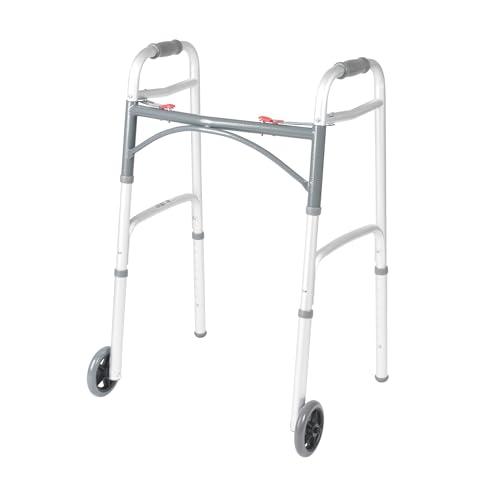
03The walker
Drive Medical Two-Button Folding Walker
Ask the hospital first — Baptist Health's own page says a walker “may be provided when you are discharged home.”
✓Two-button release folds one-handed — no bending to unlock.
✓350 lb. weight cap, 5" front wheels roll over carpet.
✓Classified E0143 in Medicare's own walker classification list (DMECS) — covered with a prescription if you do end up buying one.
How we chose it: The same folding walker we pick for hip and knee replacement. It has no seat, the plain design Medicare's E0143 code was built around. Baptist Health's hip-fracture page is why it says ask first here.
One flaw (not a dealbreaker): No seat — and per Baptist Health, some patients go home with one already provided. Ask before adding this to a cart.
Because Baptist Health gives a specific protocol most people don't know — and a knee-shaped wrap doesn't hug a hip.
05The ice pack
Magic Gel Hip Ice Pack Wrap
Curved for the hip, not adapted from a knee wrap — two straps hold it in place hands-free.
✓Baptist Health, verbatim: "Use cold packs for 20 minutes approximately five times per day... always put a towel between your skin and the cold pack."
✓Anatomically curved to hug the hip and outer thigh, with a strap around the waist and one around the leg.
✓Designed with an orthopedist for post-surgical inflammation, per the listing.
How we chose it: The same ice pack we pick for hip replacement. We looked for a pack shaped for the hip instead of reusing a knee-shaped one, and the same reasoning applies here.
One flaw (not a dealbreaker): No continuous cold — you're swapping packs from the freezer, the same tradeoff as any gel pack against a machine.
80.3% of hip fracture surgery patients (12,568 of 15,655) were discharged to an inpatient care facility — a skilled nursing or inpatient rehab stay — rather than straight home, per a peer-reviewed cohort using national surgical-quality data.
Baptist Health and AAOS both frame home discharge as the norm and a facility stay as the exception for patients with 'extra care needs' — a softer, more reassuring picture than this harder number. Both are accurate: hospital materials are written to reassure a scared family, and a facility stay is often a waypoint on the way home, not a permanent placement. Either way, some of what's on this checklist may end up furnishing a facility room instead of a house.
If you're shopping for the ride home: Baptist Health names a specific detail no planned-surgery guide on this site mentions — plan for “a vehicle that sits low to the ground and has plenty of leg room.” If the bathroom you're prepping isn't on the main floor, both AHRQ and Baptist Health treat grab bars in the shower or tub as part of the setup too — that's a hardware-store or handyman job, not something we sell a pick for.
Depends on your repair and precautions
ORIF and hemiarthroplasty don't carry the same near-default precautions a planned hip replacement does — Baptist Health's own instructions read 'continue hip precautions, if ordered.' These four only matter if that applies to you.
Because if your discharge instructions include hip precautions, bending forward to grab your own leg may be off the table for a while.
The leg lifter strap
RMS Premium Leg Lifter with Hand Strap and Foot Loop
Worth buying only if hip precautions were actually ordered for you — ask your care team first.
✓35" rigid strap with a metal-rod core — hooks under a foot to lift the leg onto a bed, into a car, or off a wheelchair footrest.
✓Baptist Health, verbatim: "Continue hip precautions, if ordered, as taught at the hospital" — conditional here, not the near-default it is after a planned hip replacement.
✓Same RMS brand as the sock aid and shoehorn already on this site.
Because AHRQ's own booklet supports this — but for sleep comfort, not as a surgeon-prescribed brace.
The hip abduction pillow
NYOrtho Abduction Wedge Knee Separator
AHRQ's guidance here is a pillow between the knees for comfort — a weaker claim than the anti-dislocation framing used after a planned hip replacement.
✓AHRQ, verbatim: "Sleep on your back or on the side you did NOT have surgery on... put a pillow or two between your legs."
✓Holds a fixed 4-inch gap between the knees, with an adjustable strap.
✓If your surgeon does prescribe a brace specifically, it's typically supplied for you, not bought.
Because Baptist Health adds a safety note here a planned hip replacement's copy doesn't need to carry.
The leg-elevation pillow
MEGCXIT Leg Elevation Pillow
Elevate with the heel floating off the edge, not resting on it — Baptist Health's own instruction.
✓Baptist Health, verbatim: elevate "with the heel floating over the edge of the pillows" — resting the heel directly on soft pillows "can cause pressure ulcers or bed sores."
✓29" × 17" × 9" foam wedge — the listing says it works in bed or on a sofa.
✓No HCPCS code exists for a wedge or leg-elevation pillow, so Medicare never bills for it either way.
What the hospital sources themselves say you don't need to add to a cart.
The gait belt is hospital-supplied and staff-operated. Baptist Health, verbatim: "a gait belt will be applied any time that you are out of bed" — not a home purchase.
The incentive spirometer is hospital-supplied. Baptist Health: "Use an incentive spirometer five to 10 times per hour while awake to help prevent pneumonia" — used in-hospital, not something you buy for home.
Ask your care team about a stool softener. Baptist Health's own caregiver checklist names "stool softeners and acetaminophen" among things to have on hand — but naming or recommending a specific over-the-counter medication is outside what this site does. That call is between you and your care team.
Grab bars are an installation item, not a product we pick. AHRQ and Baptist Health both name grab bars in the shower or tub as part of home setup — a hardware-store or handyman job, not something with a product page here.
Borrow or skip
What's worth asking about before you buy anything — and what's out of your hands entirely.
Ask before buying a walker. Baptist Health's own page: "Equipment such as a walker may be provided when you are discharged home." Confirm before you add one to a cart.
Ask your surgeon before buying a hip abduction pillow or brace. If one is prescribed, it's typically supplied for you — see the abduction-pillow card above.
A rehab-facility bed can be the actual holdup, not equipment. AHRQ, verbatim: "If you need to go to a rehab center, you may need to wait for an open bed or for insurance to approve it." Ask early — this isn't something you can shop your way around.
Placement coordination is case-manager-led, not a family DIY task. Both AHRQ and Baptist Health describe finding a nursing home, rehab facility, or home-health agency as social-worker/case-manager territory — see the coverage page for the cost side of that decision.
Go deeper
Two follow-up pages — the coverage question that runs the opposite direction from a planned joint replacement, and how the two surgical repairs change what's actually worth buying.
This is an equipment and cost-coverage guide, not medical advice. It doesn't cover weight-bearing status, physical therapy, or any instruction that should come from your surgeon or care team — follow your own discharge instructions over anything here, and talk to your family about who's able to help before you assume equipment alone solves a hard discharge.
See the full printable checklist ↓
Everything on this page, in one list — the six essentials, the four items that depend on your repair and precautions, and what you don't need to buy. This is what prints when you use the button up top.
The full hip-fracture-recovery checklist
Item
Category
Status
Medicare
Raised toilet seat
Essential
Buy
Not covered (E0244)
Shower chair
Essential
Buy
Not covered (E0240/E0245/E0247)
Walker
Essential
Ask first — may already be provided
Covered w/ Rx (E0143)
Bedside commode
Essential
Buy
Covered w/ Rx (E0163)
Hip-shaped ice pack
Essential
Buy
No HCPCS code
Non-slip bath mat
Essential
Buy
No HCPCS code
Leg lifter strap
Depends on your precautions
Buy, only if hip precautions were ordered
No HCPCS code
Hip abduction / knee-separator pillow
Depends on your precautions
Buy, comfort-only rationale
No HCPCS code
Leg-elevation wedge pillow
Depends on your surgery
Buy
No HCPCS code
Furniture / chair risers
Depends on your home
Buy
No HCPCS code
Gait belt
Nothing to buy
Hospital-supplied
Not a purchase
Incentive spirometer
Nothing to buy
Hospital-supplied
Not a purchase
Stool softener / Tylenol
Nothing to buy
Ask your care team
Medication — out of this site's scope
Grab bars
Nothing to buy (installation)
Hardware-store / handyman task
Installed, not bought
Patient lift sling
Ask about — not a default
See the coverage page
Covered w/ Rx (E0621)
The coverage story
A typical 3–5 day hospital stay for hip fracture surgery (Baptist Health) already clears Medicare's 3-consecutive-day qualifying stay for a skilled nursing facility — the opposite risk from a short, increasingly outpatient surgery.
The real coverage question here usually isn't whether you'll qualify for a SNF stay — it's what that stay costs once you're in it, and which items on this checklist Medicare pays toward separately.
This page has Amazon links — we may earn a commission if you buy through them, at no extra cost to you. It never changes which product we recommend. See our methodology.
Baptist Health (Louisville, KY), "Hip Fracture Education" — the 36-hour surgery timing, the family-caregiver checklist, the conditional hip-precautions/WBAT quote, the hospital-stay length, and the leg-elevation pressure-ulcer caveat; read 2026-08-06
Amazon product listings — We check each Amazon price and whether it is in stock every night. A price only shows if it was checked in the last 24 hours.