Two things to buy, one that’s free, and the rest depends which surgery you had — you’ve got this.
By VerifiedCareData · How we check. Last checked .
Covers tennis elbow (lateral epicondylitis) release, cubital tunnel/ulnar nerve release, distal biceps tendon repair, olecranon fracture ORIF, and total elbow replacement — five different surgeries whose first weeks at home look almost identical from a shopping standpoint. What differs by procedure — splint duration, sling use, and how long any lifting restriction lasts — is in the table below. Read it before you assume one timeline fits your surgery.
A splint, cast, or brace is applied by your surgical team — you won’t buy one, whichever of these five surgeries you had. What you actually need to arrange yourself is smaller: ice on a schedule that’s identical across three separate hospital sheets, your arm propped above heart level (free, with pillows you own), and a way to keep the dressing dry in the shower. Today the two things everyone buys come to about $43 on Amazon. If surgery’s close, order today, since most items arrive within a few days.
Every pick here was checked against 10 hospital, academic, and professional-society sources and one nationwide claims study — how we choose →
Before you shop: which surgery did you have? There is no single number here, because there isn’t one. Splint duration, whether you get a sling, and how long any lifting restriction lasts are all different by procedure — especially the last one. Every figure below is a direct hospital-source quote, not a generalized estimate.
Restrictions by procedure — direct hospital-source quotes, not averaged
Procedure
Splint / dressing
Sling
Lifting restriction
Return to activity
Cubital tunnel release
Dressing only, 5–7 days — often no splint at all
Optional, hours only (post-anesthesia)
No heavy work for 1–2 weeks
Days (desk job) to 2–4 weeks (physical job); final nerve results up to 12–18 months
Yes — hospital-provided, swappable if uncomfortable
“Nothing heavier than a glass of water,” 6 weeks
Bone heals 6–12 weeks; heavy labor 3–6 months; full recovery up to 6 months
Total elbow replacement
Padded dressing over the incision
Not named in our sources
Permanent: 5–10 lb max, for life (after an initial no-weight-bearing period of about 6 weeks)
Much slower to return to daily activities than the other four — ask your own surgeon for your timeline
Total elbow replacement is the outlier on this whole page: AAOS OrthoInfo states plainly that “most surgeons recommend a permanent lifting restriction of no more than 5 to 10 pounds” — for life, not for a few weeks like the other four procedures. These vary by surgeon and case — follow your own discharge instructions over any range here. See the full breakdown, hospital by hospital →
The essentials
Two things to buy. One costs nothing.
Because the exact same icing instruction shows up, word for word, in three separate hospital sheets for three different surgeries.
01The ice wrap
TheraICE Elbow Ice Pack Wrap
A compression sleeve that wraps the joint and stays put hands-free, instead of balancing a flat pad in place.
✓Three separate Kaiser Permanente "what to expect at home" sheets (tennis elbow, arthroscopy, distal biceps repair) give the identical instruction: ice 10-20 minutes at a time, every 1-2 hours, for about 3 days.
✓Dr. Myeroff's olecranon-fracture sheet gives a more aggressive cadence for fracture patients specifically: 20 minutes every hour while awake.
✓A cubital-tunnel-specific post-op sheet (CU Anschutz) names a shorter 48-hour icing window — real, minor surgeon-to-surgeon variation.
How we chose it: We checked 2 elbow-shaped ice wraps. The ankle, shoulder and wrist ice wraps we recommend elsewhere are the wrong shape for an elbow. We checked the Amazon listings for both wraps on 2026-08-06.
One flaw (not a dealbreaker): Costs more than a flat gel pack — you're paying for the joint-hugging shape and the slip-on strap, not a different cooling technology.
Because every source we read names this, with no exceptions — and it costs nothing.
02Elevation — free, no product
Pillows you already own
Prop your elbow above heart level. There is nothing to buy for this.
“Elevation above your heart… When possible you should lay on your back (supine) with your elbow propped up over your chest with or without your sling. By using with a pillow folded at your side, and another folded on your chest. This is the only way to truly elevate your elbow above your heart.”
— Dr. Chad Myeroff, Twin Cities Shoulder and Elbow, olecranon fracture information sheet
Kaiser's tennis-elbow, arthroscopy, and distal-biceps sheets each independently give a version of the same instruction — one names "2 or 3 pillows under your elbow." This is the same do-it-yourself advice we give for leg elevation after ACL and meniscus surgery.
Because a dressing has to stay bone-dry through however many showers it takes to get cleared — and that window itself varies by procedure.
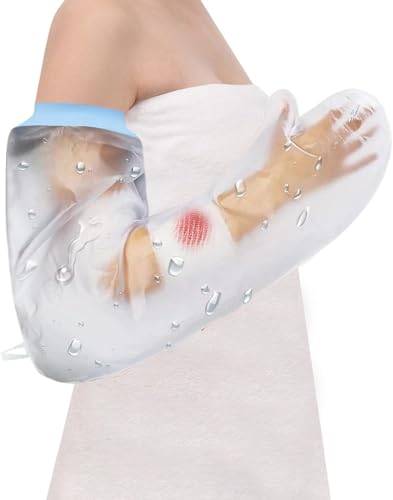
03Waterproof shower cover
CureSquad Waterproof Arm Shower Cover
A silicone sleeve that seals around the forearm — the same cover we recommend for a broken bone in a cast. It fits the forearm.
✓Kaiser's tennis-elbow sheet: "Keep your bandage dry by covering it with plastic."
✓CU Anschutz's cubital-tunnel sheet: the dressing stays on 5 days, then "it is OK to get the wound wet in the shower" — the shortest window of any procedure here.
✓The CORE Institute's olecranon ORIF sheet: plastic bags with tape sealant, no submersion for at least 4 weeks — the longest window.
How we chose it: The same cover we recommend for a broken bone cast and after shoulder surgery. It fits the forearm.
One flaw (not a dealbreaker): A seal only helps once your dressing is actually cleared to get near water — check your own surgeon's timeline (5 days to 4 weeks, by procedure, per the table above) before relying on it.
Recovery tip: The CORE Institute's own olecranon ORIF sheet has a free tip worth using regardless of which surgery you had: bring or wear comfortable, loose-fitting clothing that's easy to put on one-handed — a button-down shirt or a sweatshirt, not something that pulls overhead.
Depends on which surgery you had
Two more, conditional on your specific procedure — not universal essentials.
Because a sling shows up for three of the five procedures here, and the free one your hospital gives you digs into your neck the same way it does after shoulder surgery.
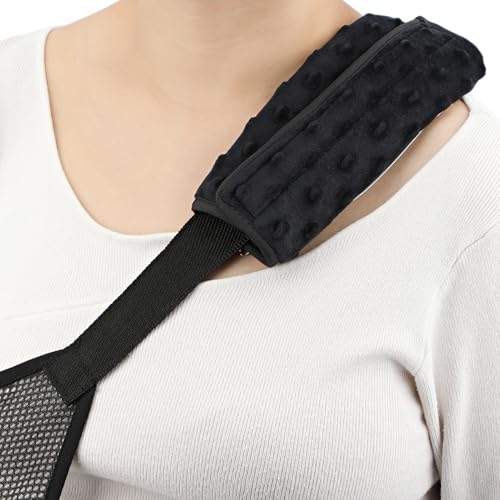
Sling comfort pad — if your procedure included a sling
BNRendles Cushioned Arm Sling Neck Strap Pad
Slides over the sling strap where it crosses your neck — for whichever of these procedures actually puts you in one.
✓Named for elbow arthroscopy (comfort), distal biceps repair (~1 week), and olecranon fracture (support, swappable if uncomfortable) — NOT for tennis elbow release or total elbow replacement, per the table above.
✓The sling itself is always hospital-provided, never something you buy on your own — the same is true after shoulder surgery.
✓Per Myeroff's olecranon sheet, you come out of the sling 2-3 times a day, so it isn't worn continuously either.
How we chose it: The same pad we recommend after shoulder surgery.
Because this is the most important timing point here: the same brace is a pre-op treatment for some patients and a post-recovery one for others — but it's never the device you wear right after surgery.
Counterforce elbow brace — before surgery or after full recovery, never during immobilization
Sleeve Stars Tennis Elbow Brace
A padded forearm strap AAOS names as a nonsurgical, pre-op treatment — and Kaiser separately names as a return-to-sport item, months after surgery. Not the same thing as the splint or hinged orthosis your surgical team applies.
✓AAOS OrthoInfo, on tennis elbow specifically: a "brace centered over the back of your forearm... counterforce brace" is a nonsurgical treatment tried first — "80 to 95% of patients have success with nonsurgical treatment."
✓Kaiser's tennis-elbow surgery sheet, separately: patients "may need a brace at work and when you play sports that stress the elbow and forearm... 4 to 6 months" after surgery — a return-to-activity item, not an immobilization one.
✓Fits 9"-23" forearm circumference, worn just below the elbow over the forearm muscle — the exact placement AAOS describes.
How we chose it: We checked 2 counterforce elbow straps. We checked both Amazon listings on 2026-08-06. None of the braces we recommend elsewhere fit an elbow, and wrist splints (L3908) are a different Medicare code — see the coverage page.
One flaw (not a dealbreaker): This is NOT the $546-$562 clinician-fitted L3760 hinged elbow orthosis your surgical team may apply after distal biceps or fracture surgery — that device is set and re-adjusted by your care team, not something to configure yourself. See the note below and the full breakdown on the Medicare page before assuming this strap substitutes for it.
Two things we found and didn't build a pick for: a compression sleeve (an Ace wrap or tubigrip stocking, hand-to-armpit, named specifically for olecranon fracture patients by Dr. Myeroff's sheet) — a commodity item, the same call we made for Ace wraps after meniscus surgery; and a hinged elbow ROM brace as a consumer purchase. That second one is the important one: the Mass General Brigham distal-biceps rehab protocol confirms the real hinged brace is set to specific locked angles by your clinical team and re-adjusted week by week — it's the L3760 device discussed on the coverage page, not something to shop for and configure yourself. If your surgeon's office supplies one, use theirs; don't assume the counterforce brace above is a substitute.
💡
Recovery tip: Kaiser's arthroscopy sheet gets specific about what "avoid lifting" actually means in the first few weeks: a child, heavy grocery bags and milk containers, a heavy briefcase or backpack, cat litter or dog food bags, or a vacuum cleaner. Line up help with those specific things before surgery day, rather than guessing at what counts as "heavy."
Borrow or skip
What this recovery doesn't need at all.
The coverage record
None of the 68 Medicare equipment codes this site tracks apply to elbow-surgery equipment. They are all for leg and general-mobility devices.
We searched the 68 Medicare equipment codes this site tracks and found no elbow codes. The same is true for shoulder surgery, carpal tunnel, and hernia. One related code does exist, though: L3760, a clinician-fitted elbow orthosis priced around $546-$562 — a real Medicare fee, just outside the 68 codes we track. See the full breakdown on the Medicare page.
Skip buying a walker, cane, raised toilet seat, shower chair, commode, or crutches entirely. None of it applies — elbow surgery doesn't restrict leg weight-bearing, and none of the 10 hospital sources we read mention a lower-body or mobility aid.
Ask before assuming you need a sling at all — and never buy one. Only three of the five procedures name a sling, and every source that mentions one is explicit that it's handed to you by your surgical team, not purchased. If your care team gives you one that's uncomfortable, ask for a different design rather than buying an aftermarket replacement.
Total elbow replacement carries a PERMANENT lifting restriction, not a temporary one like the other four procedures. AAOS states it plainly: most surgeons recommend no more than 5-10 pounds, for life, to protect the metal parts from loosening. This isn't a "restrictions ease over time" situation the way it is for the other four surgeries — state it to yourself distinctly if this is your procedure.
The counterforce elbow brace is optional, and its timing is narrow. It's a before-surgery or months-after-recovery item for tennis elbow specifically — not something most readers need on surgery day itself.
Go deeper
Two follow-up pages cover what comes up next after elbow surgery — the full per-procedure restriction breakdown, and the Medicare fine print.
This is an equipment and cost-coverage guide, not medical advice. It doesn't cover physical therapy, range-of-motion exercises, or any other instruction that should come from your surgeon or care team — follow their discharge instructions over anything here. Splint duration, sling use, and lifting restrictions vary by procedure, surgeon, and how your elbow heals; the table above cites direct hospital sources, not this site's own general advice.
See the full printable checklist — all 8 items ↓
Everything on this page, in one list — the essentials, the two situational picks, and what to skip entirely. This is what prints when you use the button up top.
The full elbow-surgery recovery checklist
Item
Category
Status
Medicare
Elbow-shaped ice wrap
Essential
Buy
No HCPCS code
Elevation (pillows you own)
Essential
Free — no purchase
Not applicable
Waterproof arm/dressing shower cover
Essential
Buy
No HCPCS code
Sling comfort pad
Depends which surgery you had
Buy, if your procedure includes a sling
No HCPCS code
Counterforce elbow brace
Depends which surgery you had
Buy, before surgery or after full recovery only
No HCPCS code (not the same as L3760)
Compression sleeve / Ace wrap
We have no pick for this
Commodity — no pick built
No HCPCS code
Hinged elbow ROM brace (L3760)
We have no pick for this
Ask your surgical team, don't self-purchase
Real code, ~$546–$562 (not one of the 68 codes this site tracks)
Nothing on this checklist is covered — but one related device, a clinician-fitted elbow orthosis, has a real $546-$562 Medicare code you should know about before shopping.
None of the 68 codes this site tracks apply to an ice wrap, a sling pad, or a counterforce brace. L3760 (elbow orthosis) is real and priced by Medicare's own PDAC tool — but it's a device your surgical team fits and adjusts, not something on this shopping list.
This page has Amazon links — we may earn a commission if you buy through them, at no extra cost to you. It never changes which product we recommend. See our methodology.
CPSC SaferProducts.gov + FDA recall databases — we checked recalls for the elbow ice wrap and the counterforce strap, but did not run a fresh search of the databases for this page, so we don't claim they are recall-free
Amazon product listings — We check each Amazon price and whether it is in stock every night. A price only shows if it was checked in the last 24 hours.