How much you can walk in the first weeks depends on your technique — these three cover what everyone needs either way.
By VerifiedCareData · How we check. Last checked .
Bunion surgery isn’t one procedure — chevron, scarf, and Lapidus (fusion) are different techniques, with or without a minimally invasive version, and how soon you can walk depends entirely on which one your surgeon used. Some patients bear weight the same day; others need a cast and crutches for eight weeks. These three essentials — a post-op surgical shoe, a wedge pillow, and an ice wrap — apply no matter which technique you had. They cost about $79 together on Amazon today. If your surgeon has you off your foot for weeks, add crutches or a knee scooter (about $119 in all with crutches, or $279 with a knee scooter). Order today if surgery’s close — most items arrive within a few days.
Covers hallux valgus correction (bunionectomy) by any standard technique — distal osteotomy (chevron), proximal/mid-shaft osteotomy (scarf, crescent), joint fusion (Lapidus), and their minimally invasive/percutaneous variants. Not covered: hammertoe correction, plantar fasciitis, or general foot-pain content.
Every pick here was checked against four hospital and professional-society sources and Medicare’s equipment fee schedule — how we choose →
Before you shop: which technique did you have? Four independent sources agree how soon you can walk depends on your specific technique, not on “bunion surgery” as one thing — and the sharpest version is a same-institution contrast: at Hospital for Special Surgery, a traditional open Lapidus (joint-fusion) procedure means a full cast and crutches for 8 weeks (per the HSS bunion-surgery overview, medically reviewed by Jonathan T. Deland, MD), while the identical Lapidus procedure done percutaneously/minimally invasively means weight-bearing at just 2–4 weeks instead (per HSS’s own minimally invasive bunion surgery page, by Anne Holland Johnson, MD) — same hospital, same procedure name, a 4x-to-8x-shorter restriction, from two different HSS surgeons’ own patient pages. A traditional chevron osteotomy allows some weight the very next day. HSS’s own scarf-procedure page is missing the exact week count for that technique’s partial-weight-bearing milestone — a real gap in HSS’s own published content, not a number we’re guessing at. Cleveland Clinic and AAOS both confirm the general “it depends on technique” pattern, and AAOS separately notes minimally invasive technique itself “has not been widely accepted” by the broader profession. Ask your surgeon which technique you had, and your own timeline, before you buy anything below.See the full technique-by-technique breakdown →
The 3 essentials
Because whether you can put weight on your foot in week one depends on your technique — and this shoe is what makes it possible for the techniques that allow it.
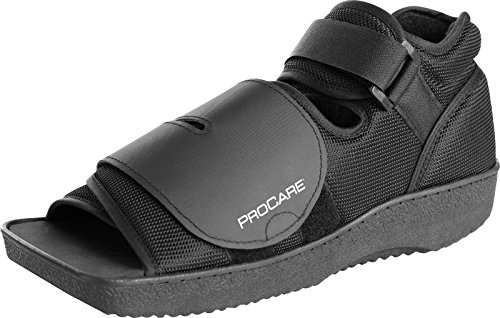
01The post-op surgical shoe
ProCare Squared Toe Post-Op Shoe
The single device HSS and AAOS both name as what protects the correction once your surgeon clears weight-bearing — and Medicare will never pay a dollar toward it.
✓AAOS, verbatim: "Some bunion procedures allow you to walk on your foot right after the surgery. In these cases, patients must use a special surgical shoe to protect the bunion correction."
✓HSS's own minimally invasive page: after PECA surgery "you will be fitted with a special surgical post-op shoe, and you can bear full weight almost immediately" — worn for about 6 weeks.
✓A rigid rocker sole, and a square, roomy toe box that leaves room for post-op swelling and a bulky dressing.
✓HCPCS L3260 — statutorily excluded from Medicare by federal law (Social Security Act Sec. 1862(a)(8)), regardless of prescription or medical necessity.
How we chose it: We compared post-op surgical shoes, including Ossur mesh-top and United Ortho models, and link the one you can buy new today. This ProCare shoe is sold in sizes Small to X-Large; the link opens the Medium.
One flaw (not a dealbreaker): Sold by size, and Amazon's stock changes by size — pick your size on Amazon and confirm it's in stock before you order.
Because HSS gives an exact elevation schedule, not just "keep your foot up": 80% of the time in week one, 50% in week two.
02The wedge pillow
MEGCXIT Leg Elevation Pillow
Under your calf, above your heart — the setup behind HSS's own elevation percentages.
✓HSS, verbatim: "it is recommended that you keep the surgical area elevated 80% of the time during the first week and 50% of the time in the second week."
✓AAOS: "Keep your foot elevated as much as possible for the first few days."
✓29" × 17" × 9" wedge with a groove that keeps your legs from sliding off, per the listing.
How we chose it: We checked one leg-elevation pillow against its Amazon listing. It is the same pick we use for knee and foot and ankle surgery, not the winner of a field checked for bunion surgery. Its listing gives 29" × 17" × 9" and says it works in bed or on a sofa.
One flaw (not a dealbreaker): No HCPCS code exists for a wedge or leg-elevation pillow, so Medicare never bills for it under any circumstance.
Because a knee-shaped gel pack won't wrap around a swollen foot, and AAOS gives a real instruction, not just "ice it."
03The ice wrap
REVIX Ankle Ice Pack Wrap
Wraps around the whole foot and ankle, hands-free — not shaped for the knee, though not shaped only for a bunion incision either.
✓AAOS, verbatim: "Apply ice as recommended by your doctor to relieve swelling and pain. Never apply ice directly on your skin."
✓Three adjustable straps hold it in place while your foot stays elevated.
✓No bunion-specific icing schedule exists in our sources. We use the 20-on/20-off schedule cited for foot and ankle surgery rather than invent one.
How we chose it: We checked 2 ankle/foot ice wraps — the same REVIX pair we use for foot and ankle surgery. This wrap fits the whole foot and ankle, not just the forefoot where a bunion incision sits. It is not a perfect fit.
One flaw (not a dealbreaker): Built for the whole foot and ankle, not a targeted forefoot wrap — it works, but it's not shaped specifically for where a bunion incision sits.
Recovery tip: AAOS's own recovery timeline runs long — it can take up to 6 months for full recovery, with swelling common from 6 months to a year, and follow-up visits sometimes needed for up to a year. Don't judge your own progress against a 2-week or 6-week milestone alone; the surgical-shoe-to-sneaker transition is an early checkpoint, not the finish line.
Depends on your technique and situation
Nine more, conditional on which technique your surgeon used, your boot, and your home.
Because a traditional open Lapidus procedure means a cast and crutches for a full 8 weeks — while the same procedure done percutaneously can mean 2–4.
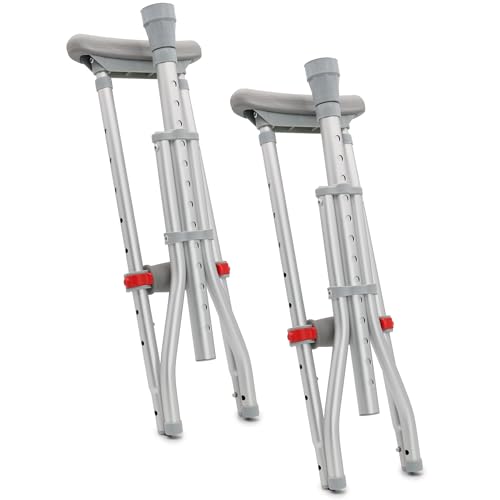
Crutches
DMI Universal Adjustable Crutches
The device named across every source for the non-weight-bearing pathway — and the one Medicare actually pays toward.
✓HSS, on the traditional open Lapidus procedure: patients "must wear a cast and use crutches for eight weeks."
✓AAOS and Cleveland Clinic both name crutches as the standard device when a surgeon requires a no-weightbearing period.
✓HCPCS E0114 — Medicare pays $57.17–$88.73 with a prescription; about $39.99 on Amazon today.
Because AAOS calls it directly: "a knee walker is a good alternative to crutches" for the same non-weight-bearing stretch.
Knee scooter
Roscoe Medical Knee Rover Steerable Knee Scooter
Rest your knee on the pad and roll instead of hobble — real cost, since Medicare pays nothing toward it.
✓Cleveland Clinic names "a knee roller/scooter" in the same breath as crutches for the non-weight-bearing pathway.
✓Falls under E0118, the code Medicare uses for crutch-substitute devices; E0118 had zero national Medicare claims in 2024.
✓Medicare pays nothing toward it, so you pay the full price (about $199.99 on Amazon today).
One flaw (not a dealbreaker): Two real recalls exist for this product category (a 2012 rod-collapse issue, an open 2024 tiller-separation recall) — check any borrowed scooter's brand and model first.
Because HSS's own page says plainly: after the two-week mark you may be given a splint to hold the correction — ask before you buy one yourself.
Bunion splint (post-op)
Vive Bunion Brace
A post-op alignment-maintenance wrap your surgeon may already provide — not a correction device, whatever the label says.
✓HSS, verbatim: "After the first two weeks, you may be given a bunion splint to maintain the postsurgical alignment."
✓This listing's own marketing claims it "gently realigns the toe" — we don't repeat that. HSS's own page states a splint "will not make the bunion go away."
One flaw (not a dealbreaker): Ask your surgeon's office whether they'll give you one before buying — this varies by practice and wasn't independently confirmed for bunion surgery specifically.
Because AAOS's own instruction is the simplest version possible: "cover your foot with a plastic bag" when you shower.
Waterproof shower cover
Asunby Waterproof Leg Cast Cover
A convenience upgrade over the plastic-bag method — not a requirement, per AAOS's own page.
✓A reusable silicone seal keeps a dressing or boot dry through a normal shower, sized for a full leg (11-24 in circumference) — bulkier than most bunion patients need for a forefoot-only dressing.
✓AAOS's own DIY method costs nothing: a plastic bag over the foot while showering.
Because balancing on one foot in a wet shower while on crutches or a knee scooter is a real fall risk — though no source we read names a shower chair for bunion surgery specifically.
Shower chair (our reasoning, not directly cited)
Medline Shower Chair with Backrest
Our reasoning from the same balance risk as crutches or a knee scooter — not a direct hospital citation.
✓350 lb. weight rating, height-adjustable in 1" steps.
✓We also pick this for foot and ankle surgery, where Kaiser Permanente cites it directly. That citation doesn't carry over to bunion surgery, so we label this pick as our own reasoning.
Recovery tip: The recurrence rate for a bunion coming back is about 20% over a patient's lifetime, per HSS. That's not a reason to skip any of the elevation or icing steps above — it's simply a number worth knowing going in, not something equipment on this page changes either way.
Bonus comfort
Two more, relevant mainly if you end up on crutches.
Because underarm soreness is the most common complaint after a few days on crutches.
Crutch underarm pads (bonus)
Vive Fleece Crutch Pads
Slides over the stock foam pad and adds a second layer plus a washable cover.
✓Four pieces: 2 underarm pad covers, 2 hand grip covers.
✓Medicare classifies this kind of accessory under codes A4635/A4636, which are not among the 68 Medicare equipment codes this site tracks.
Because your operated foot is in the surgical shoe, not a lace-up sneaker — but your good foot still needs one, and bending down to tie it is a balance risk you're avoiding.
Elastic no-tie laces (bonus)
Xpand No-Tie Elastic Shoelaces
Turns any real sneaker into a slip-on without a single lace to tie.
✓One pack fits most standard sneaker eyelets — keeps your existing shoes.
What this recovery doesn't need, according to the hospitals and the data.
The coverage record
The post-op surgical shoe nearly every bunion-surgery patient wears — HCPCS code L3260 — is statutorily excluded from Medicare coverage by federal law (Social Security Act Sec. 1862(a)(8)), confirmed directly against a Medicare DME contractor's own published coding bulletin, regardless of prescription or medical necessity.
That's a stronger finding than a simple 'zero claims' absence — it's an affirmative legal exclusion, and it applies to nearly every reader regardless of which technique they had. Crutches (E0114) are the one item on this checklist Medicare does pay toward, $57.17–$88.73 with a prescription, for the non-weight-bearing subset of patients specifically. See the full breakdown on the Medicare page.
Ask your surgeon whether they'll give you a bunion splint before buying one. HSS's own page frames it as something the surgeon "may give" the patient after the two-week mark — a hospital-provides-it-first item, not confirmed here as a default purchase.
Toe spacers and bunion splints will not correct a bunion on their own. HSS and AAOS are both explicit — comfort and post-op support only, never a substitute for surgery.
A plastic bag over the foot is AAOS's own stated shower-protection method. The waterproof cover on this checklist is a convenience upgrade, not a requirement, and the existing pick is sized for a full leg — larger than most bunion patients need.
Borrowing crutches or a knee scooter is common and reasonable — but check a borrowed knee scooter's brand and model against CPSC and FDA recall records first: 2 real recalls are logged (a 2012 rod-collapse issue and an open 2024 tiller-separation recall).
If your surgeon's office already gives you a post-op shoe as part of the surgical kit, you likely don't need to buy a second one. Ask before ordering — this varies by practice, and we did not confirm it for bunion surgery specifically.
Go deeper
Two follow-up pages cover what comes up next for this surgery specifically — the Medicare coverage story, and the technique question that decides everything else on this page.
This is an equipment and cost-coverage guide, not medical advice. It doesn't cover physical-therapy protocols, medication management, wound care, or any other instruction that should come from your surgeon or care team — follow their discharge instructions over anything here. Which technique you had, your weight-bearing timeline, and whether you need a cast, boot, or low surgical shoe vary by procedure and surgeon.
See the full printable checklist — all 14 items ↓
Everything on this page, in one list — the three essentials, the nine conditional picks, and the two bonus-comfort picks. This is what prints when you use the button up top.
The full bunion-surgery recovery checklist
Item
Category
Status
Medicare
Post-op surgical shoe
Essential
Buy
Statutorily excluded (L3260)
Leg-elevation wedge pillow
Essential
Buy
No HCPCS code
Ankle/foot-shaped ice wrap
Essential
Buy
No HCPCS code
Crutches
Depends on your technique (non-weight-bearing subset)
Buy, if your technique requires it
Covered w/ Rx (E0114)
Knee scooter
Depends on your technique (non-weight-bearing subset)
Buy, alternative to crutches
Not covered (E0118)
Toe spacer
Depends on your situation (pre-op/comfort)
Optional
No HCPCS code
Bunion splint
Depends on your situation (post-op, ask surgeon first)
Ask surgeon first
No HCPCS code
EVENup shoe leveler
Depends on your situation (tall boot only)
Buy, if in a tall walking boot
No HCPCS code
Waterproof shower cover
Depends on your situation (optional convenience)
Optional
No HCPCS code
Shower chair
Depends on your situation (our reasoning)
Buy, if showering feels unsteady
Not covered
Bedside commode
Depends on your technique (our reasoning)
Ask hospital first
Covered w/ Rx (E0163)
Reacher / grabber
Depends on your situation (our reasoning)
Optional
No HCPCS code
Crutch underarm pads
Bonus comfort
Buy, if on crutches
Not tracked here (A4635/A4636)
Elastic no-tie laces
Bonus comfort
Buy
No HCPCS code
What Medicare actually pays for
The post-op surgical shoe nearly every bunion-surgery patient wears is statutorily excluded from Medicare by federal law — not just absent from the claims data, an affirmative legal exclusion (L3260, Social Security Act Sec. 1862(a)(8)).
Crutches (E0114, $57.17–$88.73) and a bedside commode (E0163, $60.15–$139.61) are covered with a prescription, for the non-weight-bearing subset of patients. A knee scooter (E0118) is not covered, by rule, regardless of prescription. Everything else on this checklist — the wedge pillow, ice wrap, toe spacer, bunion splint, shower cover, EVENup, shower chair, reacher, crutch pads, laces — has no HCPCS code at all. See the full breakdown on the Medicare page.
This page has Amazon links — we may earn a commission if you buy through them, at no extra cost to you. It never changes which product we recommend. See our methodology.
CPSC SaferProducts.gov + FDA recall databases — checked for every product on this page — no recalls for the two new product types; 2 knee-scooter recalls (other brands, not our pick) are on record
Amazon product listings — We check each Amazon price and whether it is in stock every night. A price only shows if it was checked in the last 24 hours.