What to Buy for a Broken Arm or Leg Cast

A cast means weeks of the same three problems whether it is on an arm or a leg: showering, sleeping, and an itch you cannot reach. Two of the three fixes are cheap, one is free — and there is one symptom that means stop reading and get seen.

Most of living in a cast is logistics, and the logistics are solved cheaply. But a cast is also a rigid shell around a limb that has just been injured and is going to swell, and there is one situation where that combination is genuinely dangerous. It is uncommon, it is treatable when caught, and delay is what turns it bad — so it goes first, before any shopping.

Every pick here is checked against named hospital instructions and the published clinical literature — how we choose →

When a cast is an emergency

Nothing to buy. Uncommon, treatable when caught early, and the one thing on this page worth reading before anything else.

A broken limb swells for the first day or two. A cast does not. Occasionally the pressure inside a muscle compartment rises far enough to cut off its own blood supply — acute compartment syndrome, described in the orthopaedic literature as one of the few true emergencies in the specialty. The reason it belongs on a consumer page is specific: the published reviews identify delay in treating it as the single most important factor behind poor outcomes, and they also note that the clinical signs are variable and hard to quantify. Which means the person best placed to notice something is wrong early is usually the person wearing the cast.

Go back to the emergency department or your fracture clinic the same day — do not wait for a scheduled appointment — if any of these happen:

  • Pain that keeps getting worse, or is much worse than you would expect, especially if it is not relieved by elevating the limb and taking the painkillers you were given.
  • Pain that increases sharply when you try to move or stretch the fingers or toes beyond the cast.
  • New numbness, pins and needles, or loss of feeling in the fingers or toes.
  • Fingers or toes that go pale, grey, blue or cold, or that you cannot move.
  • A cast that feels crushingly tight rather than merely snug, or one that becomes wet, cracked, softened or has something stuck down inside it against the skin.
  • New burning or stinging under the cast, a bad smell, or discharge staining through it.

None of that is a diagnosis you can make at home, and it is not meant to be. Most of the time a tight-feeling cast is just a tight cast and it gets split or changed in a few minutes. That is the point: the check is cheap and quick, and the thing it rules out is not. If you are unsure, ring the fracture clinic and describe it — that call is what the number is for.

The 3 essentials

Which of these apply to you depends on your cast — see the fork above.

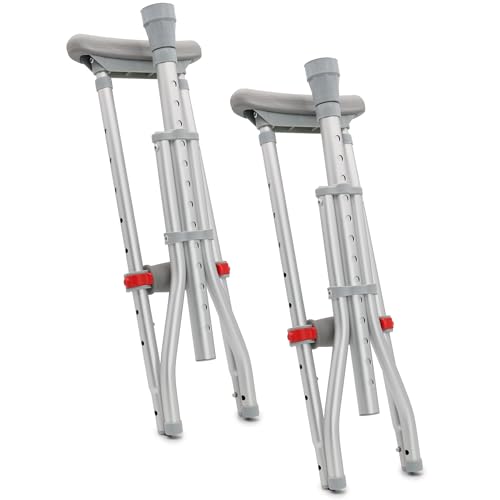
Drive Medical RTL10433 Adjustable Crutches for Walking, Silver

Because Cleveland Clinic says it plainly: once your leg cast is fully hardened, they'll show you how to use crutches to get around safely.

Crutches (leg cast)

Drive Medical Adjustable Crutches

The device two hospital sources name for a leg cast — and per coverage_status.json, the one item on this whole checklist Medicare or insurance can help pay for.

  • AAOS, verbatim: don't walk on a walking cast until it's fully hardened — about 1 hour for fiberglass, 2 to 3 days for plaster.
  • Euro-style clips plus a pushpin adjust height (38.5"-62.5") and handgrip position separately — most adults skip a separate size purchase.
  • HCPCS E0114 — Medicare pays $57.17-$88.73 with a prescription, 44,541 DY2024 claims nationally.

The count: This is the same live-verified crutches pick this site's foot-ankle-surgery and bunion-surgery hubs already use — not researched fresh for this hub, and not a smaller or different field checked specifically for a plain fracture.

One flaw (not a dealbreaker): Underarm soreness after a few days of steady use is the most common complaint — the crutch pads further down this page are the cheap fix, not a reason to skip crutches.

Asunby Waterproof Cast Covers for Shower Leg Adult, Full Long Leg

Because three hospitals independently say the same thing about keeping a cast dry for a shower — and one pediatric hospital disagrees with the other two.

Waterproof cast shower cover (arm or leg)

Asunby Waterproof Leg Cast Cover

A reusable silicone seal keeps a normal shower off a cast or dressing — AAOS’s own words, "purchase waterproof shields." For a CHILD’s cast, read the flaw line below before you buy one.

  • AAOS, verbatim: "Use 2 layers of plastic or purchase waterproof shields to keep your splint or cast dry while you shower or bathe."
  • Cleveland Clinic, verbatim: "Your provider will show you how to cover the cast in plastic wrap or special plastic guards while you’re bathing."
  • AAOS's own caution, worth knowing before your first shower with it on: even a covered cast shouldn't be submerged or held under running water — "a small pinhole in the cast cover can cause the injury to get soaked."

The count: Checked against three independent hospital sources naming the same waterproof-shield/plastic-guard approach in the same breath as a DIY plastic-wrap fallback — see the full comparison and the child-vs-adult tension in detail on the gear page and the showering spoke.

One flaw (not a dealbreaker): For a CHILD’s cast, UCSF Benioff Children’s Hospitals recommends AGAINST a cover: "Cast covers are not recommended as they can leak... Stick to sponge baths." This card does not resolve that disagreement — see it stated in full on the showering spoke before you buy one for a kid.

Arm cast instead? See the CureSquad cover ($12.59)

See the full waterproof cast cover comparison →

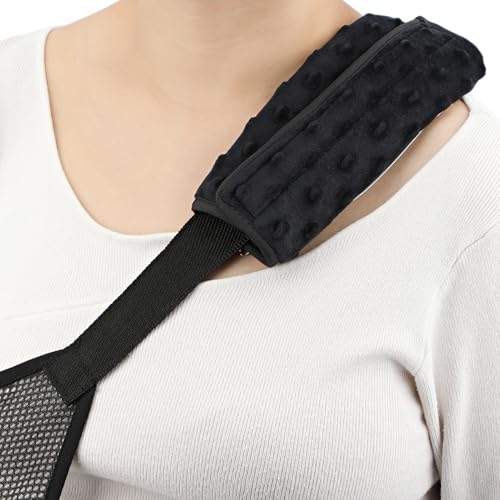
BNRendles Cushioned Arm Sling Neck Strap Pad

Because UCSF Benioff's own page confirms two things at once: the sling is often given by the clinic, not bought — and it comes off at bedtime.

Sling comfort pad (arm cast, if a sling is used)

BNRendles Cushioned Arm Sling Neck Strap Pad

Not every arm cast comes with a sling — if yours does, this is the padding people actually buy, not the sling itself.

  • UCSF Benioff, verbatim: "An arm sling is sometimes provided for comfort. You can remove the sling at bedtime or during naps if your child finds it uncomfortable for sleeping."
  • Slides over the strap where it crosses the neck — the thin factory pad most slings ship with isn't enough for weeks of wear.
  • No HCPCS code exists for a sling or its padding — not billed as DME either way.

The count: The same sling-comfort-pad pick this site's shoulder-surgery hub already verified — reused here because the same 'the sling is provided, the padding is what you buy' pattern applies to an arm-cast sling too.

One flaw (not a dealbreaker): Skip this entirely if your cast has no sling at all — plenty of arm and wrist casts don't use one.

Itching: it's free, not a product

No cast-itch gadget on this hub — no source in our research ties a hospital or FDA-cleared claim to one.

The hospital's own advice

Use the cool setting on a hair dryer to blow air into the cast.

UCSF Benioff Children's Hospitals' own patient-education page, quoted verbatim — paired with three more free techniques from the same source: gently tap on the outside of the cast; scratch a different part of the body (it can trick the brain into feeling relief); or use distraction, like a movie or an activity.

Source: UCSF Benioff Children's Hospitals, Cast Care

No cast-itch gadget sold on Amazon — backscratcher wands, air-blower tools, and similar listings — carries a hospital or FDA-cleared claim in this research pass, so none is recommended here. That's a deliberate zero-SKU tier, not an oversight: an honest "this is free" answer is worth more than a product that isn't backed by anything. AAOS and Cleveland Clinic both independently corroborate the one rule that does matter: never stick an object like a coat hanger inside the cast to scratch, and don't apply powders or deodorants to itching skin under it.

If it is a buckle fracture, it may not need a cast at all

Nothing to buy. The commonest wrist fracture in children, and the one where the standard treatment has been overtaken by the evidence.

A buckle fracture — also called a torus fracture — is what happens when a child falls on an outstretched hand and the soft bone of the forearm compresses and bulges rather than snapping through. It is inherently stable, it is very common, and it is the fracture most likely to be treated more heavily than it needs to be.

The finding this page is built on

Across 8 randomised trials and 781 children, non-rigid immobilisation — a removable splint, soft cast or bandage — outperformed a rigid cast on functional recovery, cost and complication rate, with a relative risk of 3.02 favouring the non-rigid approach. More patients said they would choose it again.

A larger 2024 meta-analysis of 7 studies and 1,550 patients supports the same picture while naming the trade-off honestly: splints came with slightly higher pain scores at three days than casts. So this is not a free win on every measure — it is a genuine choice, in which the less restrictive option performs at least as well overall and costs less.

Source: Management of pediatric forearm torus fractures: a systematic review and meta-analysis, Pediatric Emergency Care (2016), PMID 26555307

Whether a fracture is a buckle fracture is read off an X-ray by a clinician, not decided from a website, and plenty of childhood forearm fractures are not buckle fractures and do need proper immobilisation. But if you have been told your child’s is one, it is entirely reasonable to ask whether a removable splint would do — because it comes off for washing, it comes off for sleeping, and it means most of the rest of this page stops applying to you.

Depends on your cast

Conditional on which cast you have, and how far into recovery you are.

HOMBYS Leg Elevation Pillow for After Surgery, Knee Replacement & Recovery

Because UCSF Benioff gives a specific elevation technique most sources skip: "float the heel."

Leg-elevation wedge pillow (leg cast)

HOMBYS Leg Elevation Pillow

Under your calf, above your heart — with the heel floating free, not resting on anything.

  • UCSF Benioff, verbatim: ‘"float" the heel: Place the pillows or towel roll under the leg so the heel isn’t touching anything and is floating in the air.’
  • 27" x 11.6" x 9" wedge — fits most beds and couches.
  • No HCPCS code exists for a wedge or leg-elevation pillow — Medicare never bills for it under any circumstance.
REVIX Ankle Ice Pack Wrap, Reusable Gel Ice Pack for Foot Pain Relief

Because UCSF Benioff's own instruction for ice is the cheapest one on this whole page: a well-sealed plastic bag.

Ice — DIY plastic bag first, gel wrap optional

REVIX Ankle Ice Pack Wrap

The DIY version — a sealed plastic bag — is the hospital-sourced default; this shaped wrap is the optional upgrade once you're icing more than a couple of days.

  • UCSF Benioff, verbatim: "If using ice to decrease pain and swelling, use a well-sealed plastic bag that is unlikely to leak."
  • Three adjustable straps hold this wrap in place hands-free around a foot or lower leg.
  • Have an arm cast instead? This site's shoulder-shaped wrap is an imperfect fit for a forearm or wrist, disclosed honestly — see the alt link.

One flaw (not a dealbreaker): The free DIY method above works fine for most people — this is a comfort upgrade, not a requirement.

Arm cast (imperfect fit, disclosed): shoulder-shaped wrap ($28.49)

EVENup Shoe Lift for Walking Boot, Adult Size Medium

Because a walking cast isn't the same as a rigid one — AAOS names the exact moment it changes.

EVENup shoe leveler (leg cast, walking-cast stage)

EVENup Shoe Lift for Walking Boot

For later in recovery, once your cast has hardened into a walking cast — not a day-one buy for a fresh, non-weight-bearing cast.

  • AAOS, verbatim: "You will be given a cast shoe to wear over your walking cast" once it’s fully hardened.
  • Straps onto the shoe on your good foot with three stackable height inserts to match whatever your cast or boot adds.
  • Not relevant to a rigid, non-weight-bearing cast — check with your provider before this applies to you.
iWALK3.0 Original Hands Free Knee Crutch

Because this isn't a default for everyone on crutches — the manufacturer's own listing draws real lines around who it works for.

iWALK hands-free crutch (leg cast, screened)

iWALK 3.0 Hands-Free Crutch

Hands-free and stairs-capable, but the eligibility bar is real — read it before you buy, not after.

  • The listing's own eligibility language: not recommended for elderly users, anyone with balance or strength limitations, or anyone significantly overweight; best fit is age 55 or under with average-or-better balance.
  • Classified under the same code as a knee scooter (E0118) — Medicare pays $0 toward it, prescription or not.
  • At $179.00 (re-verified live), it costs roughly 5x a basic pair of crutches — the priciest item on this hub by a wide margin.

One flaw (not a dealbreaker): A skip for most readers, not a default upgrade — read the eligibility language above before buying.

Bonus comfort

Two more, relevant mainly if you end up on crutches for a while.

Vive Fleece Crutch Pads & Hand Grips

Because underarm soreness is the most common complaint after a few days on crutches.

Crutch underarm pads (bonus)

Vive Fleece Crutch Pads

Slides over the stock foam pad and adds a second layer plus a washable cover.

  • Four pieces: 2 underarm pad covers, 2 hand grip covers.
  • PDAC-classified A4635/A4636 — an accessory code family this site's 68-code Medicare dataset doesn't track, an honest out-of-scope gap.
Xpand No Tie Elastic Shoe Laces for Sneakers

Because bending down to tie a shoe while balancing on crutches, or with one hand in a cast, is exactly the risk you're avoiding.

Elastic no-tie laces (bonus)

Xpand No-Tie Elastic Shoelaces

Turns any real sneaker into a slip-on without a single lace to tie.

  • One pack fits most standard sneaker eyelets — keeps your existing shoes.

Borrow or skip

The honesty section — what this checklist doesn't need, according to the hospitals and the data themselves.

The coverage record

If your leg cast means you need crutches, that's the one item on this checklist Medicare or insurance can help pay for (E0114, $57-$89 a pair, with a prescription) — everything else here, from cast covers to sling pads, has no billing code at all.

IRS Publication 502 names crutches directly as an FSA/HSA-eligible expense too, alongside a much broader medical-expenses definition that covers most of the rest of this checklist a different way. See the full coverage breakdown.

Source: data/coverage_status.json (68 HCPCS codes), IRS Publication 502

  • Ask before buying a waterproof cast cover for a CHILD's cast. A real pediatric hospital (UCSF Benioff) recommends sponge baths instead and specifically warns that cast covers can leak.
  • Skip any cast-itch gadget marketed on Amazon. No hospital or FDA source in this research supports a specific product category — the free techniques above (hair dryer, tapping, distraction) are what hospitals actually recommend.
  • Don't walk on a fresh leg cast until it's fully hardened — about 1 hour for fiberglass, 2 to 3 days for plaster — and use the crutches or cast shoe your provider gives you until then.
  • A too-tight cast, or fingers/toes that look blue, purple, deep red, or feel cold, is an emergency — call 911 or go to the nearest ER, don't wait it out. That's UCSF Benioff's own instruction, stated plainly, not this site's editorializing.

How many people does this affect? No single "X million fractures a year, all ages" figure survived our own source-checking — a real gap in the published literature, not something we're rounding over. Two real, age-segmented counts instead: about 900,000 U.S. children (ages 0–18) are treated for a fracture in an emergency department every year, 2010–2015 average (Farrell et al., Pediatric Emergency Care, 2022) — the strongest reason a large share of this hub's readers are parents managing a child's cast, not the patient themselves. Separately, projecting one long-running county study nationally, U.S. adults 50+ have roughly 3.9 million fractures a year (Amin et al., J Bone Miner Res, 2014) — though the study's own authors caution their county's rates run higher than the broader population, so treat this as an upper-bound estimate, not a clean national count.

How we know this

Every recommendation above has to survive independent checks. None of them is our opinion.

  1. Medicare’s own data. Whether the item is covered, what it pays, and how many were billed nationally — from the CMS DMEPOS fee schedule, the HCPCS Level II file and DY2024 utilization, queried directly rather than through a third party’s summary. Published as an open dataset.
  2. Named hospital instructions. Clinical claims are quoted from a named institution’s own discharge or patient-education material and linked, never paraphrased into fact. Where sources disagree, the page says they disagree instead of picking one.
  3. Published outcome research. Two things a page about living in a cast owes the reader: the complication that cannot wait, and the evidence on whether the commonest childhood wrist fracture needs a rigid cast at all. Every figure on this page that describes what happens during recovery — when pain rises, when the wound changes, what the evidence says about diet — comes from one of these, cited inline and linked to the paper rather than summarised from memory.

What that research is and is not. These are studies of what happens to patients after this operation — how the wound heals, how pain moves, what changes outcomes. They are not a substitute for your surgeon's instructions, and this page never tells you what treatment to have. Where a study's finding and your discharge sheet disagree, follow the discharge sheet and ask the question at your follow-up.

Our datasets are published under CC BY 4.0 — see the rest of our datasets. More about who writes this and how →

Go deeper

Two follow-up pages cover what comes up next — the coverage story, and the single most-asked question in this whole research pass.

This is an equipment and cost-coverage guide, not medical advice. It doesn't cover which fractures need surgery, weight-bearing status, pain management, or any circulation/emergency symptom — that's your provider's call, not a shopping decision. Quoted hospital instructions above (itch relief, elevation, when to call 911) are reproduced verbatim with attribution, not authored by this site.
See the full printable checklist — all 11 items ↓

Everything on this hub, in one list — the three essentials, the four conditional picks, and the two bonus-comfort picks. This is what prints when you use the button up top.

The full broken-bone-cast checklist
ItemCategoryStatusMedicare
Crutches Essential (leg cast) Buy Covered w/ Rx (E0114)
Waterproof leg cast cover Essential (leg cast) Buy (adult) / ask first (child) No HCPCS code
Waterproof arm cast cover Essential (arm cast) Buy (adult) / ask first (child) No HCPCS code
Sling comfort pad Essential (arm cast, if sling used) Buy, if given a sling No HCPCS code
Leg-elevation wedge pillow Depends on your cast (leg) Buy No HCPCS code
Ice wrap (leg or arm, imperfect-fit disclosed) Depends on your cast DIY plastic bag first No HCPCS code
EVENup shoe leveler Depends on your cast (leg, walking stage) Buy, once walking cast No HCPCS code
iWALK hands-free crutch Depends on your cast (leg, screened) Buy, if eligible Not covered (E0118)
Crutch underarm pads Bonus comfort Buy, if on crutches Out of this site's scope (A4635/A4636)
Elastic no-tie laces Bonus comfort Buy No HCPCS code
Cast-itch gadget Deliberately not recommended Skip — use free techniques No HCPCS code
What Medicare actually pays for

Casts and splints are billed clinically (a CPT procedure code, the ER or urgent-care visit itself) — not through Medicare's DME fee schedule, so 'cast,' 'splint,' and 'fracture' return zero hits in this site's own 68-code coverage_status.json dataset. That's correct, not a gap.

The one exception: crutches (E0114, $57.17-$88.73 with a prescription, 44,541 DY2024 claims nationally). Everything else on this checklist has no HCPCS code at all — but IRS Publication 502 names crutches AND bandages/medical supplies as FSA/HSA-eligible, and its general medical-expenses definition covers the ER or urgent-care visit itself. See the full breakdown.

Source: data/coverage_status.json (68 HCPCS codes), IRS Publication 502

See the full coverage & FSA/HSA breakdown →

This page has Amazon links — we may earn a commission if you buy through them, at no extra cost to you. It never changes which product we recommend. See our methodology.

Sources

  1. American Academy of Orthopaedic Surgeons (AAOS), OrthoInfo, "Care of Casts and Splints" (POSNA-reviewed) — fiberglass vs. plaster, the waterproofing instruction, the walking-cast hardening times, the object-insertion warning; fetched live 2026-07-30
  2. AAOS, OrthoInfo, "Fractures (Broken Bones)" — the healing-time range and the "cast is the most common treatment" framing; fetched live 2026-07-30
  3. Cleveland Clinic, "Casts: Types & Care" — independent corroboration of the waterproofing and object-insertion guidance, plus the crutches-for-a-leg-cast citation; last reviewed 08/11/2023, fetched live 2026-07-30
  4. UCSF Benioff Children’s Hospitals, "Cast Care" — the itch-relief techniques, the sponge-bath-first/cast-cover caution, the DIY ice method, the "float the heel" elevation technique, and the cast-too-tight emergency callout; fetched live 2026-07-30
  5. Farrell C, Hannon M, Monuteaux MC, Mannix R, Lee LK. "Pediatric Fracture Epidemiology and US Emergency Department Resource Utilization." Pediatric Emergency Care. 2022;38(7):e1342-e1347. — source of the ~900,000 children/yr ED-fracture figure
  6. Amin S, Achenbach SJ, Atkinson EJ, Khosla S, Melton LJ III. "Trends in Fracture Incidence: A Population-Based Study Over 20 Years." Journal of Bone and Mineral Research. 2014. — source of the ~3.9 million/yr adult 50+ projection, with the authors’ own overestimate caveat
  7. data/coverage_status.json (68 HCPCS codes) — crutches (E0114) — the one covered item on this checklist
  8. IRS Publication 502, Medical and Dental Expenses — FSA/HSA eligibility basis; fetched live 2026-07-30
  9. CPSC SaferProducts.gov + FDA recall databases — checked for every ASIN on this hub — zero hits for every cast-specific category
  10. Amazon product listings, direct live fetch (scripts/verify_asin.py, curl + mobile Safari UA; scripts/price_audit_20260805.json) — all 11 ASINs on this hub independently re-verified LIVE for this build, 2026-08-05
  11. VerifiedCareData dataset.json (CC-BY-4.0) — every coverage fact above in one machine-readable endpoint