What You Need After Foot or Ankle Surgery

Six weeks, typically, with no weight at all on one foot. The shopping list is the easy part — the decision that actually shapes those weeks is how you are going to move, and the device you will almost certainly be handed first is the one this recovery’s own patients most often send back.

Ankle fracture repair, Achilles tendon repair, ankle fusion and ankle replacement all end in the same instruction: keep the foot off the ground completely. Everything you need follows from that one sentence — a way to move, a way to keep the leg up, a way to wash without soaking a cast. Having a bunion corrected instead? That recovery is weight-bearing far sooner and has its own page.

Every pick here is checked against named hospital instructions, Medicare’s own coverage data and 216 posts from people who had these operations — how we choose →

First, what “non-weight-bearing” actually means

Nothing to buy. The instruction is stricter than almost everyone assumes.

The American Orthopaedic Foot & Ankle Society’s patient site defines it literally: no weight whatsoever on the operated foot, not even for a second or two, whether you are standing or sitting. Not a steadying tap on the floor. Not resting the toes down while you brush your teeth. That is the standard your whole setup has to meet.

How long varies by operation and by surgeon. Among the people in this page’s research corpus who gave a figure, the median was six weeks, and the range ran from two weeks to twelve. Several were longer still before they were walking normally. Plan for the number on your own discharge sheet, but plan for it to be measured in months rather than days.

It matters because of what it rules out. You cannot hop to the bathroom at 3am. You cannot carry a plate from the kitchen. For a while you cannot stand at a worktop at all. Almost everything below exists to solve one of those three problems.

The one real decision: how you’ll get around

Two separate datasets point the same way, and it is not the way the system does.

When your foot cannot touch the floor, your arms and your other leg take over the entire job of moving you. That is the whole problem, and it is why there is no single right answer here — the right device depends on parts of your body that have nothing to do with your foot.

The finding behind this page

Medicare covers the device this recovery’s patients most often cannot use, and pays nothing toward either of the two they switch to. Underarm crutches (E0114) are covered and were billed 44,541 times in 2024. The code that covers both a knee scooter and a hands-free crutch (E0118) is not covered at all, and has zero claims.

Medicare’s own descriptor for E0118 names both alternatives in one line — ‘a device strapped to the lower leg with a platform or a device with wheels and a platform the beneficiary propels with their sound limb’. In the 25 patient threads behind this page, crutches were the most-mentioned way of getting around (33 of 49 people) and by far the most complained about; 22 people named a knee scooter and 8 a hands-free crutch, both of which they paid for themselves.

Source: Verified Care Data analysis of CMS DY2024 utilisation, codes E0114 and E0118; Canes and Crutches Policy Article A52459, LCD L33733

So take the choice seriously before surgery rather than after, because you will probably be paying for whatever you actually end up using. Here is what each option demands of you, in the words of people who tried them.

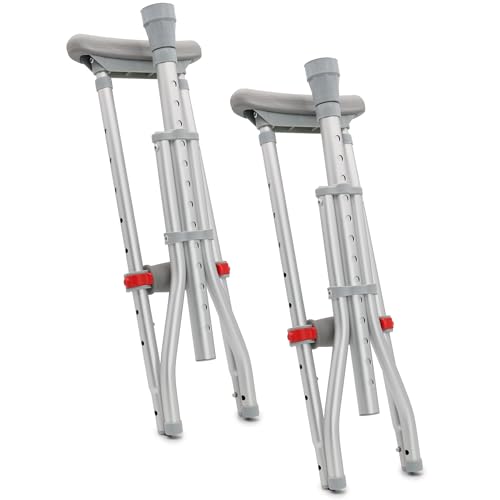
Drive Medical RTL10433 Adjustable Crutches for Walking, Silver

Because this is what you will almost certainly be handed, and the only one of the four Medicare pays toward — but it asks more of your shoulders, wrists and balance than anything else on this page.

Crutches

Drive Medical Adjustable Crutches

The default nearly every hospital source names first — and the one Medicare actually pays toward, at $57–$89 a pair.

  • AOFAS's own fitting instructions, quoted directly: two fingers under the arm standing, handgrip at the wrist crease — the exact fit check to run before your first walk.
  • Euro-style clips plus a pushpin adjust height and handgrip position separately across a 24-inch range (38.5"-62.5"), so most adults skip a separate size purchase.
  • HCPCS E0114 — Medicare pays $57.17-$88.73 with a prescription, and this one code carries 44,541 of the roughly 46,000 total crutches claims Medicare paid nationally in 2024, about 31 times every other crutch code combined.

The count: We checked 2 crutch picks for this hub — this push-button Drive Medical pair adjusts height AND handgrip position separately; most single-SKU crutches only adjust one or the other.

One flaw (not a dealbreaker): Underarm soreness is the most common complaint after a few days of steady use — the crutch pads further down this page are the cheap fix, not a reason to skip crutches.

Also good: BodyMed sized pair for a tighter fit ($44.99)

See the crutches vs. knee scooter vs. iWALK decision →

Drive Medical Adjustable Steerable Knee Walker Scooter with Basket

Because it is the alternative people in this hub's research most often switched to — 22 of 49 named one — and the one thing it needs is a knee that tolerates kneeling on it for weeks.

The knee scooter

Drive Medical Steerable Knee Scooter

Rest your knee on the pad and roll instead of hobble — the real tradeoff is Medicare pays nothing toward it, while the crutches below cost far less and are covered with a prescription.

  • The American Orthopaedic Foot & Ankle Society's own patient site: "You place your knee on the pad and roll yourself forward using handle bars to balance and steer" — named directly as a genuine crutches alternative, not a novelty.
  • 350 lb weight rating, adjustable knee-pad height (16.5"-20.5") and handle height (31"-40"), removable basket for keeping your hands free.
  • Classified under HCPCS E0118 — the same code Medicare uses for the iWALK hands-free crutch further down this page, and E0118 had zero national Medicare claims in 2024.

The count: We've verified 3 knee scooters on this site — this steerable Drive Medical model is the one Palmetto GBA's own PDAC product list classifies as the standard 4-wheel shape most DME suppliers stock, not the all-terrain or budget alternative.

One flaw (not a dealbreaker): Two real recalls exist for this exact product category — a 2012 Invacare rod-collapse issue and an open 2024 Medical Depot tiller-separation recall (neither is this pick) — check any borrowed scooter's brand and model first.

Also good for less: Medline economy knee walker ($126.99)

See the full knee-scooter comparison →

iWALK3.0 Original Hands Free Knee Crutch

Because this isn't a default for everyone told to stay non-weight-bearing — the manufacturer's own listing draws real lines around who it works for.

iWALK hands-free crutch

iWALK 3.0 Hands-Free Crutch

Hands-free and stairs-capable, but the eligibility bar is real — read it before you buy, not after.

  • The listing's own eligibility language, not this site's: not recommended for elderly users, anyone with balance or strength limitations, or anyone significantly overweight; best fit is age 55 or under, height 5'2"-6'2", with average-or-better balance and 1-3 days to learn it.
  • Classified under the same HCPCS code as the knee scooter above (E0118) — Medicare pays zero toward either one, prescription or not.
  • At $144.99 (re-verified live), it costs about 3.6x a basic pair of crutches — the priciest item on this hub, though not the priciest item this site tracks overall.
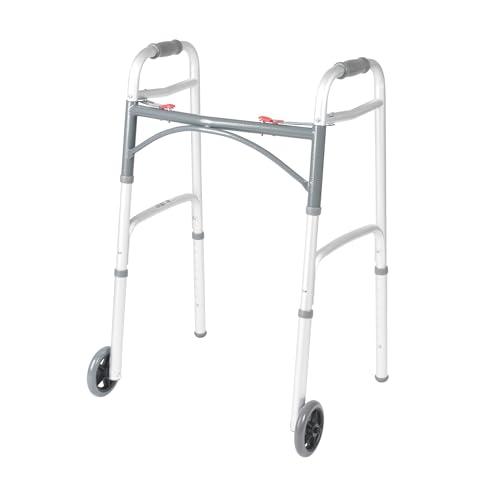
Drive Medical Two-Button Folding Walker with Wheels, Height Adjustable

Because a walker is named by two of the three procedures in this hub's research — Erlanger's own booklet states it flatly for ankle replacement: must use walker after surgery.

Walker

Drive Medical Two-Button Folding Walker

Named more often than a knee scooter across this hub's own hospital sources — a secondary mobility device, not the default lead pick.

  • Kaiser Permanente lists it alongside crutches and a knee scooter for 6-8 weeks after ankle fusion; Erlanger's own home-safety checklist calls it mandatory for total ankle replacement.
  • 350 lb capacity, dual push-button height adjustment — the same folding walker Medicare's E0143 code was built around.

Most people end up with more than one. Of the 42 people in this corpus who named any way of getting around, 27 named two or more, and 14 named three or more. They were not indecisive — they were switching by room and by week. One used a knee scooter everywhere except the downstairs shower room, where there was no space to turn it, and kept a frame in there instead. Another used the scooter at night when the boot came off and crutches during the day once it went back on. A third moved from a wheelchair to a scooter to a walker to a cane across three months.

If you can, borrow or try before you commit to the expensive one. Several people in this corpus bought a knee scooter, found their knees could not take kneeling on it, and returned it; one was lent a hands-free crutch by someone on the forum who had finished with theirs.

Elevation, and why the ice may not reach

The one place the obvious purchase is the wrong first purchase.

Elevation is the instruction every source here agrees on and the one people most underestimate. One hospital’s own post-operative sheet asks for the leg to be elevated 23 of the first 24 hours, and above the level of the heart rather than merely propped up. In the patient threads it is what people say worked when nothing else did: “I had the ankle elevated all the time unless using the crutches to get to the toilet.”

Correction, August 2026. An earlier version of this page listed an ankle-shaped ice wrap among the first five things to buy. The patient corpus does not support that for the early weeks, and we have moved it. While you are in a cast or a splint the ice largely cannot get to the injury — as one of the forum’s own moderators put it, “icing won’t do anything with that cast on”, and a patient several weeks in was blunter: “ice cannot reach inside a cast to properly cool off your injury, only elevation will do this.” People who iced anyway did it above the cast or behind the knee, and described it as partial relief rather than the real thing.

So the order matters. Sort out elevation for the cast weeks; buy the ankle wrap for when the cast comes off, which is when it finally fits the joint it is shaped for. If you want cold during the cast phase, a plain gel pack that can sit above the cast does the same partial job for a fraction of the price.

HOMBYS Leg Elevation Pillow for After Surgery, Knee Replacement & Recovery

Because one hospital's own instructions are blunt about it: elevate your leg 23 of the first 24 hours home.

Leg-elevation wedge pillow

HOMBYS Leg Elevation Pillow

Under your calf, above your heart — for a week where one hospital wants your leg up 23 hours out of 24.

  • Erlanger Health System's own booklet, verbatim: "At home, we want you to elevate your leg 23 out of 24 hours a day for the first week."
  • The ankle-ORIF discharge sheet and Kaiser Permanente each independently instruct elevating above the heart — the same instruction as Erlanger's, above, across all three procedures this hub covers.
  • The product's own Amazon title already lists "Ankle Support" alongside knee and hip — not a generic pillow relabeled for this hub.

The count: This is the one pick on the hub with no second option to compare against on file — its own Amazon title already lists 'Ankle Support,' the direct reason it reuses cleanly from the knee hub.

REVIX Ankle Ice Pack Wrap, Reusable Gel Ice Pack for Foot Pain Relief

Because once the cast is off, a knee-shaped gel pack won't wrap around a swollen ankle — but while the cast is still on, this is the wrong purchase and elevation is the one that works.

Ankle/foot-shaped ice wrap

REVIX Ankle Ice Pack Wrap

Wraps fully around the foot and ankle with three straps, hands-free, instead of balancing a flat pad in place.

  • Kaiser Permanente's ankle-fusion page: 10-20 minutes at a time, cloth barrier, leg propped above the heart while icing.
  • Three adjustable straps hold it in place hands-free while the foot is elevated — the knee-shaped pack this site's other hubs use doesn't fit a foot or ankle at all.

The count: We checked 2 ankle/foot ice wraps for this hub — both are a genuinely different REVIX product line from the knee-shaped pack this site's other hubs use, confirmed by comparing the listings directly, not assumed interchangeable.

One flaw (not a dealbreaker): Straps that wrap fully around swelling can feel tight in the first days — loosen them rather than forcing a snug fit over a freshly swollen foot.

Also good for less: REVIX budget wrap ($9.99)

The shower

Named together, as a pair, in more threads than anything else here.

A cast has to stay completely dry for weeks, and you cannot stand on one leg in a wet shower to keep it that way. In the patient threads these two items are almost always named in the same breath — “you need a waterproof cast cover and shower stool at the minimum” — and getting them sorted is consistently described as the moment the recovery started to feel manageable.

Two practical notes from people who had already tried it. Get a cover long enough to seal above the cast rather than on it; one person specifically recommended one that reaches the thigh, plus a hose extension so the water can be aimed rather than rained down. And a bench that extends out over the edge of the bath, so you sit down outside it and slide across, solves the step that a chair standing inside the tub does not.

It does not work for everyone. At least one person in this corpus gave up on the cover-and-chair combination entirely and washed at the sink for the duration. That is a legitimate outcome, and worth knowing before you buy a chair you may return.

Asunby Waterproof Cast Covers for Shower Leg Adult, Full Long Leg

Because a cast or boot has to stay bone-dry through weeks of normal showers, and a hospital's own booklet says a garbage bag isn't your only option.

Waterproof leg cast/boot shower cover

Asunby Waterproof Leg Cast Cover

A reusable silicone seal keeps the whole boot or cast dry through a normal shower — the upgrade over a trash bag and duct tape, not a required purchase.

  • Erlanger Health System's own patient booklet, verbatim: "Medical supply stores sell cast covers made specifically for bathing" — named in the same sentence as the DIY garbage-bag method, not instead of it.
  • Fits an 11-24 inch leg/knee/foot/ankle circumference, reusable rather than single-use.
  • Three other hospital sources (Genesis Orthopedics, UF Health, the Achilles discharge sheet) each independently describe a different DIY fallback — a plastic bag, a sponge bath, plastic wrap — so this is a convenience upgrade, not the only way to keep a cast dry.

The count: We checked 2 waterproof leg cast covers for this hub — this one's own listing names foot, ankle, and knee surgery specifically, not just a generic 'cast cover.'

One flaw (not a dealbreaker): A seal only works if it's actually sized to the leg — measure the circumference at its widest point (11-24 inches on this pick) before ordering, not just the general 'adult' label.

Also good for less: Zoyehoo budget cover ($18.95)

Medline Shower Chair with Backrest and Padded Armrests

Because Kaiser Permanente's own ankle-fusion instructions say it plainly: it may help to sit on a shower stool.

Shower chair

Medline Shower Chair with Backrest

A backrest and padded arms to push off from while balancing on one leg in a wet shower.

  • Kaiser Permanente, verbatim: "You may shower 24 to 48 hours after surgery... it may help to sit on a shower stool."
  • 350 lb weight rating, height-adjustable in 1" steps.

The parts of you that aren’t your foot

The complaints that show up after a fortnight, from people who did not see them coming.

Nobody in this corpus wrote a thread about their foot hurting. They wrote about everything else. Wrists, shoulders and hands come up constantly, because those are what is now carrying you: one person wore a wrist brace to get through the crutch weeks, another needed a different style of crutch entirely to take the load off an arthritic thumb, and a third could not use crutches at all after shoulder surgery. If you already know your shoulders or wrists are unreliable, that is an argument for the scooter or the walker, and worth raising before surgery rather than after.

The good leg gets overworked too, and people are surprised by it — “my good leg is just too sore and weak from compensating”. So does your balance, which is why the walking boot creates its own problem: it adds an inch or more of sole on one side only, and you spend weeks walking lopsided.

Vive Fleece Crutch Pads & Hand Grips

Because underarm soreness is the single most common complaint after a few days on crutches.

Crutch underarm pads (bonus)

Vive Fleece Crutch Pads

Slides over the stock foam pad and adds a second layer plus a washable cover.

  • Four pieces: 2 underarm pad covers, 2 hand grip covers — fits most standard adult and youth underarm crutches.
  • PDAC-classified A4635/A4636 — an accessory code family this site's 68-code Medicare dataset doesn't track, an honest out-of-scope gap, not a covered-or-not claim.
EVENup Shoe Lift for Walking Boot, Adult Size Medium

Because a walking boot adds an inch or two of sole height on one side only, and every discharge sheet with a boot in this hub's research names the boot without mentioning the limp it causes.

EVENup shoe leveler

EVENup Shoe Lift

Straps onto the shoe on your good foot, not the boot, with three stackable inserts to match whatever height your specific boot adds.

  • Sold by shoe-size band, not one universal SKU — measure the shoe on a flat surface before ordering; sizes run Small through X-Large.
  • Three stackable height inserts (1/2", 3/4", 1 1/4") match the boot instead of guessing with a flip-flop or a thick sneaker.
  • Relevant to two of the three procedures in this hub — the ankle-ORIF sheet and the Achilles discharge sheet both name a walking boot as part of recovery.
Medline Adjustable Steel Drop-Arm Bedside Commode, Portable Bedside Toilet, 350 lb Weight Capacity

Because Erlanger's own booklet lists this among what the hospital may already give you — ask before you buy.

Bedside commode

Medline Drop-Arm Bedside Commode

Shortens the trip to the bathroom at night, when hopping on one foot is at its least safe.

  • Erlanger Health System, verbatim: "Provide you with a rolling walker and bedside commode (if needed)" — hospital-provided, not always a purchase.
  • 350 lb capacity. This Medline pick replaces an earlier Drive Medical pick that lost its Add to Cart button between hubs — verified live in stock 2026-07-29 (the back-surgery build's own re-verification), reused here as the current in-stock pick.
Blue Jay 32" Reacher Grabber Tool for Seniors, 2 Pack - Sturdy Non-Folding Pick Up Stick with Magnetic Tip

Because balancing on crutches or a knee scooter while bending down for something is a real fall risk — though no hospital source in this research names a reacher directly.

Reacher / grabber (honest inference, not a direct instruction)

Blue Jay 32" Reacher (2-Pack)

An honest inference, not a direct citation — the one pick on this hub without a hospital source behind it, stated plainly.

  • Non-folding construction with a magnetic tip — a rigid shaft holds up under weight better than a folding jaw.
  • Two in the pack: one upstairs, one down.
Xpand No Tie Elastic Shoe Laces for Sneakers

Because the operated foot is usually in a boot, not a lace-up shoe — but the good foot still needs one, and bending down to tie it is exactly the balance risk you're avoiding.

Elastic no-tie laces (bonus)

Xpand No-Tie Elastic Shoelaces

Turns any real sneaker into a slip-on without a single lace to tie.

  • One pack fits most standard sneaker eyelets — keeps your existing shoes rather than requiring a new pair.

How we know this

Every recommendation above has to survive independent checks. None of them is our opinion.

  1. Medicare’s own data. Whether the item is covered, what it pays, and how many were billed nationally — from the CMS DMEPOS fee schedule, the HCPCS Level II file and DY2024 utilization, queried directly rather than through a third party’s summary. Published as an open dataset.
  2. Named hospital instructions. Clinical claims are quoted from a named institution’s own discharge or patient-education material and linked, never paraphrased into fact. Where sources disagree, the page says they disagree instead of picking one.
  3. 216 posts from 49 people who had this surgery, across 25 threads on the BoneSmart other-joints forum, May 2017 to March 2024. Counted per person rather than per post, so the handful of very prolific posters cannot distort a total. Excerpts are short, attributed, and linked back to the thread they came from.

What that corpus is not. People who post on a recovery forum are self-selected — more prepared than average, and often posting because recovery is going badly. The counts are a floor, not a census: someone can use a walker for six weeks and never write the word. And a mention is not an endorsement — we count who raised a thing, then read the posts to see what they said about it. Whether an item was recommended or rejected is read by a person, because pattern-matching that judgement was tested and got it wrong.

The corpus is published in full at /data/patient-corpus-foot-v1.json under CC BY 4.0, alongside the rest of our datasets. More about who writes this and how →

Go deeper

Two follow-up pages cover what comes up next for this surgery specifically — the Medicare coverage story, and the day-to-day decision of how you'll actually get around.

This is an equipment and cost-coverage guide, not medical advice. It doesn't cover physical-therapy protocols, medication management, wound care, or any other instruction that should come from your surgeon or care team — follow their discharge instructions over anything here. Non-weight-bearing duration, the choice between crutches/knee scooter/iWALK, and whether a boot or cast is used genuinely vary by procedure, surgeon, and how your foot or ankle heals.
See the full printable checklist — all 13 items ↓

Everything on this hub, in one list — the five essentials, the six situational picks, and the two bonus-comfort picks. This is what prints when you use the button up top.

The full foot-and-ankle-surgery recovery checklist
ItemCategoryStatusMedicare
Knee scooter Getting around Buy Not covered (E0118)
Crutches Getting around Buy Covered w/ Rx (E0114)
Waterproof leg cast/boot shower cover The shower Buy No HCPCS code
Leg-elevation wedge pillow Elevation and ice Buy No HCPCS code
Ankle/foot-shaped ice wrap Elevation and ice (after the cast is off) Buy No HCPCS code
iWALK hands-free crutch Getting around Buy, if you meet the eligibility profile Not covered (E0118)
EVENup shoe leveler The rest of you Buy, if in a walking boot No HCPCS code
Shower chair The shower Buy, if showering feels unsteady Not covered
Bedside commode The rest of you Ask hospital first Covered w/ Rx (E0163)
Walker Getting around Ask hospital first Covered w/ Rx (E0143)
Reacher / grabber The rest of you (honest inference) Optional No HCPCS code
Crutch underarm pads The rest of you Buy Out of this site's scope (A4635/A4636)
Elastic no-tie laces The rest of you Buy No HCPCS code
What Medicare actually pays for

Two mobility devices on this checklist do the identical job — keeping weight off a healing foot — and Medicare prices them completely differently: crutches (E0114) at $57.17-$88.73 with a prescription, a knee scooter or the iWALK (both E0118) at $0, by rule, regardless of prescription.

A walker (E0143, $55.55-$125.91) and a commode (E0163, $60.15-$139.61) are also covered with a prescription — both hospital-providable 'if needed' per Erlanger's own booklet, so ask before buying. Everything else on this checklist has no HCPCS code at all. See the full breakdown, corrected against the raw fee-schedule data, on the Medicare page.

Source: data/coverage_status.json (68 HCPCS codes)

See the full Medicare coverage breakdown →

This page has Amazon links — we may earn a commission if you buy through them, at no extra cost to you. It never changes which product we recommend. See our methodology.

Sources

  1. American Orthopaedic Foot & Ankle Society (AOFAS), FootCareMD, "How to Be Non-weightbearing After Surgery" — the defining NWB quote, crutch-fitting instructions, and the knee-scooter/seated-scooter descriptions; reviewed by 3 named MDs, fetched 2026-07-28
  2. AOFAS FootCareMD, "How to Use Crutches" — the stairs technique quoted in the recovery tip above; fetched 2026-07-28
  3. Genesis Orthopedics & Sports Medicine (Matthew Diamond, DPM), Bunionectomy Discharge Instructions (PDF) — one of three sources naming a DIY shower/cast-cover fallback on this hub; its own bunionectomy-specific NWB figure and icing cadence are used on the dedicated /recover/bunion-surgery/ hub instead; dated 11/2025, text-extracted 2026-07-28
  4. UF Health, "Bunion Removal - Discharge" — one of three sources naming a DIY shower/cast-cover fallback on this hub; its own bunion-specific partial-weight-bearing figure and device menu are used on the dedicated /recover/bunion-surgery/ hub instead; reviewed 12/2022, fetched 2026-07-28
  5. Ankle ORIF discharge instructions (Jaewon Chang, DO / Jared Smith, MD, arnothealth.org) (PDF) — elevation hierarchy and crutches citation for ankle fracture surgery; text-extracted 2026-07-28
  6. Achilles tendon repair discharge instructions (same practice) (PDF) — the 6-week NWB figure and the plastic-wrap shower method; text-extracted 2026-07-28
  7. Kaiser Permanente, "Ankle Fusion: What to Expect at Home" — 6-8 week device-use window, shower-stool recommendation, icing cadence; fetched 2026-07-28
  8. Erlanger Health System, Total Ankle Replacement Patient Education Manual (ORTHO0026) (PDF) — the "23 of 24 hours" elevation quote, the walker/commode hospital-provided note, and the cast-cover citation; reviewed 03/2026, 24 pages, text-extracted 2026-07-28
  9. Karzon AL, et al. "The Fall and Rise of Total Ankle Arthroplasty: A Database Analysis of Procedural Incidence Between 2009 and 2019." Foot Ankle Orthop. 2022;7(4). — source of the total-ankle-replacement volume stat; fetched 2026-07-28
  10. data/coverage_status.json (68 HCPCS codes) — crutches (E0114), knee scooter/iWALK (E0118), walker (E0143), and commode (E0163) — every ranking claim on this hub checked against all 68 rows directly, 2026-07-29
  11. data/dmecs_products.json — PDAC classification confirming the iWALK 3.0 and this hub's crutches pick under their respective HCPCS codes
  12. Amazon product listings, direct live fetch (Chrome UA) — stock/price re-verification for all 9 new ASINs on 2026-07-29 — see the frontmatter comment above for method and result
  13. CPSC SaferProducts.gov + FDA recall databases — checked for every new category/ASIN above — zero hits for all 6 new gear files; the knee scooter's own 2 recalls are logged separately in knee-scooters.json
  14. VerifiedCareData dataset.json (CC-BY-4.0) — every coverage fact above in one machine-readable endpoint