If you're here because of a baby's belly-button bulge: most infant umbilical hernias close on their own. Nationwide Children's Hospital, verbatim: “In most cases, an umbilical hernia closes on its own by the time a child is 1 year old. Almost all umbilical hernias close without surgery by the time a child is 5 years old.” Doctors typically only suggest surgery if it gets bigger with age, can't be pushed back in, or is still there after age 3 to 5 — see Nationwide Children's own page →. Everything below this note is for adults having or recovering from umbilical hernia repair surgery — not a children's shopping guide.
Not really, based on what hospitals themselves publish. We looked for an umbilical-specific recovery story and mostly found the same story our main hernia guide already tells — the real differences track hospital philosophy and how big the repair is, not which part of your abdominal wall the hernia was in.
The fact
University Hospitals Cleveland's own umbilical-hernia patient-instructions page is a near-verbatim copy of its inguinal and ventral hernia pages — so close that its Diet section still reads, verbatim: 'Repair of your inguinal hernia does not require any special diet restrictions after surgery,' on a page titled 'Umbilical Hernias.'
We're not flagging this to embarrass University Hospitals — shared-template patient education is normal, and the clinical guidance itself is still valid. But it is verifiable evidence that at least one major hospital system doesn't meaningfully differentiate its recovery instructions by hernia location. That is why this is a short page under our main hernia guide, not a separate guide with invented distinctions.
About 175,000 umbilical hernia repairs are performed annually in the United States, according to the National Institutes of Health (NIH StatPearls) — real and worth its own page, but well below the roughly 600,000 inguinal (groin) repairs in the SAGES figure on our main hernia guide. These are two separate figures for two separate hernia types; don't add them together as one combined number. They do triangulate consistently with Cleveland Clinic's "more than 1 million hernia surgeries of every kind" figure — 600,000 inguinal plus 175,000 umbilical leaves a plausible 225,000-400,000 a year for ventral, incisional, femoral, and other types to reach that total.
Umbilical hernias are also three times more common in women than men, largely tied to pregnancy, childbirth, and obesity — yet 70% of surgical repairs are performed on men, per the same StatPearls source. The incidence in adults ranges from 23% to 50%, peaking at ages 31-40 in women and 61-70 in men.
What do hospitals actually say about lifting?
The same disagreement our main hernia guide documents for inguinal repair shows up here too — three sources, three different levels of specificity, for the same hernia type:
Hospital positions on lifting after umbilical hernia repair
Avoid lifting more than 15 lbs for the first 2 weeks
“There are no medical or physical restrictions on activity after surgery. That means it is OK to walk, climb stairs, lift, have sexual intercourse, mow the lawn, or exercise as long as it doesn’t hurt... However, if it doesn’t feel good, don’t do it. Take it easy and let pain be your guide!”
— University Hospitals Cleveland Medical Center, "Umbilical Hernias" patient instructions (source)
“Avoid lifting anything that would make you strain. This may include heavy grocery bags and milk containers, a heavy briefcase or backpack, cat litter or dog food bags, a vacuum cleaner, or a child.”
— Kaiser Permanente Health Encyclopedia, "Umbilical Hernia Repair: What to Expect at Home" (source)
A "10 lb until your doctor clears you" figure and a "15 lbs for 4 weeks" figure both circulate widely online, attributed to various umbilical-specific sources — neither appears as a specific number on the live Kaiser page we fetched (it gives the strain-avoidance list quoted above, not a pound figure), so we're not repeating either as fact here. See the lifting-restrictions page on our main hernia guide for the same pattern across inguinal and ventral repair, including Johns Hopkins' 15 lb / 2-week figure.
What about returning to work?
Kaiser's figures for umbilical repair — most people return within 1 to 2 weeks, but 4 to 6 weeks for a job requiring heavy lifting or strenuous activity — match University Hospitals' own umbilical figures almost exactly, and are consistent with what our main hernia guide documents for inguinal and ventral repair. That consistency, across hospital systems and hernia locations, is itself the finding: work-return time tracks the job and the size of the repair, not which type of hernia you had.
What should I actually buy?
The same 5 essentials as our main hernia guide — a cough-splint pillow, ice packs, a heating pad, a raised toilet seat, and a reacher — cover umbilical repair recovery with no umbilical-specific variant needed; see the full essentials list →. Two items are worth calling out here specifically:
Because the same watchful-waiting and pregnancy-related bridge-to-surgery situations our main hernia guide documents for inguinal repair apply here too — WashU's own page names umbilical hernias in pregnancy specifically.
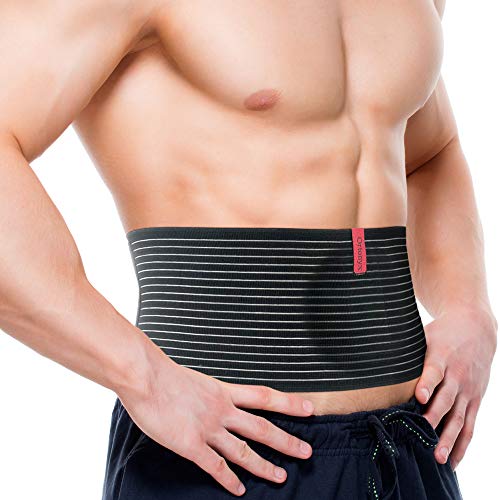
Umbilical/ventral hernia belt (pre-op, doctor-conditional)
ORTONYX Umbilical Hernia Belt
A wider band with a centered compression pad over the navel — a different shape from the groin-focused inguinal picks, for the same bridge-to-surgery reason.
✓Same conditional, doctor-directed framing as our inguinal truss pick: symptom relief while you wait for a surgery date, not a treatment.
✓Centered compression pad sits over the navel, not the groin — the one shape difference we found between umbilical and inguinal belt products.
✓Manufacturers themselves (ORTONYX, Everyday Medical, BLITZU) market this same belt shape for umbilical, ventral, incisional, and epigastric hernias interchangeably — not a separate product category.
One flaw (not a dealbreaker): Relief lasts only as long as you're wearing it, same limitation as every hernia belt — it manages symptoms while you wait, it doesn't fix the hernia.
If your repair is larger (a bigger umbilical defect, or done alongside mesh placement), our abdominal binder pick may apply to you too — Kaiser's own umbilical-recovery page independently confirms a binder is sometimes used post-op: “You may have a special girdle, called a binder, placed around the area where you had surgery... Your doctor will tell you how long to wear it.” That matches our existing binder citation (University Hospitals: 6 weeks for ventral repair) — ask your own surgeon, since duration is doctor-directed either way.
Does Medicare cover any of this differently for umbilical repair?
No. We ran the same coverage check as for inguinal repair, this time for "umbilical." We found no matches among the 68 Medicare equipment codes this site tracks, the same as for inguinal repair. There's no separate umbilical coverage story; see the full coverage breakdown →.
This is an equipment and cost-coverage guide, not medical advice. Whether your umbilical hernia needs surgery at all, what repair technique your surgeon uses, and your specific activity restrictions should come from your own surgeon or care team — follow their instructions over anything here.